Marble in three colours
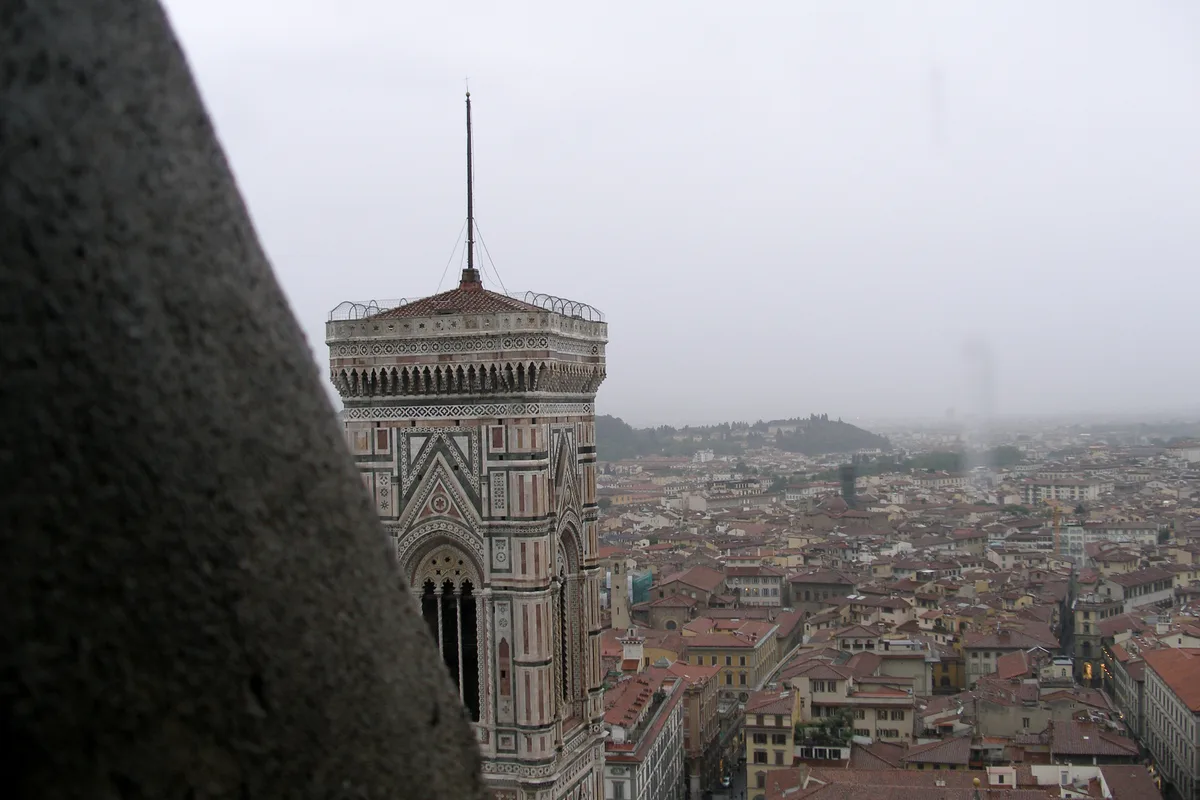
Stand at the tower’s base and look straight up. Stripes and panels of white, green and pink-red marble climb about 85 metres, all of it in neat geometric bands. The white is Carrara, the green comes from Prato and the red from the Siena area. It’s the same palette as the cathedral beside it and the Baptistery opposite.
Giotto designed it and started building in 1334, but he died within a few years. Andrea Pisano carried the lower storeys forward. Francesco Talenti finished the upper levels around 1359, with their tall Gothic windows. That’s why the tower gets lighter and more open as it rises: the solid base gives way to paired windows and then to the large triple-light openings near the top.
Reading the base before you climb
Start at the bottom, at eye level. The lowest storey is set with hexagonal relief panels showing the creation of humanity, the arts and the trades. They include weaving, sailing, medicine and astronomy. Above them, a row of diamond-shaped lozenges shows the planets, the virtues and the liberal arts.
The panels on the tower today are copies. The originals, along with the prophet statues that once stood in the upper niches, are kept indoors at the Museo dell’Opera del Duomo, behind the cathedral apse. If the carving catches your eye, go and see the real pieces there.
414 steps, no lift
There is no elevator. The climb is 414 steps on a narrow stone staircase, and in places people going up and people coming down have to squeeze past each other. The stairs run through the thickness of the walls, so the passages are tight and the steps are worn smooth.
The tower helps you out by breaking the climb into stages. Several intermediate floors let you step off the stairs, catch your breath and look out through the Gothic windows. Each stop is higher than the last, and the view keeps changing. Most people take 20–40 minutes to get up and down, plus time on top. Allow about an hour in total.
If you’re nervous about tight spaces or have knee or heart problems, think hard before you go. Once you’re in, the only way out is the same staircase.

Eye level with Brunelleschi’s dome
This is the real reason to pick the bell tower over the dome climb. If you climb the dome, you stand on the dome and can’t see it. From the top of the campanile, the dome fills the view: its red-tiled ribs, the white marble lantern and the octagonal drum, all close enough to follow the brick courses.
The top terrace is enclosed by a protective mesh fence. Photographers usually push their lens up to the gaps. Beyond the dome you can pick out:
- The crenellated tower of Palazzo Vecchio, to the south
- The marble façade of the Baptistery of San Giovanni, directly below
- The hills of Fiesole to the north
- Rows of terracotta roofs reaching toward the Arno
Timing the climb on Piazza del Duomo
The square is crowded from morning to evening, and the tower’s staircase backs up quickly. It’s one of the most-climbed monuments in Florence. At the moment the doors open at 8:15am and close at 6:45pm. These hours change with the season and on some holidays, so check the official Duomo site for this month’s times.
On weekends, the quietest stretch is usually 9am–10am. Try not to arrive between 10am and 11am, or between 3pm and 6pm. That’s when the stairwell slows to a shuffle and the terrace gets crowded with people waiting at the fence. We don’t have reliable weekday patterns, but arriving soon after opening is the safest bet on any day.
Late afternoon brings warmer light on the dome, but on weekends it overlaps with the busy hours. Expect to queue for it.
Sharing a staircase built in the 1300s
Here’s how the climb works in practice.
- Tickets. The tower is sold as part of the cathedral complex’s combined tickets, which also cover sites like the Baptistery and the museum. Buy them from the official Opera di Santa Maria del Fiore website or the ticket points around the square. Current prices and passes are listed there. Check whether your ticket needs a time slot for the tower.
- Bags. Security rules apply, and large bags and backpacks can be a problem on the stairs. Bring as little as you can.
- Passing on the stairs. On narrow stretches, whoever is climbing usually waits at a wider spot or landing. Wait your turn rather than squeezing past.
- Water. Bring a small bottle. There’s nowhere to buy one inside, and the upper flights get warm in summer.
- Dress. The tower doesn’t have the cathedral’s dress code, but your ticket may also cover the cathedral. Covered shoulders and knees save you a trip back to the hotel.
After the descent
You come out at the foot of the cathedral, so everything else is a few steps away. Look at Ghiberti’s Gates of Paradise on the Baptistery’s east side; the panels mounted there are copies too. Then walk round to the Museo dell’Opera del Duomo to see the original tower reliefs and the gilded original doors.
From the square, Via dei Calzaiuoli runs south to Piazza della Signoria in about ten minutes, passing the church of Orsanmichele on the way. Santa Maria Novella railway station is about a 10–15 minute walk west via Via de’ Cerretani. That makes the tower an easy first or last stop if you’re on a day trip by train.
Frequently asked questions
When is the quietest time to climb Giotto's Bell Tower?
On weekends, 9am–10am is usually the calmest window. Avoid 10am–11am and 3pm–6pm on weekends, when the staircase and terrace are busiest. There's no reliable weekday pattern, but arriving soon after the 8:15am opening is a safe choice.
How many steps are there, and is there a lift?
There are 414 steps and no lift. The staircase is narrow and sometimes shared with people coming down, but several intermediate floors let you stop and rest along the way.
Should I climb the bell tower or Brunelleschi's dome?
Climb the bell tower if you want to see the dome. From the top terrace you look straight across at its tiled ribs and lantern, which you can't see while standing on the dome itself.
How long does the visit take?
Allow about an hour: 20–40 minutes for the climb up and down, plus time on the terrace and at the intermediate stops. Add more if you plan to see the original reliefs in the Museo dell'Opera del Duomo afterwards.
How do I get there from Santa Maria Novella station?
Walk east along Via de' Panzani and Via de' Cerretani to Piazza del Duomo. It takes about 10–15 minutes, and the tower stands beside the cathedral façade, opposite the Baptistery.
Plan your trip to Florence
Italy eSIM & staying connected →
Some links above are affiliate links — if you book through them, Wander Atlas earns a small commission at no extra cost to you. It's how we keep every guide free.
Related guides
 attraction
Cathedral of Santa Maria del Fiore: Florence Travel Guide
 attraction
Museo Nazionale del Bargello: Florence Travel Guide (4.7★)
 attraction
Palazzo Vecchio: Florence Travel Guide
 attraction