Florence’s great sculpture museum looks like a fortress because, for most of its life, it was one. It has rough stone walls, a crenellated roofline and a slim tower rising over Via del Proconsolo. Behind that front, Michelangelo’s first major statue shares the building with Donatello’s bronze David.
It is one of the most-reviewed museums in a city full of them. Still, it rarely gets the crowd pressure of the Uffizi or the Accademia, and that’s the reason to come.
A palace built to keep order
The building went up from 1255 as the Palazzo del Popolo, Florence’s first seat of civic government. Later it housed the podestà, the chief magistrate. From the 16th century it held the bargello, the city’s police chief, and that’s where the name comes from.
For about three centuries it was a prison. Executions took place in the courtyard. It became a national museum in 1865, and the stone still has a hard, official feel.
The courtyard of coats of arms
This is where your visit starts. It also explains the building better than any wall text does. The courtyard is open to the sky and ringed by an arcade. Its walls are covered in carved and painted coats of arms that belonged to the magistrates who once governed from here.
An open stone staircase climbs one side to the upper loggia. Large statues stand under the arches and around the edges, so you’re walking among sculpture before you’ve entered a single gallery.
Look up at the stairs. They are one of the most photographed corners of medieval Florence, and they set the scale for the rooms above.
Michelangelo on the ground floor
The ground-floor sculpture hall holds a group of Michelangelo works you can walk all the way around. Seeing them from every side is something the Accademia’s crowds rarely allow.
- Bacchus: a young, tipsy god leaning off balance, carved in Rome when Michelangelo was in his early twenties. A small satyr nibbles grapes behind him.
- Pitti Tondo: a round marble relief of the Virgin and Child, left partly unfinished, so you can see the chisel marks.
- Brutus: a bust of the Roman, roughly finished, with a heavy jaw and a turned head.
- David-Apollo: a small, twisting figure whose identity is still argued over.
Nearby, work by Giambologna and Cellini shows where sculpture went after Michelangelo, including Giambologna’s lightly balanced bronze Mercury.

Donatello’s hall and the two Davids
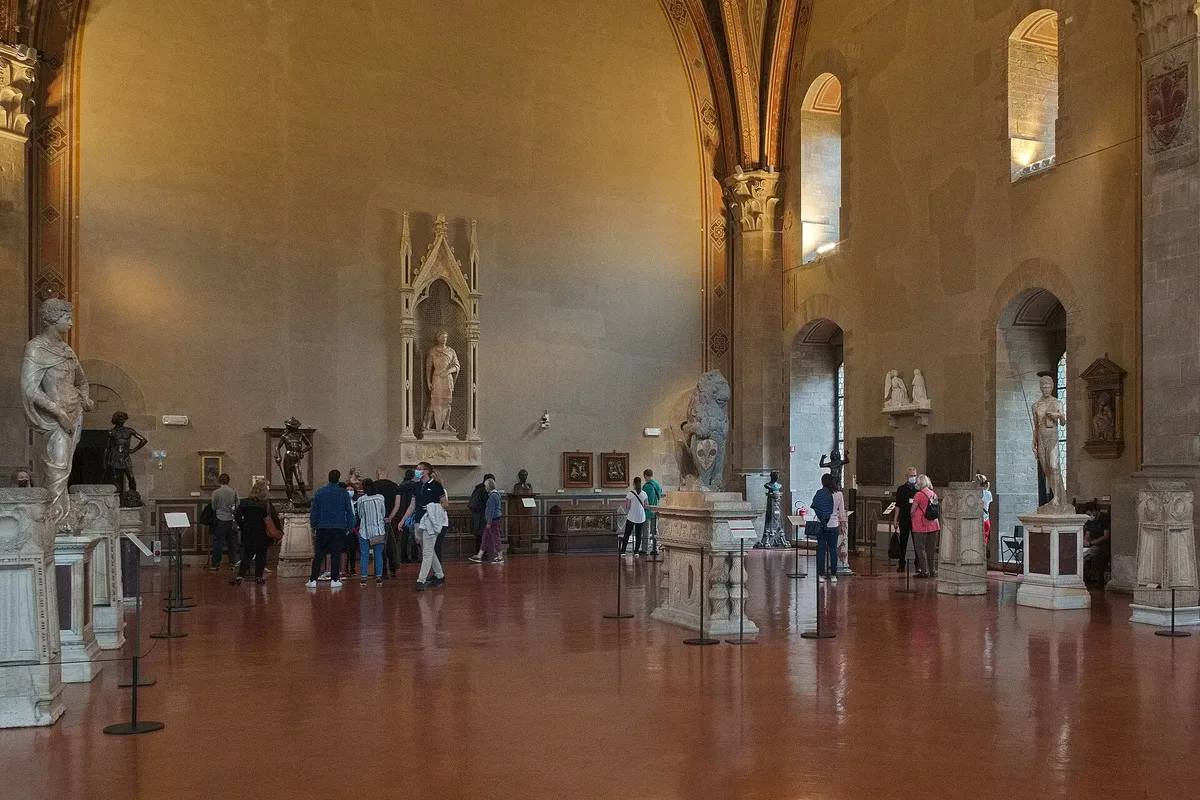
Climb to the first floor for the high, vaulted Salone di Donatello. This is the museum’s centre of gravity. Donatello’s bronze David stands here. It was the first freestanding male nude cast since antiquity: a slight youth in a shepherd’s hat with Goliath’s head at his feet.
His earlier marble David is in the same space. So is the original St George, brought indoors from its niche on Orsanmichele.
Don’t skip the two small bronze panels on the wall. In 1401, Brunelleschi and Ghiberti each made a Sacrifice of Isaac for the competition to design the Baptistery doors. Ghiberti won.
Seen side by side, they are the start of the Florentine Renaissance in two square-ish frames. Upstairs again, you’ll find Verrocchio’s David, glazed blue-and-white terracottas by the della Robbia family, and the chapel frescoes from Giotto’s circle.
Getting to Via del Proconsolo
Florence has no metro. The historic centre is compact enough to cover on foot, and that’s how almost everyone arrives.
- From the Duomo: walk south down Via del Proconsolo for about five minutes.
- From Piazza della Signoria: head east through the narrow streets behind Palazzo Vecchio. It’s a few minutes.
- From Santa Maria Novella station: allow 15–20 minutes on foot across the centre.
The entrance is at Via del Proconsolo 4, across the street from the Badia Fiorentina’s bell tower. Driving into the centre is restricted, so leave any car outside it.
Beating the weekend rush at the Bargello
The forecast pattern here is simple. Weekends from 10am to 6pm are typically the busiest stretch, so try not to arrive in that window on a Saturday or Sunday.
On a weekend, come right at the 8:15am opening, which falls before the peak. Better still, come on a weekday. The museum is currently closed on Mondays, which catches out many visitors on short trips.
Opening times at Italian state museums change through the year and around holidays. Check this month’s hours on the official Musei del Bargello site before you set out. That site also lists current ticket prices and lets you book a timed slot.
Florentines just call it il Bargello (bar-JEL-lo), and that’s the word to use when asking directions. Inside, plan for about two hours. Do the courtyard and Michelangelo first, then save your energy for the Donatello hall upstairs.
After the Bargello
You come out into one of the densest few blocks in Florence.
- Badia Fiorentina, the medieval abbey church directly opposite, with its tall hexagonal bell tower.
- Casa di Dante, the museum devoted to the poet, in the lanes just to the north.
- Piazza della Signoria and Palazzo Vecchio, a few minutes west, with copies and originals of more Renaissance sculpture in the Loggia dei Lanzi.
- Orsanmichele, where you can compare the niche that held Donatello’s St George with the original you’ve just seen.
- Santa Croce, a ten-minute walk east, for Michelangelo’s tomb.
That last one makes a fitting finish if the Bacchus is still on your mind.
Frequently asked questions
When is the quietest time to visit the Bargello?
BestTime's forecast doesn't name a single quietest hour. It does show weekends from 10am to 6pm as typically the busiest time, so avoid that window. Come on a weekday, or arrive at the 8:15am opening on a Saturday or Sunday, before the usual peak.
Is the Bargello open on Mondays?
No. It's currently closed on Mondays and open Tuesday to Sunday, 8:15am–6:50pm. State museum hours change through the year and around holidays, so check the official Musei del Bargello site for this month's times.
How long do I need at the Bargello?
About two hours covers the courtyard, the ground-floor Michelangelo room and Donatello's hall on the first floor. Sculpture enthusiasts can easily spend longer upstairs with the della Robbia terracottas and the chapel frescoes.
What are the must-see works at the Bargello?
Start with Michelangelo's Bacchus and Pitti Tondo, then Donatello's bronze David and the original St George. Also see Brunelleschi's and Ghiberti's 1401 competition panels for the Baptistery doors, Giambologna's Mercury and Verrocchio's David.
How do I get to the Bargello from the Duomo?
Walk south along Via del Proconsolo for about five minutes. The entrance is at number 4, opposite the Badia Fiorentina. From Santa Maria Novella train station, allow 15–20 minutes on foot.
Plan your trip to Florence
Italy eSIM & staying connected →
Some links above are affiliate links — if you book through them, Wander Atlas earns a small commission at no extra cost to you. It's how we keep every guide free.