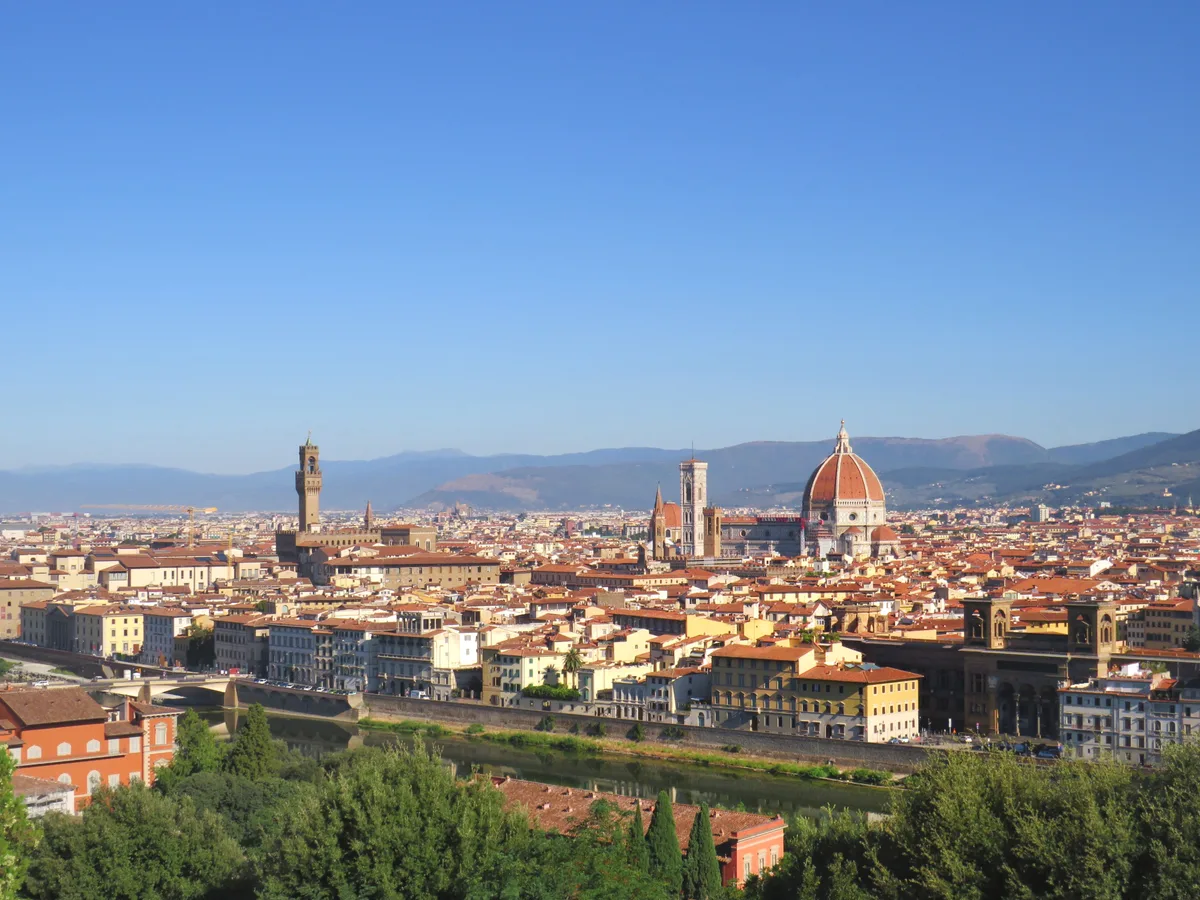
A terrace built to look back at Florence
Florence is a city of narrow streets. Up here it finally opens out.
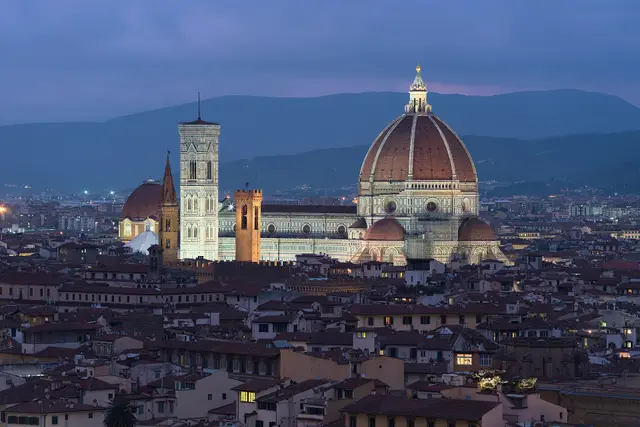
The piazzale is a wide paved terrace cut into the hillside south of the Arno. A stone balustrade runs along its northern edge, and everything worth recognising sits below it. Brunelleschi’s terracotta dome rises over the rooftops. The crenellated tower of Palazzo Vecchio stands to its left, and the white marble front of Santa Croce sits closer in.
Follow the river and you will see the Ponte Vecchio, its shops hanging over the water. Behind the city, the hills climb towards Fiesole. Few places give you that whole picture in a single turn of the head, which is why so many people come.
The David that stands in the open air
In the middle of the square, a bronze David looks out over the city. It is a replica: the marble original is indoors at the Galleria dell’Accademia. This one has a green-brown patina from more than a century of weather.
Look at the base. Four reclining figures copy Michelangelo’s sculptures of Dawn, Dusk, Day and Night from the Medici tombs at San Lorenzo. The whole monument honours the artist the square is named after. Few visitors notice it, because most stand with their backs to it, facing the view.
Poggi’s balcony for a new capital
The piazza is a 19th-century project. Architect Giuseppe Poggi designed it in the late 1860s, while Florence was briefly the capital of the newly unified Italy. The city’s old walls came down and wide boulevards replaced them. Poggi laid out the Viale dei Colli, a tree-lined road that winds up the hill, with this terrace as its showpiece.
At the back of the square stands a colonnaded loggia, also by Poggi. It was meant to hold a museum of Michelangelo’s work, but that museum never opened. Today the building houses a restaurant.
Climbing up from San Niccolò
The walk up is part of the visit. It takes roughly 20–30 minutes from the Ponte Vecchio, depending on your pace.
- The classic route: cross the Arno at Ponte alle Grazie and walk east through San Niccolò. Look for Porta San Niccolò, a tall medieval gate tower standing on its own. Behind it, the Rampe del Poggi zigzag up the slope past fountains and artificial grottoes.
- The steeper shortcut: climb the stone stairway of Via di San Salvatore al Monte, also starting near the gate.
- By bus: city lines 12 and 13 climb the Viale dei Colli and stop at the piazzale. They are useful if the heat or your knees argue against stairs.
- By car: there is parking on and around the square, but tour coaches use it too, and spaces go fast at busy times.
A good plan is to ride the bus up and walk down through San Niccolò. You get the views on the stairs without the climb.

Sunrise against sunset
Most crowds come for one moment, and it isn’t the one we would pick.
The terrace is famous for sunset. The sun goes down over the river to the west and lights up the bridges. On weekends the busiest stretch usually runs from 10am to 8pm, so arriving for golden hour means sharing the balustrade with a long row of phones. Expect to wait for a gap at the front.
The forecast points to a better plan. The quietest hour is usually 7am–8am, on weekdays and weekends alike. Early light comes from the east, behind Santa Croce. It catches the dome and the tower in soft side-light, and the terrace is mostly runners, street cleaners and a few photographers.
If you do come in the evening, choose a weekday. Pick your spot well before the light starts to change.
Claiming a spot on the steps
The terrace has a routine of its own, and knowing it saves hassle.
- Sit on the steps. Below the balustrade, wide stone steps step down towards the view. People settle there with a drink to watch the light, and that is accepted here.
- Wave off the sellers politely. Hawkers work the square selling selfie sticks, bracelets and roses. A firm “no, grazie” without stopping is enough.
- Use the kiosks or the loggia. Drinks and snacks come from the vendors’ stands on the square, or from the restaurant in Poggi’s loggia. Prices are posted at each counter, and many stands accept cards.
- Watch your bag when it’s busy. Packed sunset crowds suit pickpockets. Zip your bag and keep your phone in your hand, not on the ledge.
- Leave the monument alone. Climbing onto the base of the David for a photo is frowned upon, and the shot is better from the balustrade anyway.
Buskers often play near the steps in the evening. If you stay for the whole set, dropping a coin in the case is normal.
Further up the hill: San Miniato and the gardens
Most visitors turn around at the balustrade. Keep climbing a few minutes instead.
Steps behind the piazzale lead to San Salvatore al Monte, a plain Renaissance church. Above it stands San Miniato al Monte, one of Florence’s finest Romanesque churches. Its façade is a geometric pattern of green and white marble. The view from its terrace takes in the city from higher still, with far fewer people.
San Miniato is still a working monastery. The monks sing Gregorian chant at vespers, and the times vary, so check the basilica’s notice board or website. Cover your shoulders and stay silent inside. The cemetery beside the church is quietly worth a wander.
Below the piazzale, on the slope towards San Niccolò, is the Giardino delle Rose, a terraced rose garden that is at its best in late spring. Nearby, the Iris Garden opens briefly around May, when Florence’s emblem flower is in bloom. Both open seasonally, so check the city’s official listings before you plan around them.
Allow about an hour for the terrace alone. Two to three hours lets you add San Miniato, the gardens and a slow walk back down to the river.
Frequently asked questions
When is the quietest time to visit Piazzale Michelangelo?
The quietest hour is usually 7am–8am, on both weekdays and weekends. Try not to come between 10am and 8pm on weekends, which is typically the busiest stretch.
How do I get to Piazzale Michelangelo from the centre of Florence?
Walk across Ponte alle Grazie, head east through San Niccolò to Porta San Niccolò, then climb the Rampe del Poggi. It takes roughly 20–30 minutes from the Ponte Vecchio. City buses 12 and 13 also stop at the piazzale.
Is the David at Piazzale Michelangelo the original?
No. It is a bronze replica. Michelangelo's marble original is indoors at the Galleria dell'Accademia. The base copies his Dawn, Dusk, Day and Night figures from the Medici tombs.
How long should I spend there?
About an hour for the view and the square. Allow two to three hours if you add San Miniato al Monte, the rose garden and the walk back down through San Niccolò.
What is near Piazzale Michelangelo?
San Salvatore al Monte and the Romanesque basilica of San Miniato al Monte are just uphill. The Giardino delle Rose and the seasonal Iris Garden are on the slopes nearby, and San Niccolò's streets lie at the bottom of the hill.
Plan your trip to Florence
Italy eSIM & staying connected →
Some links above are affiliate links — if you book through them, Wander Atlas earns a small commission at no extra cost to you. It's how we keep every guide free.