A city of the dead on a hill
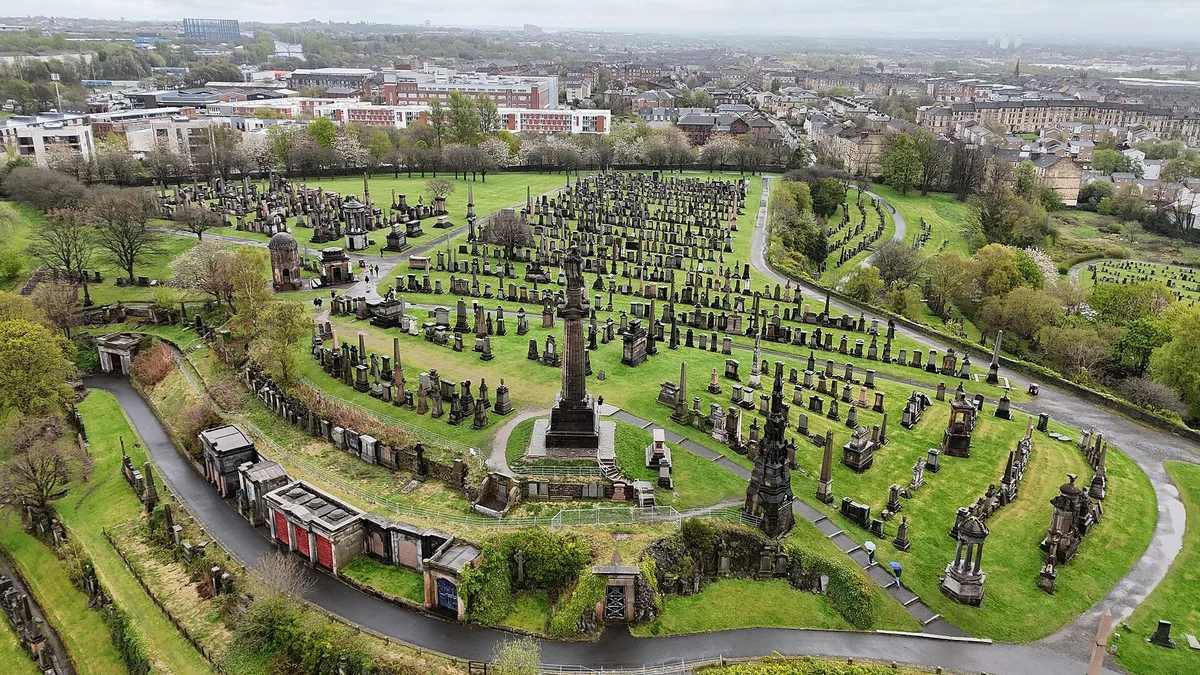
The cemetery starts at a bridge. From Cathedral Square you cross the stone Bridge of Sighs over Wishart Street, which runs along the line of the old Molendinar Burn. Glasgow’s funeral processions took the same route into the cemetery. Ahead of you the hill rises steeply, and it is crowded with obelisks, columns and temple-fronted tombs.
The Necropolis opened in 1833. It was laid out as a garden cemetery for the merchants, shipowners and industrialists who made Victorian Glasgow rich. Each family tried to outbuild the next, and the result is a hilltop of sandstone and granite monuments packed together on terraced, winding paths.
What you’re actually looking at
Above everything stands the John Knox monument. The column was put up in 1825, before the cemetery existed, and the Necropolis was later built around it. Knox isn’t buried here. The statue was a statement of Protestant pride on Glasgow’s skyline.
Worth tracking down as you climb:
- The Monteath Mausoleum, a round, domed tomb that stands out from the rows of obelisks.
- The Egyptian Vaults, set into the slope near the lower paths.
- The Alexander McCall headstone, an early design by Charles Rennie Mackintosh, in the form of a Celtic cross.
- Monuments by Alexander “Greek” Thomson, the city’s other great Victorian architect.
- The memorial to William Miller, who wrote the nursery rhyme “Wee Willie Winkie”.
Many of the inscriptions list occupations and trading companies. You end up reading the commercial history of a port city one grave at a time.
The view from the top
At the summit, the climb pays off. Right below you is the dark stone of Glasgow Cathedral, and the city centre’s towers and spires spread out to the west. Next to the cemetery, Tennent’s Wellpark Brewery sits at the foot of the hill, a reminder that this is still a working part of town.
Bring something warm. The hilltop is open to the wind, and Glasgow weather can turn quickly.

Walking the slopes without the rush
The Necropolis is well known, but it covers a big hillside, so it rarely feels crowded once you’ve climbed past the bridge. You can usually find a quiet terrace to yourself. Treat it as an active cemetery rather than a theme park: keep your voice down and stay on the paths.
A few things that help:
- Footwear matters. The paths are steep and uneven, and they get slippery when wet. Wheelchair and pushchair access to the upper levels is hard going.
- Don’t climb on the monuments, however good the photo would be. Many are fragile and some lean.
- Go early. The listed hours are currently 7am–4:30pm every day, which makes it an unusual early-morning stop before the museums open. These hours can shift with the seasons, so check the council’s listing before a late visit, especially in winter.
- Join a tour for the stories. The Friends of Glasgow Necropolis run guided walks. Their website lists dates and how to book, and the guides explain who the people behind the biggest tombs were.
Getting to Castle Street
The address is Castle St, G4 0UZ, at the top of the High Street. From Glasgow Queen Street station or Buchanan Street subway it’s about a 15–20 minute walk east, uphill along Cathedral Street. High Street railway station is a little closer, and from there you walk north up the High Street.
Many city bus routes stop around Cathedral Square. If you’re driving, parking nearby is limited, so walking from the centre is usually easier.
Making a morning of the East End
The Necropolis is part of Glasgow’s oldest corner, and everything worth seeing is a few minutes apart. On the same square you’ll find:
- Glasgow Cathedral, a medieval cathedral that survived the Reformation largely intact.
- St Mungo Museum of Religious Life and Art.
- Provand’s Lordship, the oldest house in the city.
A good order is cathedral first, then the Necropolis, then down the High Street for food. That fills a half day without much walking.
Frequently asked questions
How do I get to the Glasgow Necropolis?
Head for Cathedral Square on Castle Street (G4 0UZ), next to Glasgow Cathedral. It's about a 15–20 minute walk uphill from Queen Street station or Buchanan Street subway. High Street railway station is a bit closer. You enter by crossing the Bridge of Sighs.
How long should I spend there?
Allow 1–2 hours to climb to the John Knox monument, find a few of the notable tombs and enjoy the view. Add an hour or two if you're also visiting Glasgow Cathedral and Provand's Lordship next door.
What are the opening hours?
Google currently lists 7am–4:30pm every day. Cemetery hours can change through the year, so check the official listing before you go, especially for a late-afternoon visit.
Are there guided tours?
Yes. The Friends of Glasgow Necropolis run guided walks, and their website has upcoming dates and booking details. A tour is the best way to learn the stories behind the mausoleums.
Is it accessible and what should I wear?
The paths are steep and uneven, and they get slippery in the rain, so wear shoes with good grip. Wheelchair and pushchair access beyond the lower areas is difficult. The summit is exposed to the wind, so bring a warm layer.
Plan your trip to Glasgow
United Kingdom eSIM & staying connected →
Some links above are affiliate links — if you book through them, Wander Atlas earns a small commission at no extra cost to you. It's how we keep every guide free.