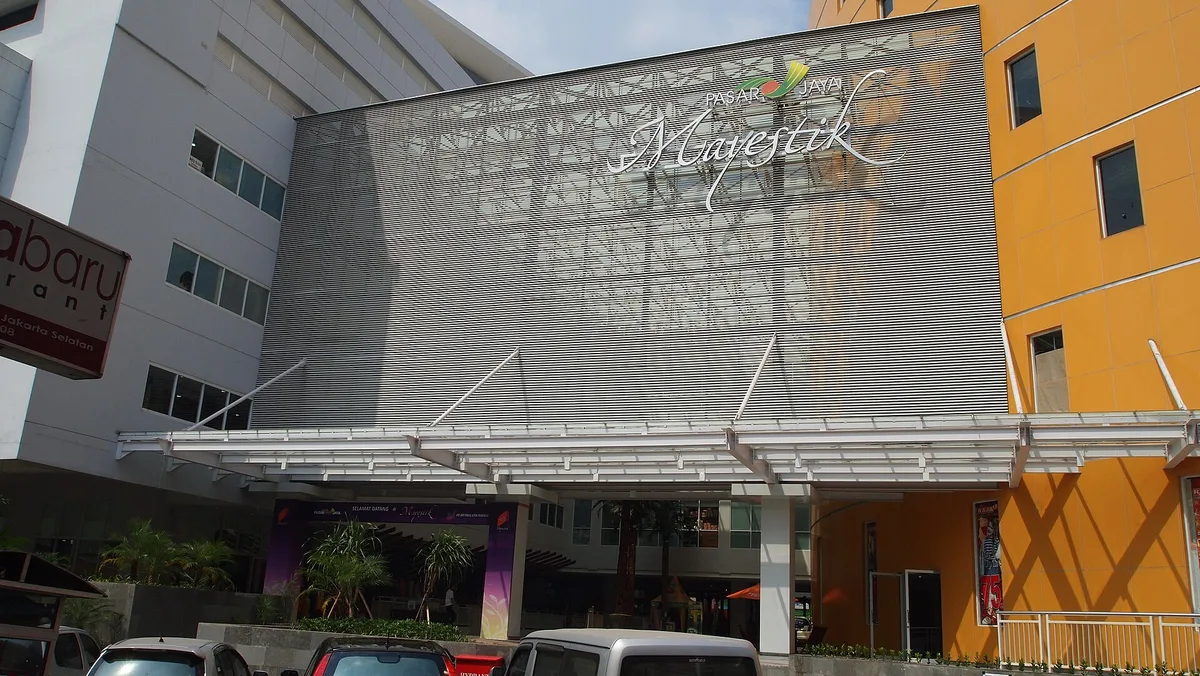
Ten floors of cloth
Mayestik is a fabric market that fills a whole building. Its modern, 10-story block on Jl. Tebah III in Kebayoran Baru holds thousands of stalls. Textiles are why most people come: bolts stacked to the ceiling, lengths of batik folded over rails, rolls of lace and brocade standing upright in narrow shopfronts.
It is also one of the most-reviewed markets in Jakarta, and it is consistently well rated. Don’t expect a quiet corner. This is where the city buys cloth for weddings, office uniforms, school events and Eid outfits, and on a normal day the aisles are busy with people doing exactly that.
Buying by the metre
The main thing to know about Mayestik is that you mostly buy cloth, not clothes. Fabric is cut to length in front of you. The seller unrolls the bolt across the counter, measures it against a rule or tape, snips the edge and tears it straight across.
So work out what you want to make before you arrive. A tailor or a pattern will tell you how many metres you need. Ask for a little extra if the fabric has a large print you need to match. If you are unsure, sellers are used to the question and will usually suggest a length for a kebaya, a shirt or a pair of trousers.
- Batik: printed and stamped cloth, in cottons for daily wear and finer weights for formal shirts.
- Lace and brocade: heavy, patterned fabric used for kebaya and wedding outfits.
- Plain cottons, linens and uniform cloth: sold in a wide range of colours, often matched against a swatch you bring.
- Trims: buttons, ribbon, sequins and lining. These count for a lot if you are having something made.
Before you pay, run a hand along the length and hold it to the light. Check the cut edge for flaws.
Getting to Kebayoran Baru
Mayestik sits in the grid of leafy streets in Kebayoran Baru, South Jakarta, just west of the Blok M area. Blok M is the obvious reference point. The MRT North–South line stops at Blok M BCA, and the neighbourhood is a big hub for TransJakarta buses.
From Blok M, the quickest way over is a short ride with Gojek or Grab, on a motorbike or in a car. Type “Pasar Mayestik” into the app and it will find the building. Jakarta traffic makes car journey times hard to predict, so give yourself more time than the map shows. If you are coming by TransJakarta, check the official app for the nearest stop on the day.
Working with the 9 to 6 day
The market keeps the same hours every day of the week, 9am to 6pm, weekends included. There is no late opening, so plan around the close. Many stalls start packing up before the doors shut.
A morning start makes sense for simple reasons. You get time to walk the floors, compare several stalls and then find a tailor without feeling rushed. Weekends bring families shopping together, while weekdays tend to suit people who want to browse properly.
In the weeks before Eid al-Fitr (Lebaran), Jakarta buys new clothes, and fabric markets feel it first. Expect that to be the most crowded time of year. Tailors are often fully booked then, too.
Bargaining at the bolt
Haggling is normal here. Prices at many stalls are a starting point, especially if you are buying several metres or more than one fabric. Keep it friendly and short. Ask the price, make a lower offer, meet somewhere in the middle, and walk on with a smile if it doesn’t work out.
A few words of Indonesian help a lot:
- “Berapa per meter?” How much per metre?
- “Bisa kurang?” Can you go lower?
- “Saya mau … meter.” I’d like … metres.
- “Terima kasih.” Thank you.
Cash is the safest choice at small stalls. Many sellers across Indonesia also take QRIS, the national QR payment code, but don’t rely on it everywhere. Carry small notes so the seller doesn’t have to hunt for change. Tipping stallholders isn’t expected.
Only start bargaining if you mean to buy. Agreeing a price and then walking away is poor form.
Getting it made
A length of batik folded in a suitcase is a good souvenir. A shirt tailored to fit you is a better one. Many visitors buy cloth at Mayestik and take it to a tailor (penjahit), and the trade that grows up around a market like this makes that easy.
Here is what helps the process go smoothly:
- A reference: a photo, or better, a garment that fits you well so the tailor can copy it.
- Your timeline: say plainly when you leave Jakarta. Ask if the job can be done before then, with time for a fitting.
- The trims: buy buttons, zips and lining at the market so everything matches.
- A written order: agree the price, the date and any details before you hand over the fabric.
Around Blok M afterwards
With the fabric bought, the rest of South Jakarta is close. Blok M is a short ride east. Its streets around Jl. Melawai are known for Japanese restaurants and izakaya, and the area is often called Little Tokyo.
M Bloc Space, a creative hub in old buildings near Blok M, has cafés, small shops and live music. Blok M Square is a big, busy shopping centre. Put those together with a morning at Mayestik and you have a full day in Kebayoran Baru without crossing the city.
Frequently asked questions
What are Mayestik Market's opening hours?
It opens every day, including weekends, from 9am to 6pm. Some stalls start packing up before closing, so arrive earlier in the day if you need time to compare fabrics.
How do I get to Mayestik Market?
It's on Jl. Tebah III in Kebayoran Baru, South Jakarta, just west of Blok M. Take the MRT to Blok M BCA, then a short Gojek or Grab ride. Search for "Pasar Mayestik" in the app.
What is Mayestik Market best for?
Fabric sold by the metre: batik, lace, brocade, plain cottons and uniform cloth, plus trims like buttons and lining. Most shoppers buy cloth there and have it made up by a tailor.
How long should I spend there?
Allow two to three hours to walk the floors, compare prices and buy trims. Add more time if you plan to brief a tailor the same day.
Can I bargain at Mayestik?
Yes, haggling is normal at many stalls, especially when you buy several metres. Keep it friendly, carry cash in small notes, and only bargain if you intend to buy.
Plan your trip to Jakarta
Some links above are affiliate links — if you book through them, Wander Atlas earns a small commission at no extra cost to you. It's how we keep every guide free.
Related guides
 restaurant
 Social House Grand Indonesia: Where to Eat in Jakarta
 attraction
 Selamat Datang Monument: Jakarta Travel Guide (4.7★)
 trendy
 Giyanti Coffee Roastery: Jakarta Travel Guide
 attraction