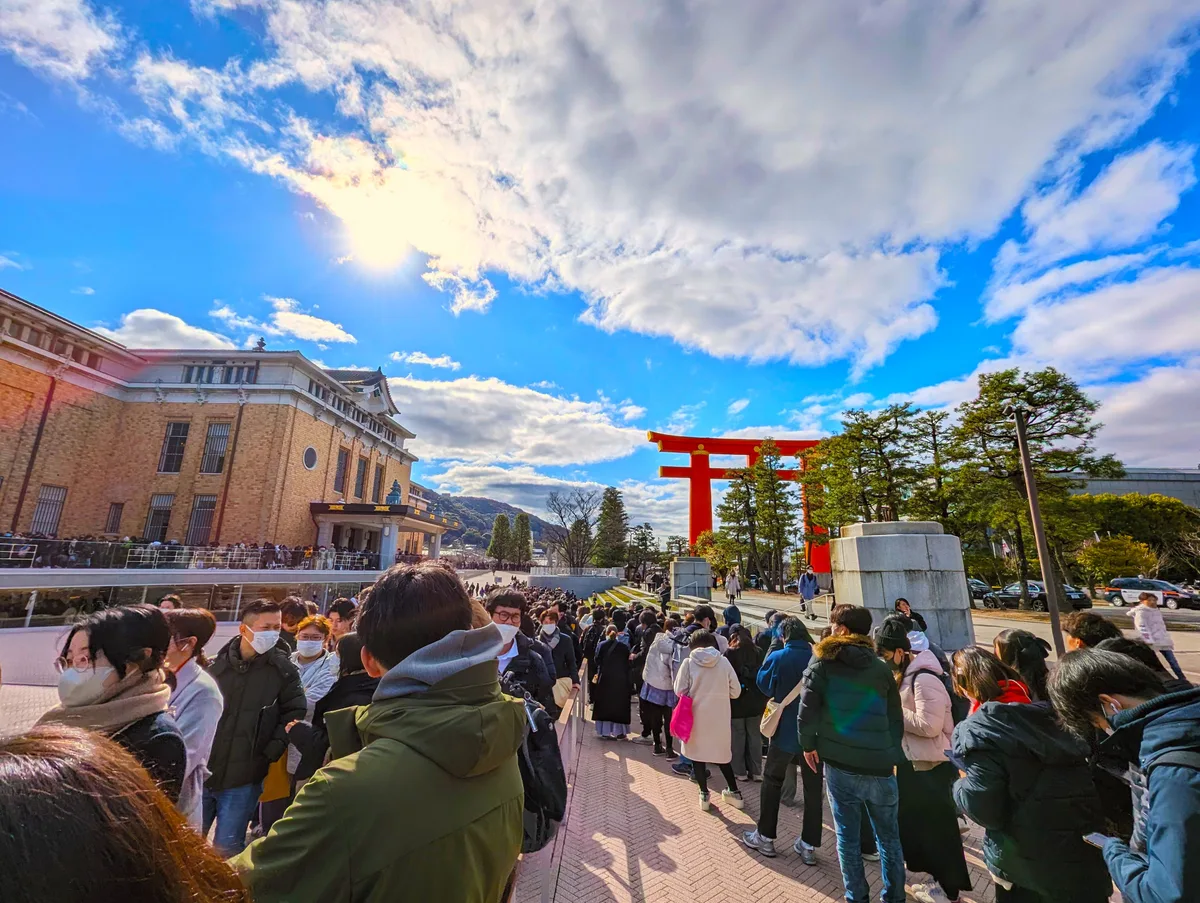
The building under the big torii
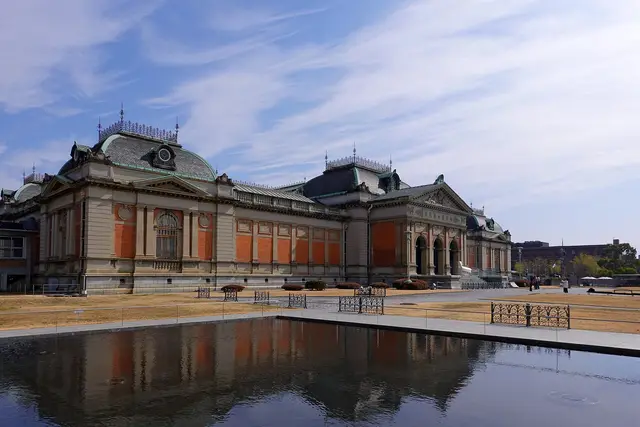
Look up before you go in. The museum opened in 1933, and its facade follows the Imperial Crown style of the period: a Western-style masonry block topped with a sweeping, tiled Japanese roof. It is one of the oldest public art museum buildings still standing in Japan.
It faces Jingu-michi, the broad avenue that runs under Heian Shrine’s enormous vermilion torii. That makes this one of the easiest landmarks in Kyoto to find. Across the road is the National Museum of Modern Art, Kyoto, so in a few square blocks you get two major collections, a theatre and a shrine.
The front plaza slopes gently down to a glass entrance at ground level. The old ceremonial steps above it stay as part of the view. Inside, the original central hall is still the heart of the building, and the galleries branch off it to either side.
What’s actually on the walls
Most of what you’ll see here is Kyoto’s own art. The core collection is modern Japanese painting and sculpture by artists tied to the city, especially nihonga, the mineral-pigment painting tradition that Kyoto’s art schools championed. Look for names like Takeuchi Seihō and Uemura Shōen, whose bijin-ga paintings of women are among the most loved works of the period.
The collection isn’t hung permanently. It rotates through themed displays, so what’s up depends on the season. Alongside it run large special exhibitions, often touring shows or big retrospectives. Those are usually the reason the queue stretches across the plaza.
Several galleries are also rented out to art societies and school groups for their annual shows. Walk the side galleries and you might find calligraphy, ceramics or student work. That’s a side of Kyoto’s art life most visitors never see.
Reading the ticket situation
Tickets here work differently from a typical “one museum, one ticket” visit. Each exhibition is ticketed on its own terms, which catches out a lot of first-timers.
- Check which exhibition you want. The collection display, the special exhibitions and the rental shows each have their own admission. Current prices are posted on the official site and at the entrance.
- Big shows sell advance tickets. For a popular special exhibition, buying ahead online or at a convenience-store ticket machine is how Japanese visitors skip the ticket line.
- Use the lockers. Large bags usually have to go into the coin lockers, which give your coin back. Don’t try to carry a backpack through.
- Photography rules change by room. Look for the camera icons posted at each gallery entrance. Many special exhibitions forbid photos entirely, and the staff will politely stop you.
- Keep your voice low. Galleries in Japan are quiet places, and phone calls belong outside in the central hall or the plaza.

Beating the weekend crowd
Timing matters more here than at most Kyoto museums. According to BestTime’s forecast of typical visitor patterns, weekends are usually busiest from 11am to 5pm. A popular special exhibition can stretch that into long lines in those hours.
Here’s what works best:
- Arrive at the 10am opening on Saturday or Sunday, when the first hour is the calmest part of the weekend.
- Go on a weekday if you can. Tuesday to Friday follow the same 10am–6pm schedule.
- Remember Monday. It is currently listed as closed. Japanese museums often open on a Monday public holiday and close the next day instead, so check the official calendar before a long weekend.
Hours shift for some exhibitions and around New Year, so confirm on the museum’s site for the month you’re travelling. Allow 1.5–2 hours for one major exhibition plus the collection rooms. If you’re adding a second show, set aside half a day.
Getting to Okazaki
The museum’s address is 124 Okazaki Enshōjichō, Sakyo Ward. The Okazaki area has no station of its own, but two easy routes get you there.
- Subway: Take the Tozai Line to Higashiyama Station and leave by Exit 1. Walk north along Jingu-michi toward the torii; it takes about 8–10 minutes on flat pavement.
- City bus: Several Kyoto City Bus routes from Kyoto Station and Shijo-Kawaramachi stop at Okazaki Kōen Bijutsukan/Heian Jingū-mae, right beside the museum. Buses on these routes fill up in peak season, so the subway is usually faster.
- On foot: From Gion and Shijō, it’s a walk of about 25 minutes north-east through Higashiyama.
Cycling is common in Okazaki, and the park’s flat avenues suit it. Use the marked bicycle parking, not the pavement.
An afternoon around Okazaki Park
The museum sits at the centre of Kyoto’s cultural district, and the best visits treat it that way. Everything below is within about 15 minutes’ walk.
- Heian Shrine: Just north, with its huge vermilion gate and a well-known garden behind the main hall.
- National Museum of Modern Art, Kyoto: Directly across Jingu-michi. Its exhibitions often complement what’s on here.
- Lake Biwa Canal: It runs along the south edge of the park, and the cherry trees lining it draw crowds in early April.
- ROHM Theatre Kyoto: Next door, for concerts and performances.
- Kyoto City Zoo: On the eastern side of the park.
- Nanzen-ji: A short walk east, with its massive Sanmon gate and the brick aqueduct in the temple grounds.
A good plan is to see the museum at 10am, have lunch in Okazaki, then walk out to Nanzen-ji in the afternoon. That way you’re in the galleries when they’re calmest and out under the trees during the weekend peak.
Frequently asked questions
When is the quietest time to visit Kyoto City KYOCERA Museum of Art?
Weekends are usually busiest from 11am to 5pm, so get there for the 10am opening on Saturday or Sunday. A weekday visit (Tuesday to Friday) is a better bet if your schedule allows.
How do I get there from Kyoto Station?
Take the Karasuma Line to Karasuma Oike, change to the Tozai Line for Higashiyama Station, leave by Exit 1 and walk north for about 8–10 minutes. Some city buses also stop at Okazaki Kōen Bijutsukan/Heian Jingū-mae, right beside the museum.
Is the museum open on Mondays?
It is currently listed as closed on Monday and open Tuesday to Sunday, 10am–6pm. Like many Japanese museums, it may open on a Monday public holiday and close the next day, so check the official calendar.
How long should I spend there?
Allow 1.5–2 hours for one major special exhibition plus the collection rooms. Plan on half a day if you want to see two shows.
What else is nearby?
The National Museum of Modern Art, Kyoto is directly opposite. Heian Shrine, the Lake Biwa Canal, ROHM Theatre Kyoto, Kyoto City Zoo and Nanzen-ji are all within about a 15-minute walk.
Plan your trip to Kyoto
Japan eSIM & staying connected →
Some links above are affiliate links — if you book through them, Wander Atlas earns a small commission at no extra cost to you. It's how we keep every guide free.