Ten Peaks Above the Water
A wall of mountains stands right behind the water. These are the Valley of the Ten Peaks, a row of steep, often snow-streaked summits that rise straight up from the far shore. The lake fills the space below them.
The colour is the reason people come. Glacial meltwater carries rock flour, a powder of ground stone fine enough to stay suspended. It scatters sunlight and turns the water a dense turquoise that looks almost opaque from above.
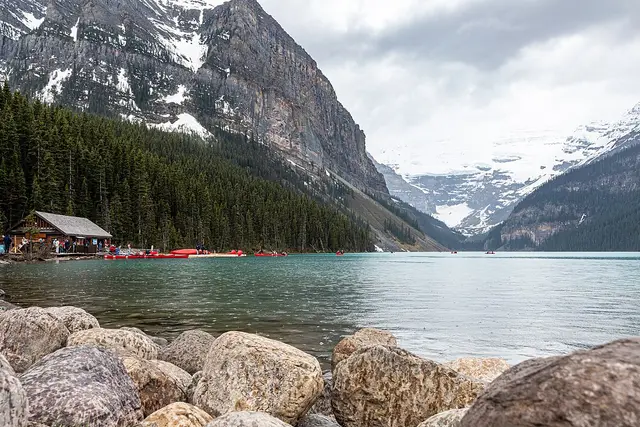
You arrive on a short paved path by the parking area and the lodge. On the left is a jumble of boulders, and ahead is a log-strewn outflow where the lake drains away. A canoe dock sits along the shore. Most visitors have it all in view within about two minutes of stepping off the bus.
The Rockpile and the Twenty-Dollar View
The view you know from photos comes from the Rockpile. It’s a natural dam of boulders at the lake’s outlet, and a short, well-built trail with stone steps climbs to the top in about ten minutes.
From the top the whole lake lines up beneath the Ten Peaks. Canadians may recognise it: this scene was printed on the back of the old Canadian twenty-dollar bill, which is why locals still call it the “Twenty Dollar View.”
The best ledges fill quickly. Benches and flat rocks along the upper loop give you room to step back from the crowd at the front edge. Stay behind the railings and marked paths, because the boulders below are loose and the drop is real.
No Car Past the Gate
Moraine Lake Road has been closed to personal vehicles since 2023. The small lot couldn’t cope, and cars used to queue back down the switchbacks before dawn. Plan around one of these options:
- Parks Canada shuttle from the Park and Ride at the Lake Louise Ski Resort, with a connector running between Lake Louise and Moraine Lake
- Roam Transit, the regional bus, which has routes from Banff town
- Commercial operators, including early-morning sunrise buses
- Cycling the road while it’s open to traffic, which means about 14 km of steady climbing from Lake Louise
The road normally opens around June and closes in mid-October, when avalanche risk shuts it for winter. These dates shift each year. Check the Parks Canada website before you build a trip around them.
You also need a valid Parks Canada pass to be anywhere in Banff National Park. Current pass and shuttle fares are listed on the official Parks Canada site.

Getting a Seat and Keeping the Peace
Shuttle seats are released online in advance and the popular departures sell out, especially in summer and larch season. Book once you know your dates. A share of seats is often held back and released closer to the day, so check again if you miss out.
On the shore, a few habits keep things easy:
- At the Rockpile, take your photo and move aside. Groups waiting for the front ledge is the main bottleneck.
- Don’t feed or approach wildlife. Ground squirrels and birds hang around the snack areas, and the valley is grizzly country.
- Carry bear spray on any trail beyond the shoreline, and know how to use it.
- Canoe rentals at the dock are first come, first served and depend on the weather. Calm mornings are the usual paddling window, before wind picks up off the peaks.
Without a car, getting stranded is the real risk. Check the time of the last return shuttle before you head out on a long hike.
Trails From the Shoreline
The Rockpile is only the start. Several trails begin at the lake, from flat strolls to proper alpine climbs.
- Lakeshore Trail: a mostly level path along the north shore toward the inlet streams at the far end. It’s an easy hour or two out and back.
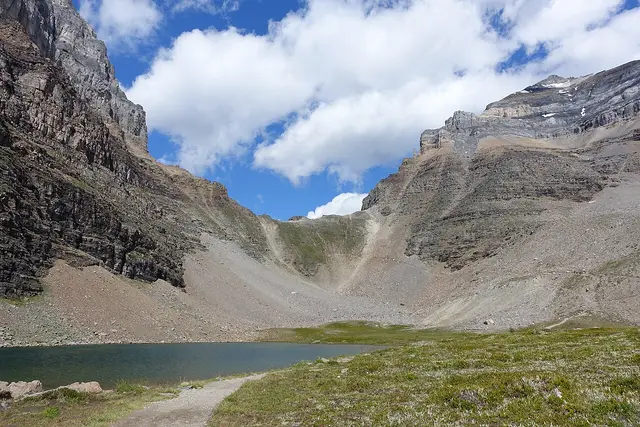
- Consolation Lakes: a moderate walk through forest and a boulder field to a pair of quieter lakes beneath glaciated cliffs.
- Larch Valley and Sentinel Pass: switchbacks climb to a high meadow ringed by larches, then continue steeply to a pass with views back over the Ten Peaks. It’s a full half-day or more.
- Eiffel Lake: splits off the Larch Valley trail and runs along the valley wall to a stark, rocky basin.
Parks Canada sometimes requires hikers on these trails to travel in tight groups of four or more because of bear activity. Posted closures and restrictions are enforced, so read the trailhead signs before setting off.
When the Water Turns Blue
The lake stays frozen and snowbound well into spring. It usually thaws in June, but the first weeks can still look pale or icy. The deep blue-green comes in July and August, when meltwater and rock flour peak.
Mid to late September brings a second high season. The larches in Larch Valley turn gold before their needles drop. This is one of the busiest times on the road, so shuttle seats go fast.
Sunrise brings the classic shot: light hitting the summits while the water is still calm. Early commercial buses are built around it. Midday is when shuttles turn over most often and the shoreline is fullest.
Give it two to three hours for the Rockpile, the shoreline and a short paddle. A big hike makes it a full day.
Pairing It With Lake Louise
Most visitors combine Moraine Lake with Lake Louise on the same day. The Parks Canada connector shuttle links the two, so you can see both without going back to the Park and Ride.
Lake Louise has its own walks, including the climb to the Lake Agnes Tea House and the Plain of Six Glaciers trail. Lake Louise village, down in the Bow Valley, has the nearest groceries, fuel and cafés. Moraine Lake has the lodge and a few facilities, but it’s still worth packing water and food for any trail.
Banff town is roughly 45 minutes southeast along the Trans-Canada Highway. The Icefields Parkway heads north from Lake Louise toward Jasper, so Moraine Lake is a natural first or last stop on that drive.
Frequently asked questions
Can I drive my own car to Moraine Lake?
No. Moraine Lake Road has been closed to personal vehicles since 2023. You can get there by Parks Canada shuttle from the Lake Louise Ski Resort Park and Ride, by Roam Transit, with a commercial bus operator or by bicycle.
When is the best time to see Moraine Lake's blue colour?
July and August, when glacial meltwater and rock flour are at their peak. Mid to late September is also popular for the golden larches in Larch Valley. The road usually opens around June and closes in mid-October, but check Parks Canada for this year's dates.
How long should I spend at Moraine Lake?
Allow two to three hours for the Rockpile viewpoint, the shoreline and maybe a canoe. Hiking Larch Valley, Sentinel Pass or Consolation Lakes turns it into a half or full day.
What is the Rockpile?
It's a natural boulder dam at the lake's outlet. A short trail with stone steps climbs to the top in about ten minutes, and the view over the lake and the Valley of the Ten Peaks there once appeared on the back of the old Canadian twenty-dollar bill.
Can I visit Moraine Lake and Lake Louise on the same day?
Yes. The Parks Canada connector shuttle runs between the two lakes, so most visitors do both in a single day without returning to the Park and Ride.
Plan your trip to Lake Louise
Canada eSIM & staying connected →
Some links above are affiliate links — if you book through them, Wander Atlas earns a small commission at no extra cost to you. It's how we keep every guide free.