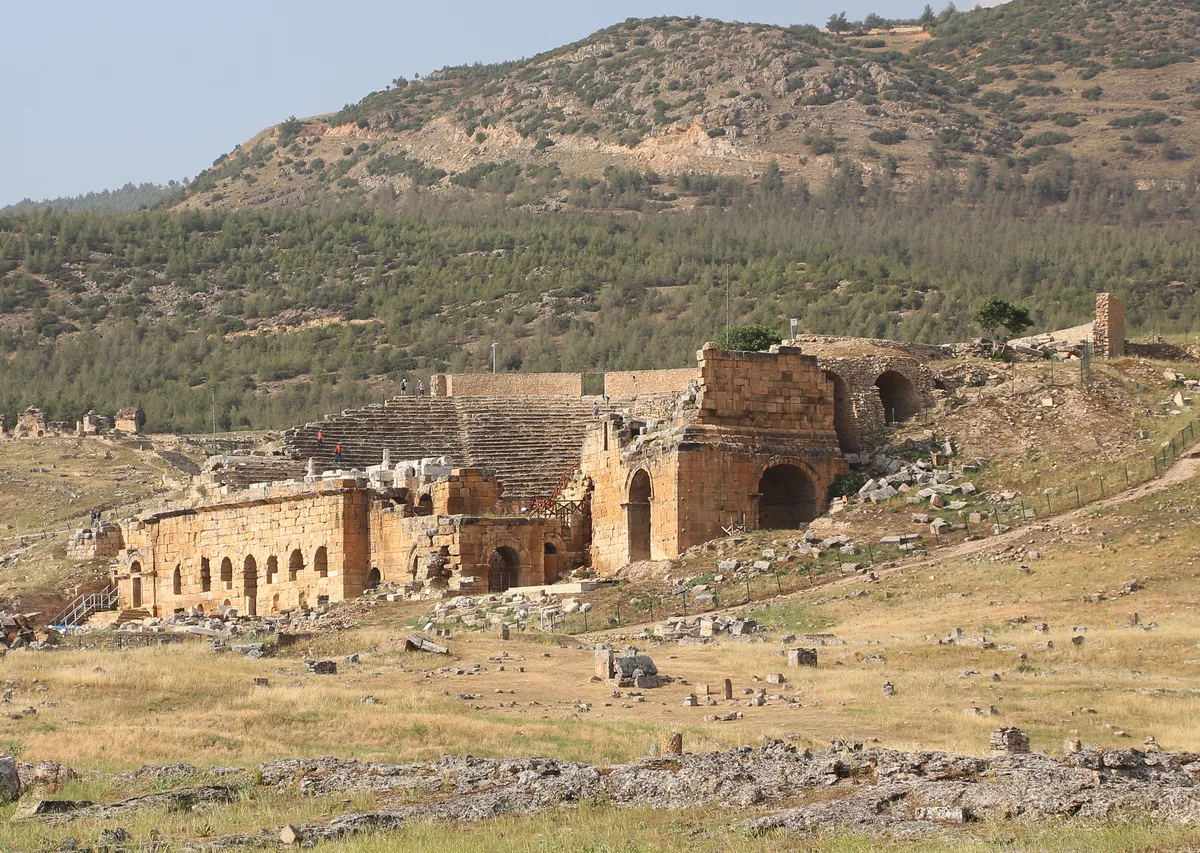
Why this theater stops people in their tracks
You climb the path up from the Hierapolis ruins, past scattered column drums and sarcophagi baking in the sun, and the theater opens up almost without warning. Tiered limestone seating curves around a stage wall that still stands two stories tall, carved with columns, niches and relief panels that once held statues of gods and emperors.
Most Roman theaters in Turkey have lost their scaenae frons, the ornate stage backdrop. Hierapolis kept a huge chunk of it, rebuilt after earthquakes in antiquity and restored again in modern times. That’s the detail that makes visitors linger here longer than at almost any other ruin on the site.
What you’re actually looking at
The theater dates to the 2nd century AD, built under Hadrian and expanded under Septimius Severus. It could seat around 12,000 people across roughly 50 rows of stone benches.
Walk to the top tier and turn around. The view stretches over the scattered white ruins of Hierapolis, the flat plain of the Lycus valley, and on clear days the ridge where the Pamukkale travertines glow. It’s one of the few spots on-site where you get the whole ancient city laid out at once.
Look closely at the stage wall for carved scenes, a frieze depicting the myth of Apollo and Artemis is one of the highlights, along with dedications to Roman emperors. Much of it has been pieced back together from fragments found scattered around the site.
Getting there
The theater sits inside the Hierapolis-Pamukkale archaeological park, on the hill above the travertine terraces near the ancient city’s center. It’s roughly a 15–20 minute uphill walk from the north entrance gate near the Antique Pool, or a shorter walk if you enter from the south gate near the necropolis.
There’s no separate ticket, admission is covered by the general Hierapolis-Pamukkale entrance fee. Wear proper shoes; the path up is uneven stone and can be slippery in places even without water.
Most visitors arrive from Denizli, about 20 minutes away by car or dolmuş, or as a stop on a wider Pamukkale day trip. If you’re staying in Pamukkale village, it’s an easy walk or short taxi ride to the entrance gates.
When to go
Turkey’s summer sun is brutal on this exposed hillside with almost no shade. Early morning, right after the site opens, is the most comfortable time to climb up and explore the seating.
Late afternoon, an hour or two before closing, is the other good window, softer light, cooler air, and a good chance of catching sunset colors over the valley from the top rows. Spring and autumn make the whole visit easier, with mild temperatures and thinner crowds than peak summer months.
How to visit like a local
This is a well-known stop on the Hierapolis circuit, so it draws steady crowds, especially tour groups mid-morning. Beating them is mostly about timing.
- Enter early or in late afternoon rather than late morning, when tour buses cluster around the theater.
- Combine the visit with the nearby Martyrium of St. Philip and the Necropolis. Both close by and often skipped by rushed groups.
- Carry water and a hat; there’s no shade and no vendors right at the theater itself.
- Pay for park entry at the gate before walking up. Bring cash as a backup in case card readers are down.
- Don’t just glance from the base, climb to the upper rows. The best photos and the full valley view are from the top, not the orchestra floor.
Give yourself 45 minutes to an hour here alone, more if you want to study the stage carvings closely. It pairs naturally with a half-day or full-day visit to the wider Hierapolis-Pamukkale site, since the travertine terraces and thermal pools are a further walk downhill.
Frequently asked questions
Is there a separate ticket for the theater?
No. It's included in the general Hierapolis-Pamukkale archaeological site entrance fee — there's no extra charge to see the theater itself.
How long should I spend at the theater?
Plan on 45 minutes to an hour to walk the seating tiers and study the stage wall carvings, more if you want to linger for photos from the top rows.
What's the best time of day to visit?
Early morning right after opening or the last couple of hours before closing — the hillside has no shade, and midday sun plus tour groups make it far less comfortable.
How do I get to the theater from the entrance gates?
It's about a 15–20 minute uphill walk from the north gate near the Antique Pool, or a shorter climb from the south gate near the necropolis.
What else should I see nearby?
The Martyrium of St. Philip and the Hierapolis Necropolis are both a short walk away and worth combining with the theater visit.
Plan your trip to Pamukkale
Some links above are affiliate links — if you book through them, Wander Atlas earns a small commission at no extra cost to you. It's how we keep every guide free.
Related guides
 attraction
 Hierapolis Archaeological Museum: Pamukkale Travel Guide
 hidden gem
 Hierapolis: Pamukkale Travel Guide
 attraction
 Ancient City of Telmessos: Fethiye Travel Guide (4.5★)
 attraction