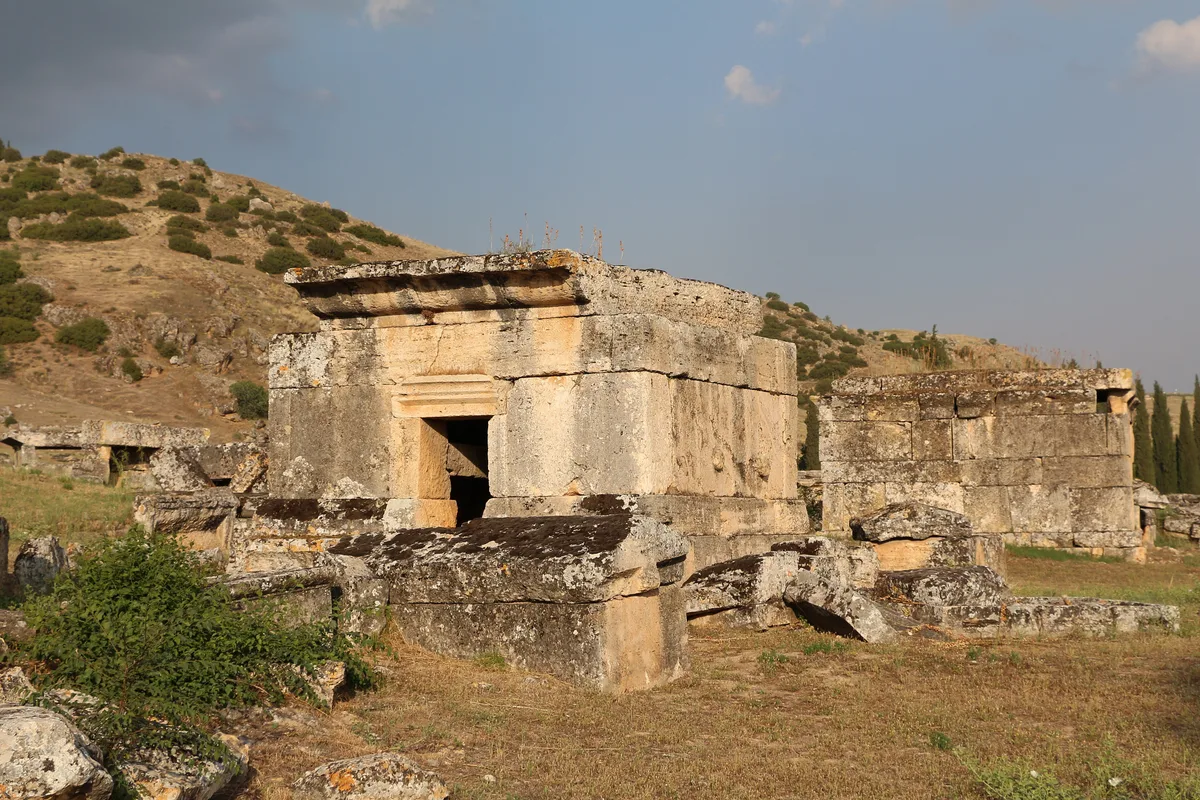
A city of the dead on the way in
Hierapolis buried its people on the road into town. Anyone arriving from the north walked past the tombs before reaching the city gate, and that’s still how you arrive if you use the North Gate entrance today.
The necropolis runs for roughly two kilometres along that approach. It is one of the largest ancient cemeteries in Anatolia, with well over a thousand tombs recorded. Most visitors take the shuttle from the south entrance or climb the white travertines from Pamukkale village and never see this end of the site. That is why it often feels close to empty.
What you’re walking through
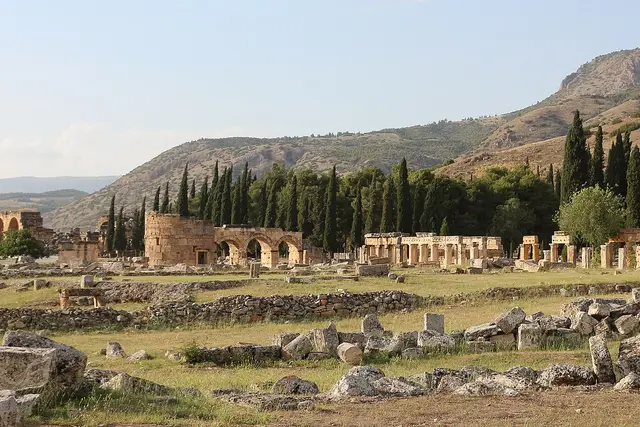
The ground is dry and uneven, covered in scrub and scattered blocks of grey limestone. Tombs stand on both sides of the path, and the styles change as you walk:
- Tumuli: low, round mounds with a small doorway at the base, the oldest form here.
- Sarcophagi: stone coffins on stepped plinths, many with lids pitched like roofs and still lying askew.
- House tombs: small rectangular buildings with gabled fronts, built for whole families.
- Heroa and monumental tombs: larger structures for the city’s wealthier citizens.
Many lids are cracked or shifted. Earthquakes did much of that, along with tomb robbers over the centuries. Some sarcophagi show a white crust where water from the hot springs has deposited calcium over the stone, the same process that built the terraces below.
Look for Greek inscriptions on the tomb faces. The best known belongs to Flavius Zeuxis, a merchant whose epitaph records that he sailed around Cape Malea to Italy 72 times. His tomb stands near the city end of the necropolis, close to Frontinus Gate.
Making the North Gate work for you
Your entrance decides your route. From the North Gate (Kuzey Kapı) on the Karahayıt side, the path takes you straight through the necropolis. After that it passes the Roman baths-basilica and reaches the three-arched Frontinus Gate, the entrance to the city’s colonnaded main street.
A sensible order:
- Walk the necropolis southward, taking your time with the tombs.
- Pass through Frontinus Gate and follow Frontinus Street.
- Climb up to the theatre and the Martyrium of St Philip if you have the legs.
- Finish at the Antique Pool and the travertine terraces at the southern edge.
That’s a one-way route of several kilometres, so think about how you’ll leave. If you arrived by taxi or minibus at the North Gate, you can exit by the travertines into Pamukkale village and avoid walking back.
Reading the tombs without wrecking them
The tombs are open to walk among, but they are not climbing frames. Stay off the sarcophagus lids and the roofs of house tombs. The stone is cracked and many pieces sit loose after centuries of earthquakes. Peering into an open tomb is fine. Reaching inside to move stones isn’t.
Some practical habits:
- Shoes: wear proper ones here. The barefoot rule applies only on the travertine terraces, not in the necropolis.
- Water: carry your own. There is almost no shade along the cemetery road, and a summer afternoon on bare limestone is punishing.
- Tickets: one ticket for Hierapolis–Pamukkale covers the necropolis. Pay at the gate, where the current price is posted. The Antique Pool charges separately.
- Museum pass: if you hold a Museum Pass Türkiye, ask at the gate whether it covers this site before you buy.
To get the cemetery largely to yourself, go early. Arriving at opening usually beats the tour coaches, which tend to head for the terraces first.
Light, heat and timing
At the moment the site opens from 8am to 9pm every day. Hours at Turkish heritage sites change with the season, though, so check the official Türkiye Müze site for this month’s times before you go.
Low sun suits the necropolis best. Raking light in the morning or late afternoon brings out the inscriptions and carved gables, while at midday everything flattens to the same pale grey. Give it 1–2 hours on its own. If you want the whole of Hierapolis plus the terraces, allow half a day or more.
Beyond the last tomb
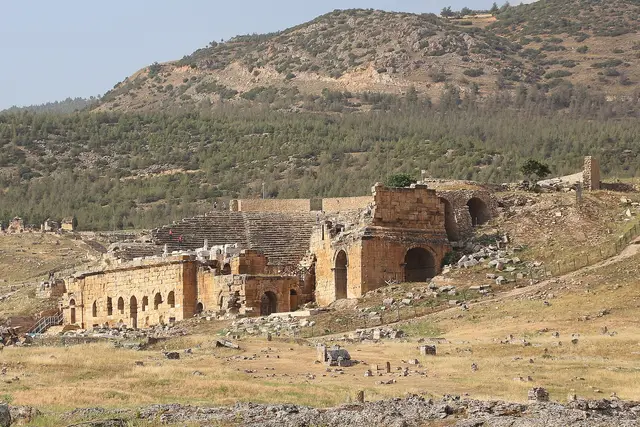
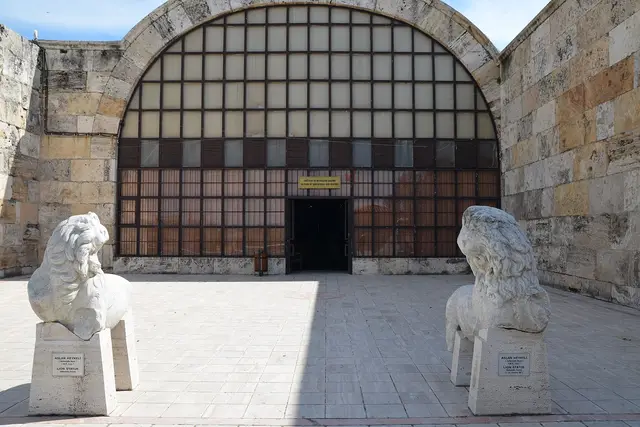
Once through Frontinus Gate, the rest of Hierapolis spreads uphill. The Roman theatre has a restored stage building with carved reliefs. Above it, the Martyrium of St Philip marks the traditional site of the apostle’s death. The Hierapolis Archaeology Museum, in the former Roman baths, holds sarcophagi and statues found across the site.
Just north of the North Gate is Karahayıt, a spa village known for its red-tinted hot springs. Further afield, the ruins of Laodicea lie on the other side of Denizli. They make a good pairing with a morning among the Hierapolis tombs.
Frequently asked questions
Which entrance is best for the Necropolis of Hierapolis?
The North Gate (Kuzey Kapı), on the Karahayıt side. The path from there runs straight through the necropolis to Frontinus Gate. From the south entrance or the travertines you would have to walk the length of the site to reach it.
How long should I spend in the necropolis?
Allow 1–2 hours for the cemetery itself. Allow half a day or more if you continue through Frontinus Gate to the theatre, the museum and the travertine terraces.
What are the opening hours?
It currently opens from 8am to 9pm daily. Hours change with the season, so check the official Türkiye Müze site for the current month before you go.
Is the necropolis included in the Pamukkale ticket?
Yes, the standard Hierapolis–Pamukkale ticket covers it. Pay at the gate, where the current price is posted. The Antique Pool is charged separately.
What should I bring?
Water and sun protection, because there is almost no shade along the cemetery road. Wear sturdy shoes too. The barefoot rule applies only on the travertine terraces.
Plan your trip to Pamukkale
Turkey eSIM & staying connected →
Some links above are affiliate links — if you book through them, Wander Atlas earns a small commission at no extra cost to you. It's how we keep every guide free.