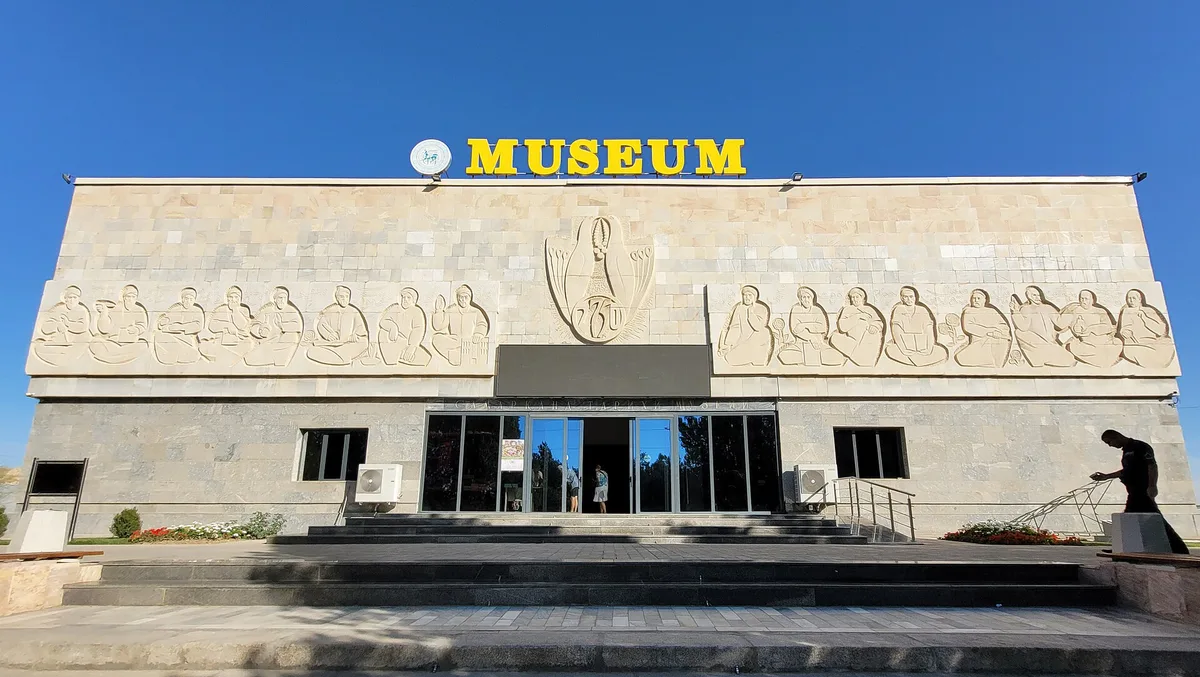
Why go
You come here for one wall. The rest of the museum is prelude.
That wall is a fragment of 7th-8th century palace fresco, unearthed from the Afrasiyab mound just outside the museum’s doors. It shows Sogdian envoys, a Chinese princess on a boat, elephants, camels, a snapshot of Samarkand as a Silk Road crossroads centuries before the Registan existed.
Everything else in the two-story building (coins, ossuaries, ceramics, excavated tools) is context for that single room.
Getting there
The museum stands on Toshkent yo’li, on the edge of the Afrasiyab archaeological mound, a short taxi or walk north of the old city.
Most visitors combine it with the Bibi-Khanym Mosque and the Shah-i-Zinda necropolis, both a few minutes away by car. If you’re walking from the Registan, plan on 20-25 minutes uphill.
Taxis and ride-hailing apps are cheap and easy in Samarkand, just confirm the driver knows “Afrasiyab muzeyi” rather than the mound itself, since both share the name.
What you’ll see inside
The ground floor sets the timeline: flint tools, pottery shards, and burial ossuaries pulled from the surrounding mound, which has been continuously inhabited since roughly the 7th century BC.
Coins trace the city’s changing rulers (Greek, Sogdian, Arab, Timurid) in a handful of display cases that reward slow reading if you like numismatics.
Upstairs is the fresco room. The lighting is dim to protect the pigment, so give your eyes a moment to adjust before the scene resolves out of the wall.
A scale model of ancient Afrasiyab nearby helps you picture the city that once stood where the empty mound now sits.

When to go
The museum opens at 9am and closes at 5pm, every day of the week, so there’s no need to work around a weekly closure.
Weekday mornings between 9 and 10am are the quietest stretch, right at opening, before tour groups arrive.
Avoid weekend mornings from 10am to 1pm if you can. That’s the busiest window, when coach groups tend to cluster in the fresco room.
Because it’s under-the-radar compared to Samarkand’s headline sites, even a moderately busy hour here feels calm next to the Registan at midday.
How to visit like a local
Treat this as a 45-minute stop, not a half-day museum crawl. The collection is small and focused, and lingering past that mostly means re-reading the same captions.
- Arrive right at 9am on a weekday for the emptiest fresco room.
- Head upstairs first if you only have limited time. The fresco is the reason to come, and it’s easy to run out of energy for it after the ground floor.
- Ask at the desk about English-language placards; captions vary in detail, and a guide or app can fill gaps on the coin and ceramic cases.
- Walk the mound itself afterward, even briefly. It’s free, unmarked in most itineraries, and gives you the scale of the vanished city the museum only sketches indoors.
The mistake most visitors make is treating this like a quick photo stop on the way to Shah-i-Zinda. The fresco needs a few minutes of quiet looking to read (the boat scene, the procession, the animals) before it clicks into a coherent narrative rather than a faded wall.
Nearby to pair it with
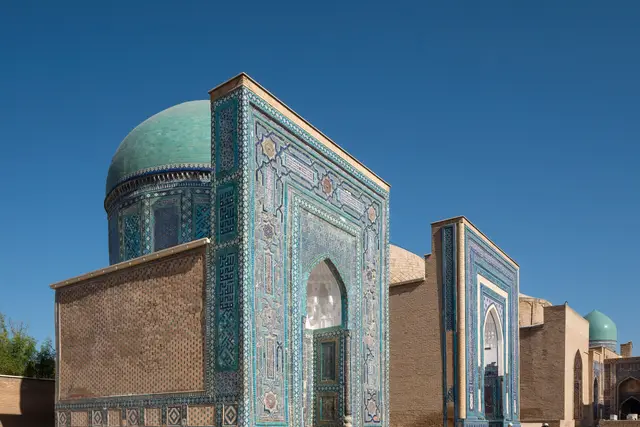
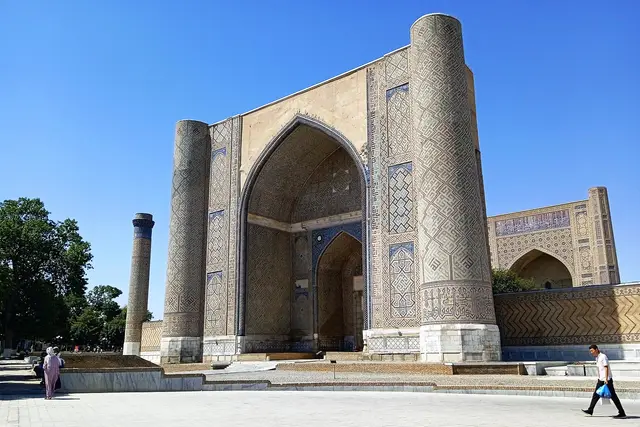
Bibi-Khanym Mosque and the Shah-i-Zinda necropolis both sit within a short drive, and most people string the three together in a single morning.
If you have time, the Afrasiyab mound behind the museum is worth a slow walk, grassy, largely unexcavated, and one of the few spots in Samarkand where you can stand on 2,500 years of layered history without a ticket booth in sight.
Frequently asked questions
How long should I spend at the Afrasiyab Museum?
45-60 minutes is enough for most visitors — the collection is compact, with the fresco room as the highlight.
When is the quietest time to visit?
Weekdays between 9am and 10am, right at opening, before tour groups arrive.
What are the opening hours?
The museum is open daily from 9am to 5pm, with no weekly closure.
What's the best time to avoid crowds on weekends?
Try to avoid 10am to 1pm on weekends, when coach groups tend to cluster around the fresco.
What else is nearby?
Bibi-Khanym Mosque and Shah-i-Zinda necropolis are both a short drive away, and the Afrasiyab mound itself is right behind the museum.
Plan your trip to Samarkand
Some links above are affiliate links — if you book through them, Wander Atlas earns a small commission at no extra cost to you. It's how we keep every guide free.
Related guides
 attraction
 Shah-i-Zinda necropolis: Samarkand Travel Guide (4.8★)
 attraction
 Bibi-Khanym Mosque: Samarkand Travel Guide (4.6★)
 attraction
 Registan Square: Samarkand Travel Guide (4.8★)
 hidden gem