Why go
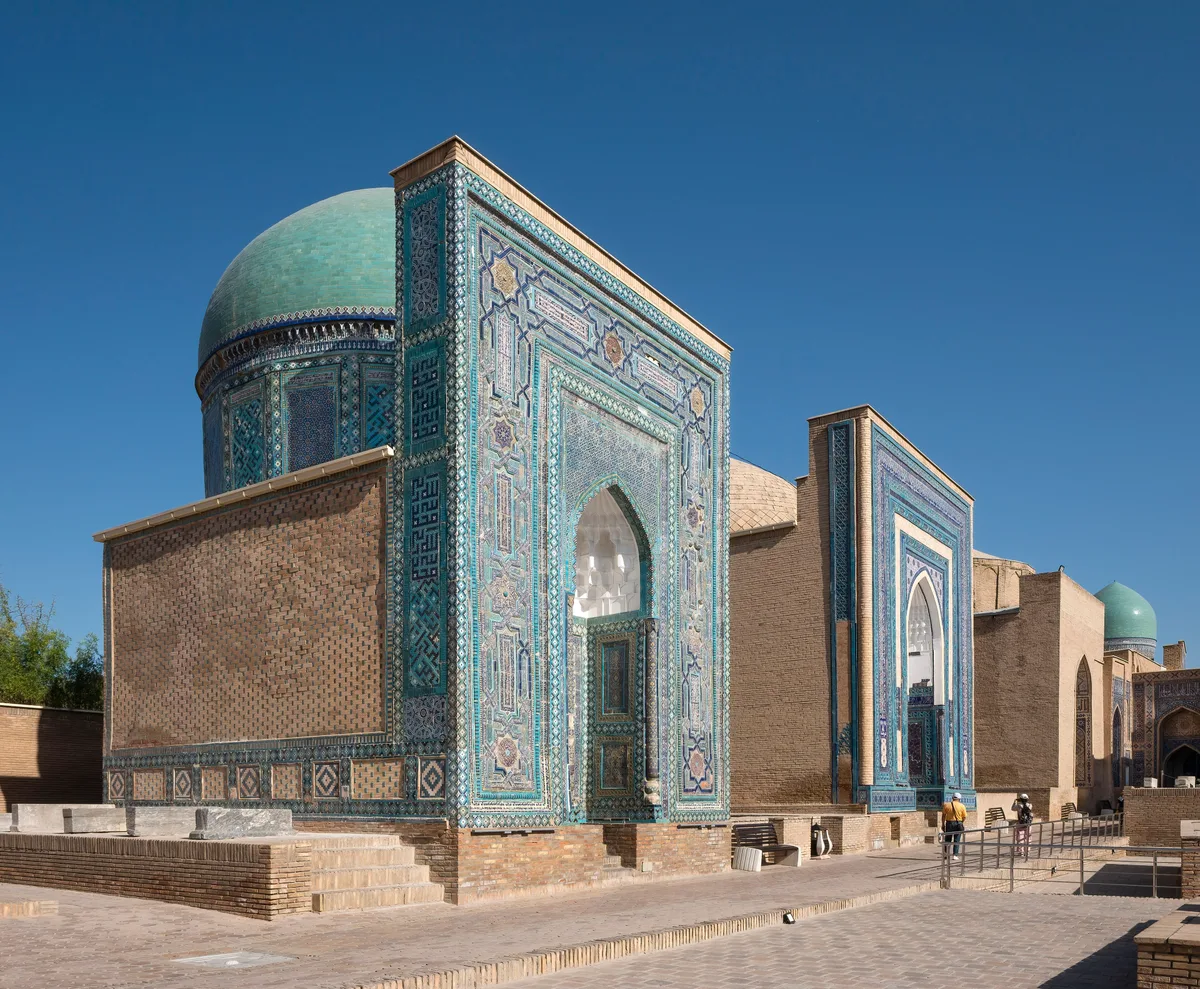
Shah-i-Zinda means “the living king”, a reference to the shrine at its heart, said to hold the cousin of the Prophet Muhammad. What you actually experience is a narrow, uphill lane flanked on both sides by 11th-to-15th-century mausoleums, each one tiled floor to dome in glazed majolica.
No two facades repeat. You’ll pass panels of star-shaped strapwork, calligraphic bands looping through cobalt blue, and carved terracotta that still holds crisp geometric relief eight centuries on. The effect builds as you climb. It’s less a single monument than a compressed timeline of Central Asian tilework.
Getting there
The necropolis sits on Shohi Zinda street on Samarkand’s northeastern edge, an easy 15–20 minute walk from the Registan. Most visitors combine the two in one outing, often continuing on to the Bibi-Khanym Mosque nearby.
A taxi or rideshare from the city center runs a few minutes and costs little. There’s no metro in Samarkand, so walking or a short taxi ride are the two realistic options.
What you’ll see inside
You enter through a grand portal (the Qusam ibn Abbas complex gate) and climb a stepped corridor lined with paired mausoleums. Look for:
- The 14th-century Shadi Mulk Aka mausoleum, with some of the site’s finest carved terracotta
- The Tuman Aka complex, tiled in deep blue majolica
- The inner sanctuary at the top, the shrine chamber itself, where visitors linger longest
- A working cemetery beyond the historic core, still used today
The staircase count is famously said to differ depending on whether you’re counting sincerely, a bit of local folklore worth knowing before you climb.

When to go
The site is open every day, 7am to 10pm, with no weekly closure. That long window is one of its best features. You can visit at sunrise, midday, or after dinner.
Weekends get busy between 11am and 7pm, when tour groups fill the staircase. Both weekday and weekend mornings and evenings stay calmer, so anchor a visit around 7–9am or after 7pm if you want the corridor closer to empty.
Evening light does something specific here: low sun catches the glazed tile at an angle and the blues turn almost luminous, especially in the upper courtyards.
How to visit like a local
This is one of Samarkand’s most-visited landmarks, not a quiet back corner, so plan around the crowds rather than expecting to dodge them entirely.
- Go early or late. Arrive right at 7am or after 7pm. The busiest window is 11am–7pm on weekends, and weekday mornings run just as calm.
- Dress modestly. It’s an active cemetery and shrine complex; shoulders and knees covered is expected, and voices tend to drop as you near the shrine chamber at the top.
- Pay small entrance/photo fees in local currency (som). Card readers aren’t reliable at ticket booths here, carry cash.
- Skip the group-tour bottleneck. If you see a large tour bus parked outside, wait 20 minutes or start from the top of the staircase and work down instead of joining the queue at the bottom.
- Don’t rush the terracotta panels near the entrance. Most visitors speed past them heading for the blue-tiled domes further up, but the carved (unglazed) sections near the gate are some of the oldest work on site.
- Combine it efficiently. Pair it with the Registan and Bibi-Khanym Mosque in one walking loop. All three sit within a 20-minute walk of each other.
Nearby stops worth the extra steps
Once you’re back at street level, the Registan’s three madrasahs are a short walk southwest, and the Siab Bazaar sits just beyond Bibi-Khanym Mosque if you want tea, dried fruit, or fresh bread after the climb. Both pair naturally with a Shah-i-Zinda visit and make a full half-day loop through Samarkand’s historic core.
Frequently asked questions
How long should I spend at Shah-i-Zinda?
Plan for 60–90 minutes to walk the full staircase, pause at the main mausoleums, and reach the shrine chamber at the top.
When is the quietest time to visit?
Early morning right after the 7am opening or after 7pm are calmest on both weekdays and weekends. Weekends get crowded between 11am and 7pm.
How do I get there from the Registan?
It's about a 15–20 minute walk northeast, or a few minutes by taxi. No metro serves Samarkand, so walking or a short taxi ride are the standard options.
What should I wear?
Dress modestly — shoulders and knees covered — since it's an active cemetery and shrine, not just a historic sight.
Can I combine it with other sights nearby?
Yes. Bibi-Khanym Mosque and Siab Bazaar are a short walk away, and the Registan is about 15–20 minutes on foot, making an easy half-day loop.
Plan your trip to Samarkand
Some links above are affiliate links — if you book through them, Wander Atlas earns a small commission at no extra cost to you. It's how we keep every guide free.
Related guides
 attraction
 Bibi-Khanym Mosque: Samarkand Travel Guide (4.6★)
 attraction
 Afrasiyab Museum: Samarkand Travel Guide (4.0★)
 attraction
 Registan Square: Samarkand Travel Guide (4.8★)
 hidden gem