Three tiled facades frame the start line. Ulugh Beg Madrasa sits on the west side of Registan Square, Sher-Dor faces it from the east, and Tilya-Kori closes the square to the north. The Samarkand Marathon gathers its runners between them, and it brings them back there at the finish.
The 2026 edition is on November 7-8. It is an annual road race with distances for almost everyone: a full marathon, a half-marathon, a 10K, a 5K, a 2K and races for kids.
A start line built in the 1400s
Registan is not a stadium. It is a sunken square paved in stone, ringed by three madrasas built over two centuries.
Ulugh Beg’s madrasa dates from the 15th century, when the astronomer-ruler made Samarkand a centre of science. Sher-Dor came in the 17th century. Its portal shows two striped tigers chasing deer beneath human-faced suns, a rare figurative design for Islamic architecture. Tilya-Kori, finished soon after, holds a mosque whose interior is covered in gold leaf.
That setting shapes the feel of race weekend. Spectators line the edges of the square and the raised viewing areas around it. Finishers come back into a space that has been Samarkand’s main public square for roughly six hundred years.
Choosing your distance
The spread of races makes this an easy weekend to share. A runner can take on the full 42.2 km while a partner does the 10K and the children run their own race.
- Marathon: the full distance, for runners who came to race seriously.
- Half-marathon: the most common pick for travellers combining the race with sightseeing.
- 10K and 5K: short enough to leave your legs fresh for the old town the same afternoon.
- 2K: a gentle loop for walkers and casual participants.
- Kids’ races: short distances for younger runners.
Registration, distance rules and start times for each race sit with the organiser’s official channels. This guide does not list a fee or a start time, because neither was supplied to us.
November on the Silk Road
Samarkand sits in a dry continental climate, and November is late autumn. Mornings are cool and can be cold. Afternoons are usually milder and dry, which makes for comfortable running weather once the sun is up.
Runners usually pack a throwaway layer for the wait at the start. A warm jacket for the finish area helps too, since you will cool fast standing in an open stone square. Daylight is shorter in November, so evening strolls around the monuments happen in the dark, when Registan is floodlit.
Getting to Samarkand and the square
Most international visitors fly into Tashkent and take the train south. The Afrosiyob high-speed service links Tashkent and Samarkand in a little over two hours. Samarkand also has its own international airport, with direct flights from a number of cities.
From Samarkand railway station to Registan is a short taxi ride across the newer part of the city. Yandex Go is the ride-hailing app most people use in Uzbekistan. It shows the fare up front, which saves any haggling.
Visitors usually stay in guesthouses and hotels around the old town. From there the start is a walk, not a drive. Streets near the square often close for the race, so walking in is generally the easiest option.
After the finish: plov, non and Tashkent Street
Samarkand eats plov at midday. This rice dish is cooked in huge kazan cauldrons with carrots, onion, mutton and chickpeas. The Samarkand style is known for layering the rice over the meat rather than stirring it all together.
Then there is the bread. Samarkand non is a round, dense loaf stamped with a pattern in the centre. It is famous across Uzbekistan and travels well, so people often carry it home.
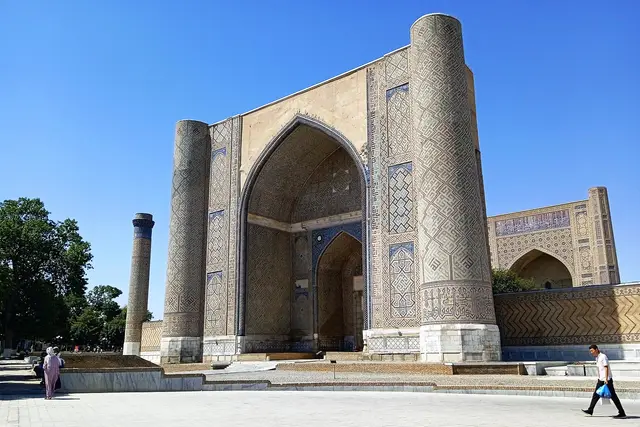
To refuel, walk north from Registan along Tashkent Street, the pedestrian promenade. It leads to the vast Bibi-Khanym Mosque and, just beyond, Siab Bazaar. There, stalls stack non, dried apricots, raisins and nuts, the classic recovery food of the Silk Road.
Table manners and getting around
A few local customs make the weekend smoother. None of them are complicated.
- Bread: never place non upside down or put it on the floor. Break it by hand rather than cutting it.
- Tea: green tea (kok choy) comes in small bowls called piyola. A host who pours only a little at a time is showing hospitality. Keep accepting.
- Greetings: a hand on the heart with a slight nod is the common greeting, especially toward elders.
- Money: Uzbek som in cash is still the default at bazaars and small cafés. Cards are more common in hotels and larger restaurants.
- Monuments: inside madrasas and mosques, people cover shoulders and knees. Women often carry a scarf for mosque interiors.
A few words of Uzbek go a long way. Rahmat means thank you, and assalomu alaykum is the standard greeting. Russian is also widely understood.
Making a trip of it
The race fills a morning, and Samarkand rewards the rest of the stay. Rest days fit easily around these sites:
- Gur-e-Amir: Timur’s mausoleum, with a ribbed turquoise dome, south-west of Registan.
- Shah-i-Zinda: a street of blue-tiled tombs climbing a hillside to the north-east.
- Ulugh Beg Observatory: the remains of the 15th-century observatory and its giant meridian arc.
- Afrosiyob: the ancient city site and museum, with its 7th-century murals.
Runners who stay longer usually add Bukhara, also on the Afrosiyob line. The whole historic centre of Samarkand is a UNESCO World Heritage Site. Running through it on two legs is a different way to learn the layout of its streets.
Frequently asked questions
When is the Samarkand Marathon 2026?
It takes place on November 7-8, 2026, as an annual road race in Samarkand, Uzbekistan.
Where does the Samarkand Marathon start and finish?
Both the start and finish are at Registan Square. The square is framed by the Ulugh Beg, Sher-Dor and Tilya-Kori madrasas in the centre of the old city.
What distances can I run?
The event offers a full marathon, half-marathon, 10K, 5K, 2K and kids' races. Registration and the details for each distance are handled through the organiser's official channels.
How do I get to Samarkand for the race?
Most visitors fly into Tashkent and take the Afrosiyob high-speed train, which takes a little over two hours. Samarkand also has its own international airport. From the station, a Yandex Go taxi reaches Registan quickly.
What is the weather like in November?
November is late autumn in Samarkand. Mornings are cool to cold and afternoons are milder and usually dry. Runners typically wear a throwaway layer at the start and bring a warm jacket for the finish.
Plan your trip to Samarkand
Uzbekistan eSIM & staying connected →
Some links above are affiliate links — if you book through them, Wander Atlas earns a small commission at no extra cost to you. It's how we keep every guide free.