
Stalls Beneath Three Madrasas
Samarkand’s showpiece square gets a winter market. Registan is framed on three sides by madrasas: Ulugh Beg on the west, Sher-Dor facing it, and Tilya-Kori closing the north side. Their tiled portals rise above anything a market stall could do.
The Holiday Craft Market sets up near this square each December. Its stalls carry the crafts Uzbekistan is known for: embroidered textiles, glazed ceramics, miniature paintings and jewellery. Artisans also demonstrate their work, so some tables show the making as well as the finished piece.
The pairing works because the buildings and the goods come from the same tradition. The geometric tile patterns on the portals show up again in the plates and the embroidery below them.
Dates, Entry and Exact Location
It happens in December, but the days change. The 2026 edition takes place in December. Dates vary yearly, so the specific days are set each season rather than fixed to a calendar.
- Entry: the market is free.
- Tickets: none needed for the market itself.
- Venue: beside Registan Square, in the historic centre of Samarkand.
- Madrasa interiors: a separate ticket covers the madrasa courtyards and Tilya-Kori’s gilded prayer hall. The price is posted at the Registan ticket office.
Most visitors pair the free market with a ticketed walk through the madrasas. Together they fill a long half day.
Reading the Stalls: Suzani, Blue Glaze and Miniatures
Knowing the crafts makes browsing faster. These are the categories the market is built around, with what to look for in each.
- Suzani and embroidered textiles: large cotton or silk panels stitched with sun discs, pomegranates and flowering vines. Hand embroidery shows small irregularities and a slightly messy reverse side, which machine work lacks.
- Ceramics: Uzbek pottery runs from the turquoise and cobalt glazes linked to Rishtan in the Fergana Valley to earthier painted wares. Bowls, plates and lagan serving platters are common shapes.
- Miniature paintings: fine-brush scenes in the Persianate manner, often of poets, hunts or caravans. Some artists paint on Samarkand’s traditional mulberry-bark paper.
- Jewellery: silver and metalwork pieces, some echoing older Central Asian designs.
Demonstrations let you see the hours behind a piece. That helps when a price seems high for something small.
Haggling in Som, Gently
Bargaining is normal at Uzbek craft stalls. It’s a polite exchange, not a fight. Sellers expect a counteroffer, and both sides usually meet somewhere between the first figure and the buyer’s opening bid.
- Currency: prices are in Uzbek som. Cash is the safest way to pay at small stalls, and banks and ATMs cluster around the centre.
- Useful words: “Assalomu alaykum” (hello), “Qancha?” (how much?), “Rahmat” (thank you). Russian is widely understood too.
- Photographs: artisans who are working usually appreciate being asked before a camera comes out.
Buyers who show real interest in technique often get a story with the object. Asking where a suzani pattern comes from opens more doors than a fast lowball.
December Light on the Registan
Winter changes the square. December in Samarkand is cold. Days hover around freezing, nights drop below it, and snow falls in some years. Experienced visitors dress in layers, because browsing outdoors means standing still for long stretches.
The low winter sun is the reward. It rakes across the tilework on the madrasa portals and brings out the blues. The Sher-Dor facade is the one to watch: its tiger-like beasts chase deer beneath sun faces, an unusual image for a religious building.
The square is lit after dark, so the facades change character in the evening. The market’s own hours aren’t fixed in this guide, so how much of that overlaps with the stalls varies.
Getting to Registan
Registan sits in the middle of the old city. Most international visitors reach Samarkand on the Afrosiyob high-speed train from Tashkent, which takes a little over two hours. Others fly into Samarkand International Airport.
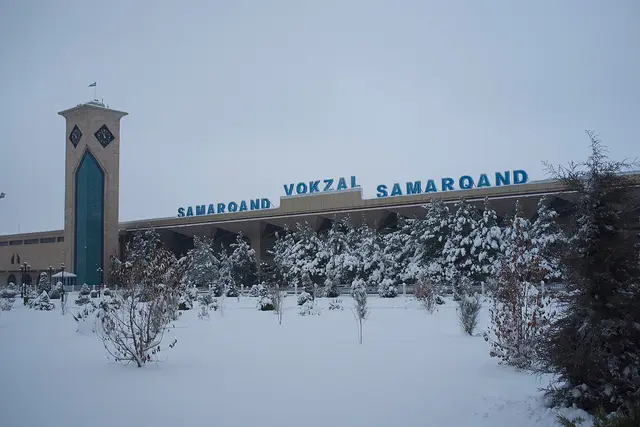
From the railway station, a taxi to Registan is a short ride. Yandex Go is the ride-hailing app most visitors use, and it shows the fare before you confirm. Hotels in the old city are within walking distance of the square, and many visitors simply walk over from them.
After the Market: Along Tashkent Street
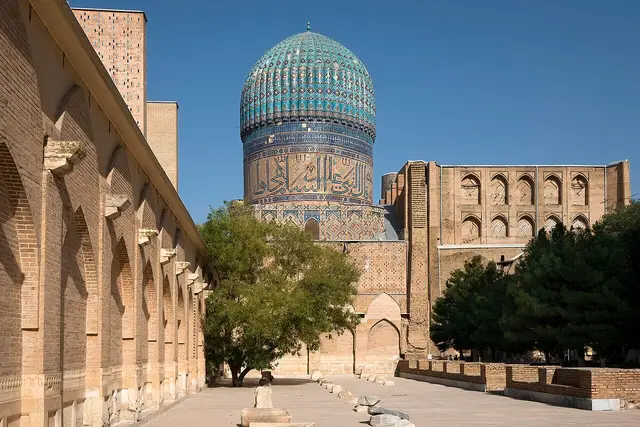
The best walk starts at the square’s northeast corner. Pedestrianised Tashkent Street runs from Registan towards Bibi-Khanym Mosque, the vast Timurid mosque built after Timur’s campaign in India.
Just past Bibi-Khanym is Siyob Bazaar, the city’s main market for dried fruit, nuts, spices and Samarkand’s round, stamped bread. It’s a good contrast after the craft stalls: everyday trade instead of gifts.
In the other direction, Gur-e-Amir is a short walk southwest of Registan. Timur himself is buried there under a ribbed turquoise dome. Further out, Shah-i-Zinda’s avenue of tiled mausoleums is a taxi ride or a long walk beyond Siyob Bazaar.
Market, madrasas and one or two of these sights fit comfortably into a single winter day.
Frequently asked questions
When is the Holiday Craft Market at Registan held?
It takes place in December. The 2026 edition is in December 2026, but the exact days vary from year to year.
Do I need a ticket for the market?
No. The market is free. A separate ticket is needed to enter the Registan madrasas, and its price is posted at the ticket office on the square.
What can I buy there?
Embroidered textiles such as suzani, ceramics, miniature paintings and jewellery. Artisans also demonstrate their crafts.
How do I get to Registan Square?
Most visitors take the Afrosiyob high-speed train from Tashkent, which takes a little over two hours. From Samarkand station, a taxi or Yandex Go ride to Registan is short, and old-city hotels are within walking distance.
What is nearby?
Tashkent Street leads from Registan to Bibi-Khanym Mosque and Siyob Bazaar. Gur-e-Amir, Timur's mausoleum, is a short walk southwest of the square.
Plan your trip to Samarkand
Uzbekistan eSIM & staying connected →
Some links above are affiliate links — if you book through them, Wander Atlas earns a small commission at no extra cost to you. It's how we keep every guide free.
Related guides
 event
20th CITES Conference of the Parties (CoP20): Dates, Tickets & Venue (Samarkand)
 Ended
Chess Olympiad 2026: Dates, Tickets & Venue (Samarkand)
 Ended
Samarkand Marathon: Dates, Tickets & Venue (Samarkand)
 event