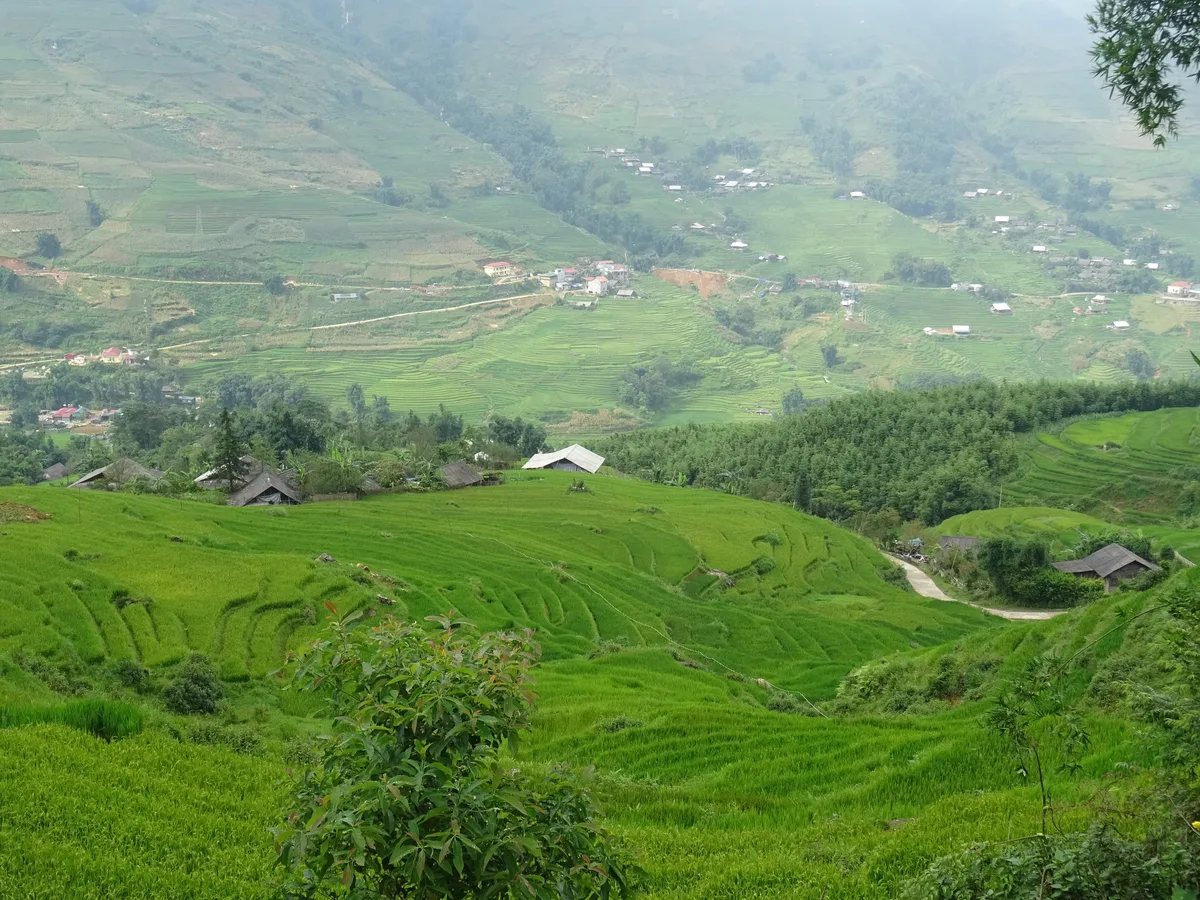
Terraces Stacked Down to the River
The road out of Sapa drops fast. Within a few kilometres the town’s hotels give way to a long, deep valley with rice terraces cut into both slopes, and the Mường Hoa stream runs along the floor. The terraces follow the contours exactly, so whole hillsides look ribbed.
This is the valley most Sapa treks go into. It still feels far from town, because the villages along it are farming communities first. Lao Chải is a Black Hmong village and Tả Van is mainly Giáy. You walk on paths the residents use every day, past buffalo, wooden houses and drying racks.
Above the eastern side rises the Hoàng Liên Sơn range, with Fansipan, Vietnam’s highest peak, at its top. The Fansipan cable car crosses the valley overhead. Even so, most visitors only look down on Mường Hoa from a car window or a gondola, and the paths through the fields stay fairly quiet.
Reading the Terrace Calendar
When you go matters more here than almost anywhere else in Sapa. The valley changes colour with the rice cycle:
- Late April–May: the terraces are flooded for planting, and on clear days the water reflects the sky.
- June–July: young rice turns the slopes bright green. This is also the rainy season, so trails get muddy.
- Late August–September: the rice ripens to gold before harvest, which is the most photographed time of year.
- October–November: the fields are cut and the weather is usually drier and clearer for walking.
- December–February: it is cold, often foggy and the terraces are bare. Frost sometimes reaches the higher ground.
The exact harvest date moves from year to year with the weather. If gold terraces are why you are coming, ask your guesthouse in Sapa a week or two ahead.
Walking From Lao Chải to Tả Van
The standard route starts on the road from Sapa town and drops into Lao Chải. From there it follows the valley to Tả Van. Counting the walk out of town, it is a solid day on foot. Most people take a good half day to a full day, depending on pace and stops.
The path goes through terraces, bamboo and small streams. On the way you cross the Mường Hoa stream on a suspension bridge near Tả Van. Some sections are packed earth that turns slick after rain, so wear shoes with real grip. Trail shoes beat sandals here.
If you don’t want to walk the whole way, it is easy to get a lift back up to Sapa from Tả Van by road. For a longer trip, keep going down the valley towards Hầu Thào or Bản Hồ, where far fewer trekkers go.
The Carved Rocks of Bãi Đá Cổ
There is more in the valley than terraces. On the slopes of Mường Hoa, around Lao Chải and Hầu Thào, lie the boulders of the Sapa Ancient Rock Field (Bãi Đá Cổ Sapa). Many are carved with lines, figures and patterns that researchers have long argued about. Some read them as maps or terrace layouts, others as symbols.
The stones sit out in the fields, and the carvings are easy to miss unless someone shows you where they are. Low sun picks out the grooves better than midday light. A guide makes all the difference here: without one, many people walk straight past the best-carved rocks.
Getting Down From Sapa Town
The valley begins a short drive southeast of Sapa town, and the address puts it in Lao Chải commune. Your options:
- On foot: walk straight out of town along the road to Lao Chải. It gets steep in places but is easy to follow.
- Motorbike taxi (xe ôm) or car: take a ride to Lao Chải or Tả Van and start walking there.
- Mountain railway and cable car: the Mường Hoa funicular from central Sapa runs down to the Fansipan cable car station, which gives you a view of the valley from above.
To get to Sapa from Hanoi, take a sleeper bus up the expressway, or the overnight train to Lào Cai and then a road transfer up the mountain. Visitors pay at a checkpoint on the road into the Lao Chải and Tả Van area. Fees are posted at the booth, so carry Vietnamese đồng.
Walking With Hmong Guides and Sellers
Soon after you set off, women from the villages will often fall into step beside you. They chat in English and help on the slippery bits. Near the end, they bring out embroidered and indigo-dyed textiles to sell. Expect this, and decide early what you will do about it.
- Be clear from the start. If you don’t plan to buy, say so kindly at the beginning, not after an hour of walking together.
- Book a local guide. Many Hmong women guide treks themselves, and guesthouses in Sapa can put you in touch. Your money then goes straight to the village.
- Ask before taking photos, especially of children and older people. A smile and a gesture at your camera is enough.
- Don’t hand out sweets or money to children. It keeps them out of school and selling. Buying from adults is the better choice.
- Stay on the paths and the tops of dykes where people already walk. Terrace walls are someone’s crop and take work to repair.
- Carry cash. Village shops, homestays and sellers rarely take cards.
A Night in Tả Van
On a day trip you only see the valley around midday. If you stay overnight, you also see early morning and evening. Tả Van has the most homestays in the valley, many in wooden family houses where you eat dinner with your hosts. They often serve rice wine as well.
Mornings in the valley often start with mist on the river that burns off as the sun rises above the ridge. Staying also gets you onto the paths before day-trippers walk down from Sapa. Bring a warm layer even in summer, because the valley is cool once the sun goes down. Book ahead for September harvest weekends.
Frequently asked questions
How do I get to Mường Hoa Valley from Sapa town?
You can walk out of town on the road to Lao Chải or take a motorbike taxi or car to Lao Chải or Tả Van. The funicular from central Sapa also runs down to the Fansipan cable car station, which gives you a view from above.
When is the best time to see the rice terraces?
Go from late August to September for golden rice before the harvest, June to July for green terraces, or late April to May for flooded fields. Harvest dates change each year, so check locally before you go.
How long does the trek take?
The classic walk from Sapa through Lao Chải to Tả Van takes most people a good half day to a full day. If you want to go on to Hầu Thào or Bản Hồ, stay a night in Tả Van.
Do I need a guide?
The main route is easy to follow, but a local Hmong guide helps on slippery sections and can show you the carved stones of Bãi Đá Cổ, which are easy to miss. Hiring one also puts your money straight into the villages.
Is there an entry fee?
Visitors pay at a checkpoint on the road into the Lao Chải and Tả Van area. The current fee is posted at the booth, so bring Vietnamese đồng in cash.
Plan your trip to Sapa
Vietnam eSIM & staying connected →
Some links above are affiliate links — if you book through them, Wander Atlas earns a small commission at no extra cost to you. It's how we keep every guide free.