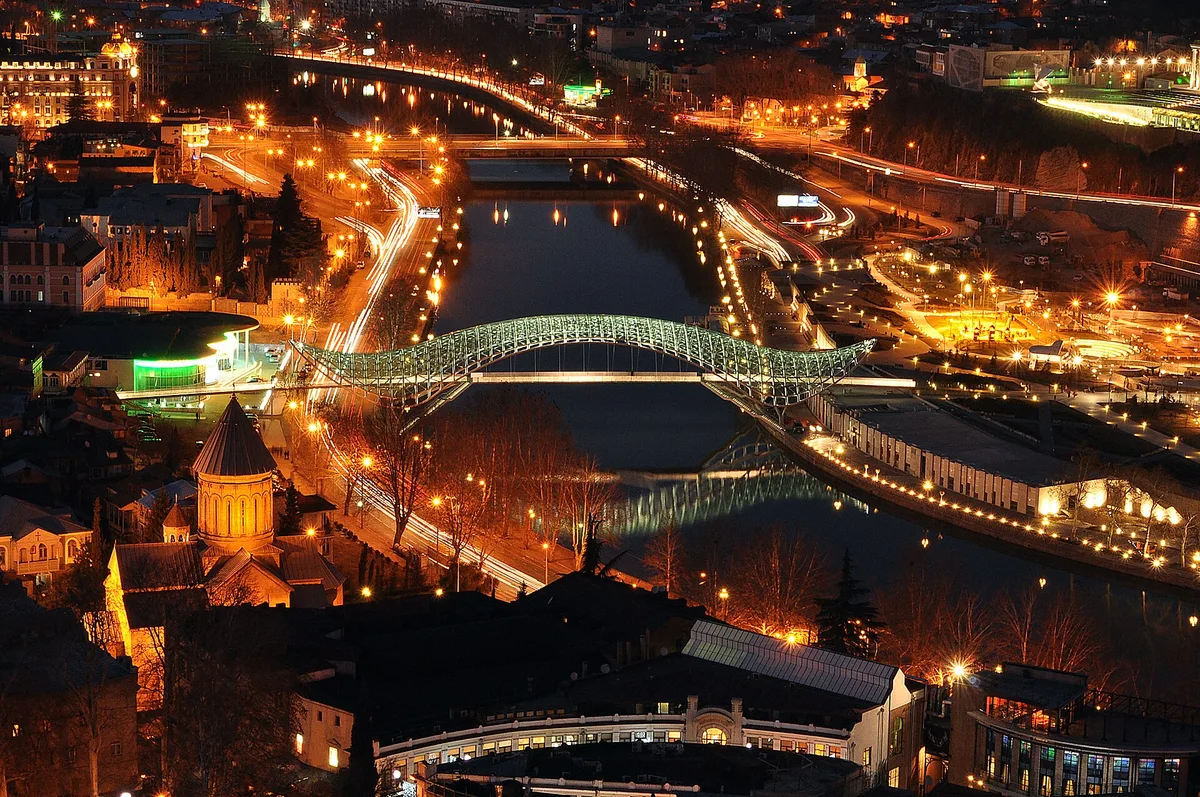
A glass canopy over the Mtkvari
The roof looks like it is still moving. A steel frame curves over the walkway in a long, low wave, and glass panels cover it like scales. Through them you can see the river and the old balconies of Kala on one bank, and the lawns of Rike Park on the other.
The bridge opened in 2010. Italian architect Michele De Lucchi designed it, and French lighting designer Philippe Martinaud did the illumination. Around 150 metres of walkway carry only pedestrians. Underfoot is a timber deck, and glass balustrades run along the edges, so at every point you have a clear view down to the water.
When the lights come on
After dark the bridge looks like a different structure. Thousands of LEDs set into the canopy pulse and ripple along its length. People line up at the railings on both banks to film it, which is why the bridge shows up in so many photos of Tbilisi.
By daylight you see the architecture properly: how the frame twists, and how the glass catches the sun. After dark you get the show. If you only have time for one crossing, go at dusk so you see both. The light changes a lot through the year, so check the local sunset time before you set out.
Getting to either end
You can reach the bridge from two sides, and the choice affects what you see next.
- From the Old Town: walk down from Freedom Square (Liberty Square station, Line 1) along Pushkin Street. Bear left toward the river and Erekle II Street. It takes about 10–15 minutes on foot.
- From Avlabari: get off at Avlabari station (Line 1) and walk downhill through Rike Park. You’ll come to the bridge’s eastern end after around 10 minutes.
- By taxi: Bolt is widely used in Tbilisi. Ask for Rike Park or Erekle II Street and you’ll be dropped a couple of minutes’ walk away.

What sits around it
The bridge makes a good hinge for a half-day loop. From the Rike Park end you can see:
- Rike Park Concert Hall: the two huge metal tubes that dominate the riverbank, a short walk east.
- Narikala cable car: the lower station is in Rike Park. Gondolas climb over the river to Narikala Fortress and the Kartlis Deda (Mother of Georgia) statue.
- Presidential Palace: the glass dome on the hill above Avlabari, best viewed from the middle of the bridge.
- Sameba (Holy Trinity) Cathedral: a steeper walk uphill past Avlabari, its gold dome visible from the deck.
On the Old Town side, Erekle II Street has cafés and wine bars. A few minutes south, Metekhi Church stands on its cliff above the river. Beyond it, the brick domes of the Abanotubani sulphur baths sit at the foot of the fortress hill.
Crossing it without the crush
This is one of the most visited spots in Tbilisi, and the deck is narrow. At sunset and on summer evenings it fills with couples, tour groups and phone tripods, all aiming at the same canopy. Some habits make it easier:
- Keep to the right and keep moving. Step against a balustrade if you want to stop for a photo. Lots of people use the bridge simply to get from one side to the other.
- Shoot from the bank, not the deck. The best shot of the whole lit curve is from the riverside path in Rike Park or from the Old Town embankment. You can’t see the shape from on top.
- Cross early for empty glass. Morning light is flat but the deck is clearer. This follows from how the day runs: the crowds build toward evening.
- Get a Metromoney card. The rechargeable card works on the metro, buses and the Narikala cable car. With one, you skip buying single tickets at the Rike Park station.
- Ignore the hustle. Street vendors and people offering photos work the two ends. A polite “no, thank you” (“ara, madloba”) is enough.
Making the most of an hour
Begin on the Old Town side in late afternoon and walk across slowly. Then take the cable car up to Narikala before the light goes. From the fortress walls you look straight down on the bridge. When the LEDs come on, you can see its full shape against the river.
Walk back down through the old lanes toward Abanotubani and Meidan Square. Then cross the bridge again in the dark. The second crossing usually beats the first: the canopy glows over your head and the hillside churches are floodlit behind it.
Frequently asked questions
Is the Bridge of Peace open at night?
Google currently lists the Bridge of Peace as open 24 hours every day. It's a public footbridge with no gate and no ticket. Evening is when most people come, because that's when the LED lighting runs.
What is the nearest metro station to the Bridge of Peace?
Avlabari (Line 1) is about a 10-minute walk downhill through Rike Park to the eastern end. Liberty Square (Line 1) is about 10–15 minutes on foot to the Old Town end, via Pushkin Street and Erekle II Street.
What is the best time to see the Bridge of Peace?
Dusk. You catch the steel-and-glass canopy in the last daylight and then see the LEDs come on. Sunset times vary a lot through the year, so check them locally. Early morning is better if you want the deck empty for photos.
How long do I need at the Bridge of Peace?
Crossing and taking photos takes 20–30 minutes. Allow two to three hours if you add the Narikala cable car from Rike Park, the fortress, and a walk back through the Old Town to Abanotubani.
What can I see near the Bridge of Peace?
Next to the bridge you'll find Rike Park, the Rike Park Concert Hall, and the Narikala cable car up to Narikala Fortress and the Mother of Georgia statue. Metekhi Church and the Abanotubani sulphur baths are a short walk away. The Presidential Palace and Sameba Cathedral are visible on the hills above Avlabari.
Plan your trip to Tbilisi
Georgia eSIM & staying connected →
Some links above are affiliate links — if you book through them, Wander Atlas earns a small commission at no extra cost to you. It's how we keep every guide free.
Related guides
 attraction
Georgian National Museum: Tbilisi Travel Guide (4.4★)
 attraction
Holy Trinity Cathedral of Tbilisi: Travel Guide (4.8★)
 attraction
Mtatsminda Park: Tbilisi Travel Guide (4.6★)
 hidden gem