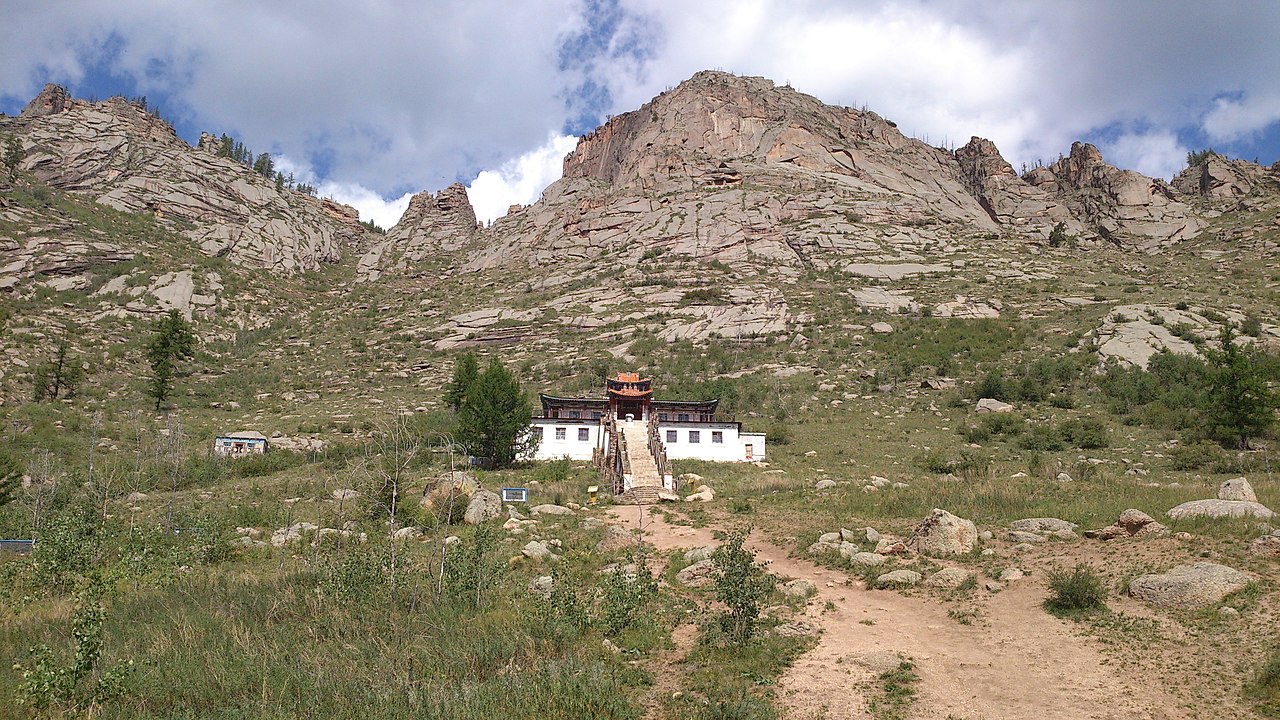
The climb up the elephant’s trunk
Aryapala is built to be approached on foot. The complex is laid out to suggest an elephant’s head against the granite slope, and the long staircase up to it is the trunk. Tradition puts the count at 108 steps, a sacred number in Buddhism.
Before the stairs, a path climbs from the parking area through larch and boulders. Signboards line it, each carrying a Buddhist teaching in Mongolian and English. A wooden suspension bridge crosses a gully partway up. At the top the meditation hall looks out over the Terelj valley, with ger camps scattered across the grassland below.
Getting out from Ulaanbaatar
Terelj is a 1.5–2 hour drive east of the capital. Most of the road is paved through Nalaikh, the district named in the temple’s postal address. Most visitors arrive by hired driver or on a tour from a ger camp. Buses to Terelj village run but are infrequent, and you would still need transport from the village to the temple.
- Park entry: foreign visitors pay a national park fee at the checkpoint on the way in. The current amount is posted there, so keep your passport handy.
- Last stretch: the road passes Turtle Rock (Melkhii Khad), then a short dirt track leads to the trailhead.
- Altitude: the hall stands at around 1,600 m. The stairs feel steeper than they look, so take them slowly.
Inside the hall: temple manners
This is a working meditation centre, not a staged attraction. Visitors move through it the way Mongolians do at any Buddhist site.
- Walk clockwise around the hall, stupas and prayer wheels, and spin the wheels clockwise too.
- Take off your hat inside and keep your voice low. Never point your feet at the altar.
- Ask before you photograph the interior or the monks. Where photos are not allowed, a sign or a nod will tell you.
- Leave offerings in the donation box, not on the altar itself.
- Cover your shoulders and knees. Wind at the summit cuts through thin layers even in July.
Because Aryapala sees far fewer visitors than Turtle Rock just down the road, there are often stretches when you have the upper terrace almost to yourself. Morning visits usually miss the day-trip vans, which tend to stop at the rock first.
Fitting it into a Terelj day
Two hours covers the climb, the hall and the slow walk back down. That leaves time for the rest of the park in a single day trip. Pair it with:
- Turtle Rock: the park’s best-known granite formation, a few minutes’ drive back toward the main road.
- Horse riding or a ger camp lunch: camps along the Tuul River valley rent horses by the hour.
- Chinggis Khaan Equestrian Statue: the giant steel statue at Tsonjin Boldog, a sensible stop on the drive back to Ulaanbaatar.
From June to September the trails are dry and the valley is green. Winter visits are possible, but expect ice on the steps and temperatures well below freezing. The current 6pm close also means you should reach the trailhead with enough time to climb before the hall shuts.
Frequently asked questions
How do I get to Aryapala Temple from Ulaanbaatar?
Hire a driver or join a Terelj tour. The drive takes 1.5–2 hours east through Nalaikh into Gorkhi-Terelj National Park, past Turtle Rock, then along a short dirt track to the trailhead. Public buses only reach Terelj village.
What are the opening hours?
At the moment it opens 9am–6pm every day. Temple hours can shift through the year and on holidays, so confirm with your driver or camp before setting out.
How hard is the walk up?
It is a moderate uphill path followed by a long staircase, traditionally 108 steps, at around 1,600 m. Most reasonably fit visitors do it in 20–30 minutes at an easy pace.
How long should I spend there?
Allow 1–2 hours for the climb, the meditation hall and the terrace views. Add Turtle Rock nearby to make a half-day.
What should I wear?
Wear shoes with grip for the steps and clothes that cover your shoulders and knees. Bring a windproof layer, because the hilltop is exposed even in summer.
Plan your trip to Terelj
Mongolia eSIM & staying connected →
Some links above are affiliate links — if you book through them, Wander Atlas earns a small commission at no extra cost to you. It's how we keep every guide free.
Related guides
 attraction
 Choijin Lama Temple Museum: Ulaanbaatar Travel Guide (4.4★)
 attraction
 Sükhbaatar Square: Ulaanbaatar Travel Guide (4.6★)
 attraction
 Chinggis Khaan National Museum Mongolia: Ulaanbaatar Travel Guide
 attraction