
Painted roofs among the glass towers
On three sides, glass office towers rise high over the compound. In the middle stand low wooden halls with curved, tiled roofs, red pillars and eaves painted in blue, green and gold. The contrast between them is the best introduction to Ulaanbaatar you could ask for.
Choijin Lama Temple Museum is a walled monastery from the early 1900s. It survived a century that destroyed most of the city’s religious buildings. Today it is a museum: a cluster of temple halls around paved courtyards, each holding Buddhist art and ritual objects. It is quieter than its location suggests, and many visitors walk past the gate on their way to the square.
The oracle who lived here
The monastery was built between 1904 and 1908 for Luvsankhaidav, the Choijin Lama. That title means the state oracle. He was the brother of the Bogd Khan, the eighth Jebtsundamba Khutugtu, who was Mongolia’s religious leader and, from 1911, its theocratic monarch. The oracle’s job was to go into trance and speak for protector deities on matters of state.
The complex was closed in 1938, during the purges that destroyed hundreds of monasteries across Mongolia and killed thousands of monks. It survived because it was turned into a museum, which opened in 1942. That is why it looks the way it does now: a sacred complex preserved under glass, with no working community of monks.
Inside the temple halls
The halls are usually counted as five, and each has its own character. The interiors are dim and close, lit mostly from the doorways. The dark wooden floors are worn smooth.
Look out for:
- The main temple, with large gilded figures and the embalmed remains of Baldan Choimbol, the Choijin Lama’s teacher, set among the statues.
- Gilt bronze sculpture in the refined style linked to Zanabazar, Mongolia’s first Bogd and its most celebrated artist.
- Thangka scroll paintings hung along the walls, some of them packed with fine detail.
- Wrathful protector deities in the Yadam temple, a tantric hall that is darker in tone than the others.
The halls are small, so don’t hurry through them. Your eyes need a minute to adjust before the paintings in the corners show up.

Tsam masks and the oracle’s costume
This is the part people remember. Tsam is the masked ritual dance of Mongolian Buddhism, performed to drive out evil and honour the protector deities. The museum’s collection of tsam masks and costumes is among the most important in the country.
The masks are large and heavily built: bulging eyes, crowns of skulls, flaming hair and bared teeth, many of them covered in coral and papier-mâché. Next to them you will usually see ceremonial robes, which give a sense of how huge and theatrical these dances were. For the full picture, see the tsam material alongside the protector figures in the halls. The masks are those same deities brought to life for a dance.
Moving through the halls
Even though it is a museum, the halls are still treated with the courtesy you would show a temple, and copying that is easy:
- Walk clockwise through each hall and around the compound, the direction Mongolians follow at any Buddhist site.
- Take off your hat indoors and keep your voice low. The rooms carry sound.
- Don’t touch the statues, the altar cloths or the painted pillars, many of which are fragile and not behind glass.
- Ask before you take photos. Photography inside the halls has traditionally needed a separate permit. The ticket desk at the entrance will tell you the current rule and price.
Buy your ticket at the gate before you enter the courtyard. Admission prices are posted there. Staff sometimes ask you to start at the main temple and work outward, which keeps the order of the halls clear.
Getting there from Sükhbaatar Square
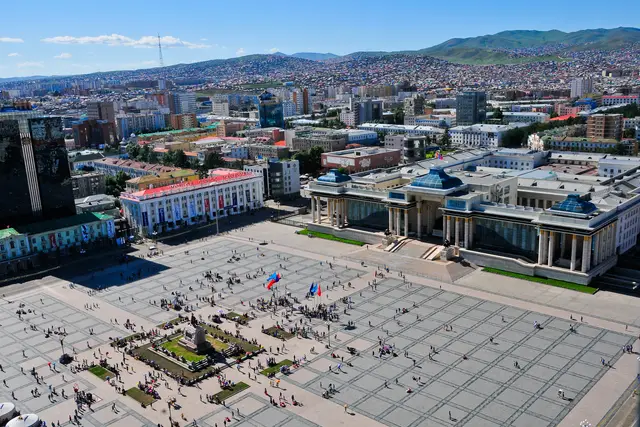
Ulaanbaatar has no metro, and the city centre is best covered on foot. From the southern edge of Sükhbaatar Square, sometimes still called Chinggis Square, walk south for a few minutes to Genden St. The temple’s walled compound is easy to spot because it is the only traditional roofline among the towers.
If you take a taxi, give the driver the name Choijin Lamyn Süm, which locals will recognise. Ulaanbaatar traffic often jams in the late afternoon. If you are coming from farther out, a morning start is easier on your nerves and leaves more of the day for the halls.
It is currently open 9am–6pm every day of the week. Museum hours in Ulaanbaatar can change with the season and on public holidays, so check the official listing before you go, especially in winter.
Pairing it with the rest of the centre
The temple fits neatly into a half-day on foot around the square. A few nearby options:
- National Museum of Mongolia, just northwest of the square, for the broad sweep from the Xiongnu to the nomadic present.
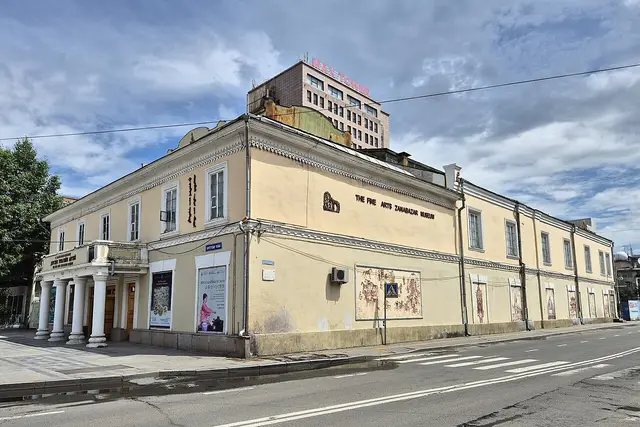
- Zanabazar Museum of Fine Arts, west of the square, which holds more work by the sculptor whose style you just saw in the halls.
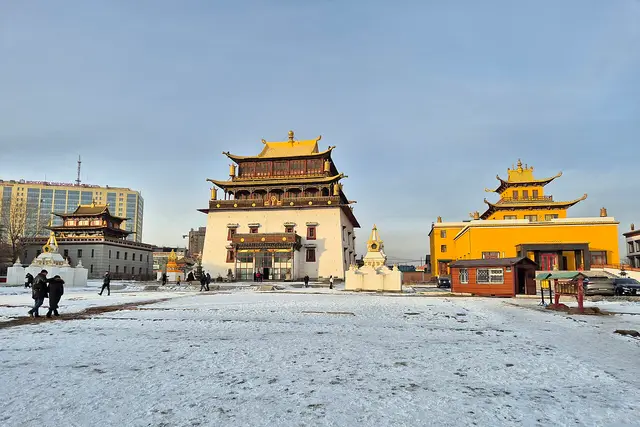
- Gandan Monastery, about two kilometres west, a working monastery with chanting monks. It makes a natural counterpoint to the museum-temple you have just left.
Seeing Choijin Lama first and Gandan second shows what was lost in the purges and what has come back since 1990.
Frequently asked questions
Where is Choijin Lama Temple Museum and how do I get there?
It is on Genden St in the Sükhbaatar district of central Ulaanbaatar, a few minutes' walk south of Sükhbaatar Square. Walking is the easiest way. If you take a taxi, ask for Choijin Lamyn Süm.
How long should I spend there?
About 1–1.5 hours lets you see all the temple halls and the tsam mask collection without rushing. Add the National Museum of Mongolia or the Zanabazar Museum of Fine Arts nearby for a half-day.
What are the opening hours?
At the moment it opens 9am–6pm every day. Hours can change with the season and on holidays, so check the official listing before you go, particularly in winter.
Is it still an active monastery?
No. It was closed in 1938 during the purges and has been a museum since 1942. Behave as you would in a temple anyway: walk clockwise, remove your hat and keep quiet.
Can I take photos inside?
Photography inside the halls has traditionally needed a separate permit. Ask at the ticket desk at the entrance for the current rule. Any price is posted there.
Plan your trip to Ulaanbaatar
Mongolia eSIM & staying connected →
Some links above are affiliate links — if you book through them, Wander Atlas earns a small commission at no extra cost to you. It's how we keep every guide free.
Related guides
 attraction
 Sükhbaatar Square: Ulaanbaatar Travel Guide (4.6★)
 attraction
 Chinggis Khaan National Museum Mongolia: Ulaanbaatar Travel Guide
 attraction
 Gandantegchinlen Monastery: Ulaanbaatar Travel Guide (4.4★)
 hidden gem