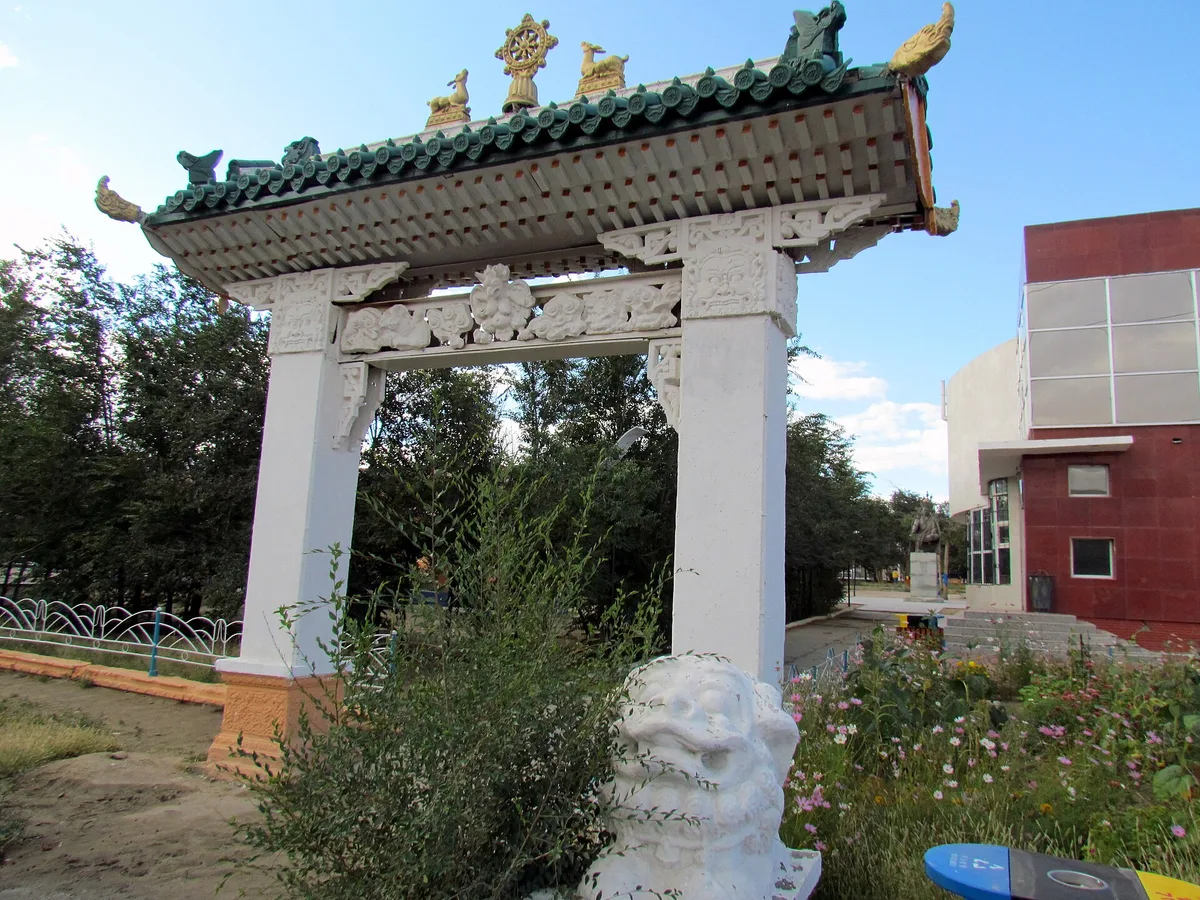
A collection that was once buried
Many objects in this museum spent decades underground. During the anti-religious purges of the late 1930s, the hereditary caretaker family of Khamaryn Khiid monastery packed its treasures into crates and buried them in the desert. The crates were dug up only after the political thaw.
The man these objects belonged to was Dulduitiin Danzanravjaa (1803–1856), the Fifth Noyon Khutagt of the Gobi. He was a lama of the Red Hat lineage, a poet, a composer and a playwright. His opera Moon Cuckoo was staged by touring troupes across the steppe. The museum in Sainshand is where his worldly life survives.
What fills the galleries
Expect a compact display, not a sprawling national collection. The museum is small and seldom crowded, and you can see all of it at an unhurried pace in about an hour. The exhibits centre on Danzanravjaa himself:
- Buddhist scroll paintings and religious statuary linked to his monastery
- Ritual objects used in Khamaryn Khiid’s ceremonies
- Theatre material connected to his touring productions
- Personal items and written works attributed to the lama
Labels are mostly in Mongolian, with limited English. Reading a little about Danzanravjaa before you go helps a lot. A local guide arranged in Sainshand helps even more, because the story behind each crate is half the point.
Getting to Sainshand, not Tsonjin Boldog
Getting the location right matters here. Some listings group this museum under “Tsonjin Boldog”, but the address is Sainshand, Dornogovi. The Tsonjin Boldog statue complex is east of Ulaanbaatar, in the opposite direction.
Sainshand is a stop on the Trans-Mongolian Railway, which runs between Ulaanbaatar and the Chinese border at Zamyn-Üüd. Most visitors take the train from the capital, and many choose the overnight service. A paved road also links Sainshand with Ulaanbaatar for anyone driving or hiring a car. The museum sits within the town itself, so once you arrive it is a short taxi ride or walk.
Timing your visit around the weekend
At the moment the museum is closed on Saturday and Sunday. From Monday to Friday it opens 11am–6pm. Museum hours in Mongolia can change with the season and around holidays such as Naadam and Tsagaan Sar. Ask your guesthouse or check locally before you go.
A weekend arrival is the costly mistake. If your train gets in on a Friday night, you will find the doors locked until Monday. A better order is to arrive midweek, see the museum in the afternoon and head out to Khamaryn Khiid the next morning. The museum opens late, which leaves time for breakfast and a walk through town first.
Late spring and early autumn are kinder months in the Gobi. Summer afternoons are hot and winter is severe, but the galleries are indoors, so the weather mostly matters for the desert trip that follows.
At the ticket desk and in the galleries
These are working sacred objects as well as museum pieces. Treat them that way.
- Pay in tögrög cash. Card acceptance in provincial Mongolia is patchy, so carry small notes. The current entry price is posted at the desk.
- Ask before photographing. Many Mongolian museums restrict photos or charge separately for them. Ask the staff first.
- Walk clockwise around shrines or devotional displays, as you would at any Buddhist site in Mongolia.
- Don’t point your feet at religious images, and don’t touch the displays.
- Ask about the caretaker story. Staff often know it well, and it explains why so much survived when most of the country’s monasteries were destroyed.
The museum is under the radar for international travellers. Visitors can usually get the staff’s attention and ask questions, which bigger institutions rarely allow.
Out to Khamaryn Khiid and the Shambhala site
The museum makes the most sense as the first half of a pair. Danzanravjaa founded Khamaryn Khiid monastery south of Sainshand in the 1820s. It was destroyed in the purges and later partly rebuilt. Nearby is the Shambhala energy centre, a ring of 108 stupas where pilgrims lie on the ground to absorb what they believe is the site’s power.
Drivers and tour operators in Sainshand run trips out across the gravel plain. Seeing the objects first gives the empty monastery grounds their meaning: you will have just seen the paintings and costumes that once filled those halls.
Frequently asked questions
Is the Danzanravjaa Museum at Tsonjin Boldog?
No. Its address is Sainshand, the capital of Dornogovi province in the eastern Gobi. The Tsonjin Boldog Genghis Khan statue is east of Ulaanbaatar, in a different direction.
How do I get to Sainshand?
Most visitors take the Trans-Mongolian Railway from Ulaanbaatar, often on the overnight train. There is also a paved road. Once in town, the museum is a short walk or taxi ride.
When is the museum open?
Currently Monday to Friday, 11am–6pm, closed Saturday and Sunday. Hours can change with the season and around holidays, so confirm locally before you go.
How long should I spend there?
About an hour covers the collection. Allow a full extra day to visit Khamaryn Khiid monastery and the Shambhala site south of town.
Can I take photos inside?
Ask at the desk first. Photography is often restricted or charged separately in Mongolian museums, and the rules can change.
Plan your trip to Tsonjin Boldog
Mongolia eSIM & staying connected →
Some links above are affiliate links — if you book through them, Wander Atlas earns a small commission at no extra cost to you. It's how we keep every guide free.
Related guides
 attraction
 Aryapala Temple Meditation Center: Terelj Travel Guide
 attraction
 Choijin Lama Temple Museum: Ulaanbaatar Travel Guide (4.4★)
 attraction
 Sükhbaatar Square: Ulaanbaatar Travel Guide (4.6★)
 attraction