A regional archive behind fortress walls
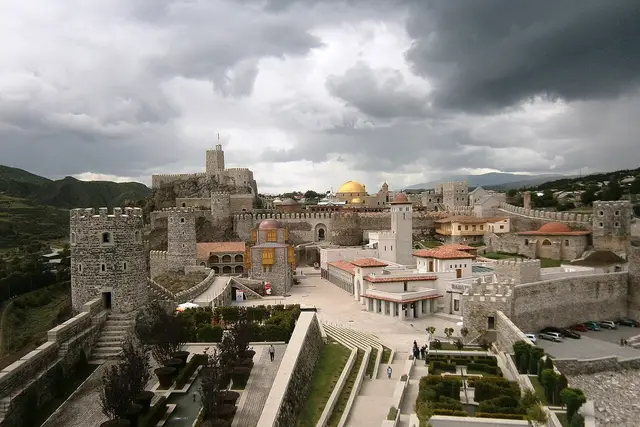
Most people climb to Rabati for the golden mosque dome and the ramparts. Fewer walk into the museum building inside the walls, and that is their loss. It holds the story of Samtskhe-Javakheti, the upland province on Georgia’s border with Turkey and Armenia. Here that story is told in stone, clay and metal rather than on information boards.
The setting does half the work. Rabati was restored on a large scale in the early 2010s. Today the complex is a mix of pale stone walls, a citadel, a madrasa, a minaret and the domed Ahmed Pasha mosque, all on a hill above the Potskhovi River. The museum puts the objects back into that landscape. You step out of a gallery and the buildings it describes are right in front of you.
The Jakeli lords and the Pashas: two empires on one hill
This section is the reason to come. Akhaltsikhe was the seat of the Jakeli family, the atabegs who ruled Samtskhe in the late medieval period. From the 16th century the town came under Ottoman control. It stayed Ottoman until the Russian army took it in 1828.
That layering explains the hilltop. A Georgian fortress town became a pasha’s capital and then a Russian garrison, and each power left buildings behind. The museum helps you read them in order. Go through it first and the mosque, the madrasa and the citadel make sense as chapters, not as a jumble of styles.
What you’ll find in the galleries
The collection runs roughly in chronological order, from the region’s earliest settlements onward. Look out for these:
- Archaeological finds: pottery and metalwork from the Bronze Age and later periods, dug up across the Samtskhe and Javakheti uplands.
- Carved stone: reliefs, steles and architectural fragments from churches and settlements in the province.
- Medieval material: objects from the Jakeli era, when Samtskhe was a semi-independent principality.
- Ottoman-period pieces: arms and everyday objects from the centuries when Akhaltsikhe was a pashalik.
- Ethnography: costume and household items from the area’s Georgian, Armenian and other communities.
Labelling and translation can be uneven in regional Georgian museums. A little background reading before you go, or a translation app on your phone, pays off. Displays get swapped and loaned out, so treat this list as a guide to the themes, not a promise of particular pieces.
Timing your visit around the castle
There is one rule to remember: Mondays are out. At the moment the museum is closed on Monday and open 10am–6pm every other day. Museum hours in Georgia can shift with the season and on public holidays. Check the official Rabati or museum listing in the week you travel.
The galleries take about an hour, or 90 minutes if you read closely. Add another hour or two for the ramparts, the mosque courtyard and the citadel. Do the museum first, while you are fresh, then climb the walls. The views from the ramparts over the town and river make a good finish.
The museum is still under the radar compared with the castle itself. Rabati draws day-trippers, and tour groups tend to head straight for the photogenic parts of the complex. That often leaves the galleries quieter than the courtyard outside.
Getting in and getting around Rabati
These habits make the visit easier:
- Buy tickets at the complex. Rabati has its own ticket point, and access to the museum may be sold separately from the castle grounds. Prices are posted at the ticket office, so check there.
- Ask before photographing. Rules on photos inside regional museums vary, and staff will tell you. A nod toward your camera and a raised eyebrow works in any language.
- Learn two words. Gamarjoba (hello) and madloba (thank you) go a long way. Older staff may speak Russian more readily than English.
- Dress for the mosque. If you go on to the Ahmed Pasha mosque, covered shoulders and knees are the respectful choice.
- Watch your step on the walls. The restored ramparts have steep stone stairs and uneven surfaces. Shoes with grip matter more here than in the galleries.
The museum’s Georgian name includes muzeumi, which is easy to recognise on signs. Ask for the “Rabati museum” and anyone in town will point you uphill.
Reaching Akhaltsikhe
Akhaltsikhe is the main town of Samtskhe-Javakheti and a natural base for the region. Marshrutkas (shared minibuses) run from Tbilisi’s Didube bus station, and the trip takes around three to four hours. Most visitors come via Borjomi, which is less than an hour’s drive to the north-east.
In town, Rabati sits on raised ground on the south bank of the Potskhovi. From the centre you can walk there, or take a short taxi ride if you are carrying bags. The address on maps is JXRG+V9V. Typing “Rabati Castle” into a map app is usually quicker.
Building a day around it
The museum works best as part of a wider loop. With a car or a hired driver, a good order is:
- Morning: the Samtskhe-Javakheti History Museum, then the Rabati walls and mosque.
- Afternoon: Sapara Monastery, a short drive out of town in a wooded gorge, with frescoed churches linked to the Jakeli family.
- Next day: Vardzia, the 12th-century cave monastery tied to Queen Tamar, roughly an hour and a half south along the Mtkvari valley.
Seeing the museum before Vardzia and Sapara gives you the political background to both. You will know whose land you are driving through and who paid for the frescoes.
Frequently asked questions
Where exactly is the Samtskhe-Javakheti History Museum?
It is inside the Rabati Castle complex in Akhaltsikhe, on raised ground above the Potskhovi River. The map address is JXRG+V9V, but searching for Rabati Castle is the easiest way to find it.
Is the museum open on Mondays?
No. At the moment it is closed on Monday and open Tuesday to Sunday, 10am–6pm. Hours can change with the season and on holidays, so check the official listing before you go.
How long should I spend there?
Plan on about an hour for the galleries, or up to 90 minutes if you read closely. Add another one to two hours for the rest of Rabati: the ramparts, the citadel and the Ahmed Pasha mosque courtyard.
How do I get to Akhaltsikhe from Tbilisi?
Marshrutkas leave from Didube bus station in Tbilisi and take roughly three to four hours. Many travellers stop in Borjomi on the way, which is less than an hour from Akhaltsikhe.
What else is nearby?
Inside the complex there are the Rabati walls, citadel and mosque. Sapara Monastery is a short drive out of town. Vardzia's cave monastery is about an hour and a half south and makes an easy day trip from Akhaltsikhe.
Plan your trip to Akhaltsikhe
Georgia eSIM & staying connected →
Some links above are affiliate links — if you book through them, Wander Atlas earns a small commission at no extra cost to you. It's how we keep every guide free.