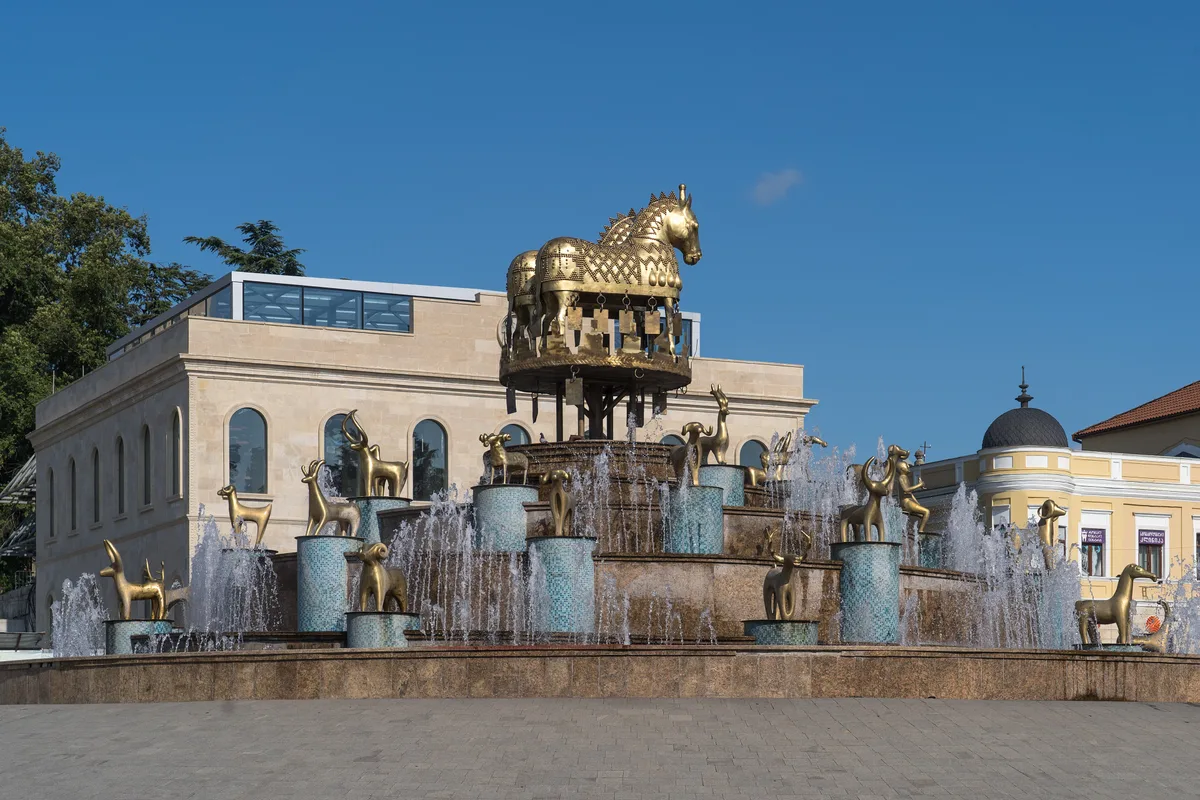
Gold Figures on a Traffic Circle
Kutaisi’s main square is built around a lot of gold. The Colchis Fountain fills the centre of David the Builder Square (Davit Aghmashenebeli Square), and cars loop around it. Gilded animals and human figures stand on tiered stone rims above the basins, each one an enlarged copy of a small Colchian artefact.
Most of the originals came out of the ground at Vani, the ancient Colchian city west of Kutaisi. The local metalwork is the reason Greek myth sent Jason and the Argonauts here for the Golden Fleece. Kutaisi is often linked with Aia, the legendary capital of Colchis, and the fountain makes that link in metal.
Reading the Statues
Walk all the way round before taking photos. The figures face in different directions, and each side shows a different group.
- Animals: horses, bulls and birds copied from bronze and gold pieces.
- Human figures: small votive-style forms, scaled up far past their real size.
- Details: the stylised manes and horns are where the ancient designs show most clearly.
If you want to see the real pieces, the Vani Archaeological Museum holds finds from the site. Georgian gold is also on show in the treasury of the Georgian National Museum in Tbilisi. Once you’ve seen the tiny originals, the giant copies make more sense.
Getting Around the Square
The fountain is the natural starting point for a walk around central Kutaisi. These are all close on foot:
- Lado Meskhishvili State Drama Theatre, facing the square.
- White Bridge over the Rioni River, a short walk downhill.
- Green Bazaar, the central market, a few blocks away.
- Bagrati Cathedral, on the hill across the river. It’s a steep walk, or a short taxi ride.
From David the Builder Kutaisi International Airport, about 20 km west, airport buses and taxis run to the centre. Ask for the fountain or “Shadrevani” and drivers will know where to go. Fifteen to twenty minutes at the fountain is plenty. Allow half a day if you’re continuing to Bagrati and the market.
Crossing to the Kolkhetis Shadrevani
In Georgian it’s the Kolkhetis Shadrevani (კოლხეთის შადრევანი). Most locals just call it “the fountain”, and it’s the usual place to meet in town.
- Use the marked crossings. Traffic circles the square all the time and doesn’t always slow down for people walking.
- Stay off the rims. The statues are public art, not climbing frames, and the stone gets slippery when wet.
- Ride-hailing works. Bolt runs in Kutaisi and saves you haggling over a taxi fare.
- Pay for coffee by card. Cafés around the square usually take cards. Keep some lari in cash for the Green Bazaar stalls.
The square is listed as open 24 hours, but the water may be switched off for maintenance or in the colder months. If you’ve come for the fountains running, check local listings before you go. This is one of the best-known stops in town, so tour groups pass through. Early morning is the easiest time to get photos of the gold with nobody in front of it.
Frequently asked questions
Where exactly is the Colchis Fountain in Kutaisi?
It's in the centre of David the Builder Square (Davit Aghmashenebeli Square), opposite the Meskhishvili Drama Theatre. The White Bridge and the Green Bazaar are a few minutes' walk away.
Is the Colchis Fountain open at night?
The square is listed as open 24 hours and is public space, so you can visit at any hour. The water may be switched off in the colder months or for maintenance.
What do the gold statues represent?
They're enlarged copies of ancient Colchian artefacts, mostly from the Vani archaeological site. They refer to the region's metalwork and the Golden Fleece myth.
How long should I spend there?
Fifteen to twenty minutes is enough for the fountain itself. Allow half a day if you're adding the White Bridge, the Green Bazaar and Bagrati Cathedral.
How do I get there from Kutaisi airport?
The airport is about 20 km west of the centre. Airport buses, taxis and Bolt all run into town. Ask for the fountain, or 'Shadrevani'.
Plan your trip to Kutaisi
Georgia eSIM & staying connected →
Some links above are affiliate links — if you book through them, Wander Atlas earns a small commission at no extra cost to you. It's how we keep every guide free.
Related guides
 attraction
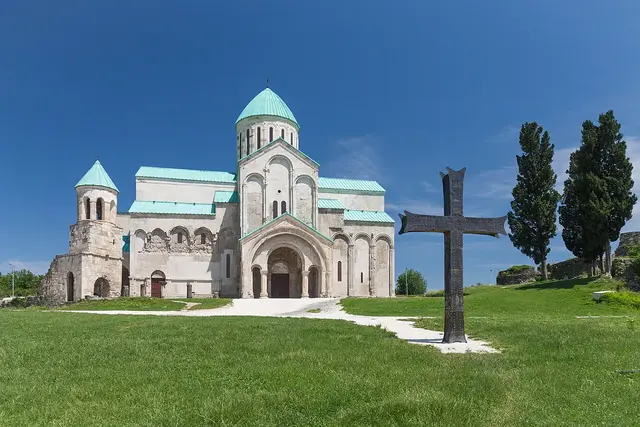
Bagrati Cathedral: Kutaisi Travel Guide (4.7★)
 attraction
Prometheus Cave Natural Monument: Tskaltubo Travel Guide
 attraction
Akhaltsikhe (Rabati) Castle: Travel Guide (4.7★)
 attraction