
A prayer hall that outlived its congregation
Most people come to Akhaltsikhe for the castle. They photograph the gilded dome of Rabati, eat lunch, and drive on to Vardzia. Very few go looking for the synagogue, and that’s the reason to go.
You’re visiting one of the oldest surviving markers of Georgian Jewish life in the south of the country. The building is small, and visitors who make the trip rate it consistently well. Its significance comes from what used to surround it, so it pays to know that story before you get there.
The town’s Jewish story, briefly
Jews lived in Akhaltsikhe for centuries. They were part of a trading town on the old frontier between the Georgian kingdoms and the Ottoman world. For a long time the community was one of the largest in Georgia, with its own streets, merchants and houses of prayer.
During the twentieth century, and especially from the 1970s onward, most Georgian Jews emigrated to Israel. Akhaltsikhe’s community shrank to a handful of families. The synagogue survived when much of that world didn’t, which is why it’s worth a detour even though it takes so little time.
Before you go, it helps to read a little about Georgian Jews. Their traditions are distinct from Ashkenazi ones, and they lived alongside Georgian Christians for well over a thousand years. Knowing that turns a quiet room into something you can actually read.
What “open 24 hours” really means here
Google currently shows the synagogue as open 24 hours, every day of this week. Treat that as a description of the site, not a promise about the door.
Small synagogues in towns with tiny congregations are usually kept locked. Someone from the community or a nearby neighbour typically holds the key. In practice:
- You can usually see the exterior and the street at any reasonable hour.
- To get inside, you may need to ask nearby or wait for whoever looks after the building.
- Late-night visits are pointless. You won’t see anything, and you’ll be in a residential area.
Go in daylight, and give yourself some slack in your schedule. Your hotel or guesthouse in Akhaltsikhe can often tell you who to ask, and that works better than knocking on random doors.
Getting to Akhaltsikhe and finding the building
Akhaltsikhe is in southwest Georgia, about three to four hours’ drive from Tbilisi. Shared minibuses (marshrutkas) run from Tbilisi’s Didube bus station. There are also connections via Borjomi, which is roughly an hour away by road.
The synagogue’s address is a plus code: JXVJ+X4G, Akhaltsikhe. Type it straight into Google Maps rather than relying on a street name. Signage in the old part of town is sparse and mostly in Georgian.
Akhaltsikhe is compact. If you’re already in town for Rabati, a short taxi ride or a walk will get you there. Taxis in Georgian towns are cheap by most visitors’ standards, and drivers know the old quarter. Agree on the fare before you set off, or use a ride app if one is working locally.
Entering a house of prayer, the right way
This is a religious building first and a sight second. A few habits will make your visit easier and more welcome:
- Dress modestly. Cover your shoulders and knees. Men should expect to cover their heads inside, and a kippah is often offered at the door.
- Respect Shabbat. From sunset on Friday to nightfall on Saturday, don’t expect a tour, and don’t photograph anyone at prayer. The same goes for Jewish holidays.
- Ask before photographing the interior, especially the Torah ark.
- Leave a donation if someone opens the building for you. Upkeep falls on very few people. A donation box or a direct offer is normal, and there’s no set amount.
- A few words of Georgian help. Gamarjoba (hello) and madloba (thank you) go a long way with whoever holds the key. Russian is also widely understood by older residents.
Don’t treat the caretaker as staff. If someone has come out to open the door, they’re doing you a favour. Let them set the pace, and listen if they want to tell you about the families who once worshipped here.
Pairing it with Rabati and the road south
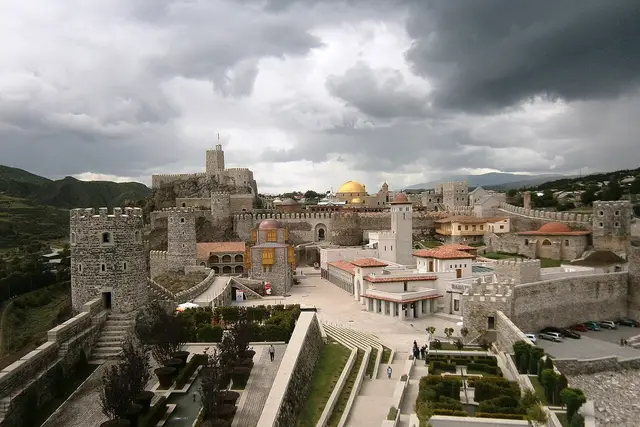
The synagogue fits easily into a day you’d already spend in Akhaltsikhe. Rabati Castle is the obvious companion. It’s a heavily restored fortress complex that holds a mosque, a church, a minaret and a museum, and it tells the town’s mixed history, the same history the synagogue belongs to.
From there, the classic onward routes are:
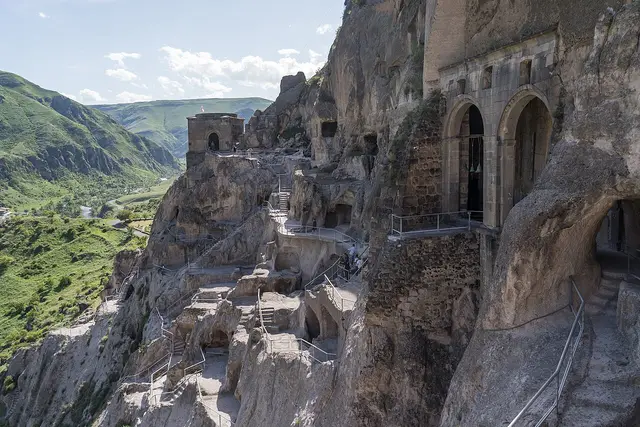
- Vardzia, the twelfth-century cave monastery carved into a cliff above the Mtkvari River, roughly 60 km south.
- Sapara Monastery, a quieter monastic complex in the hills a short drive from town.
- Borjomi, the spa town known for its mineral water, on the way back toward Tbilisi.
A sensible plan is to see Rabati first, then spend 20–40 minutes at the synagogue. That leaves Vardzia for the afternoon or the next morning.
When it suits the trip best
Late spring through early autumn is the easiest time to visit this region. Roads to Vardzia and the mountain villages are clear, and days are long enough to fit everything in.
In winter, Samtskhe-Javakheti gets cold and snowy. The synagogue itself is a short stop and isn’t affected much, but daylight is limited. Weekday daytimes are the most reliable for finding someone who can open the building. Avoid Friday evenings and Saturdays, when it’s reserved for its original purpose.
Frequently asked questions
Is the Akhaltsikhe Synagogue really open 24 hours?
Google currently lists it as open 24 hours, but that mainly reflects access to the site. The prayer hall is often locked, so go in daylight and be ready to ask nearby or through your guesthouse for whoever holds the key.
How do I get to the synagogue from Tbilisi?
Take a marshrutka from Tbilisi's Didube bus station to Akhaltsikhe, a trip of about three to four hours. Then enter the plus code JXVJ+X4G into Google Maps, and walk or take a short taxi ride into the old part of town.
How long should I spend there?
Plan on 20–40 minutes, plus some waiting time if you need to find someone to open the building. It pairs easily with Rabati Castle on the same day.
Can I visit on Saturday?
Avoid Friday evening through Saturday nightfall, and Jewish holidays too. That's Shabbat, when the building is used for worship and tours or photography aren't appropriate. Weekday daytimes work best.
What else is nearby?
Rabati Castle is in town. The Vardzia cave monastery is about 60 km south, Sapara Monastery is a short drive into the hills, and the spa town of Borjomi is about an hour away on the road back to Tbilisi.
Plan your trip to Akhaltsikhe
Georgia eSIM & staying connected →
Some links above are affiliate links — if you book through them, Wander Atlas earns a small commission at no extra cost to you. It's how we keep every guide free.
Related guides
 attraction
Akhaltsikhe (Rabati) Castle: Travel Guide (4.7★)
 attraction
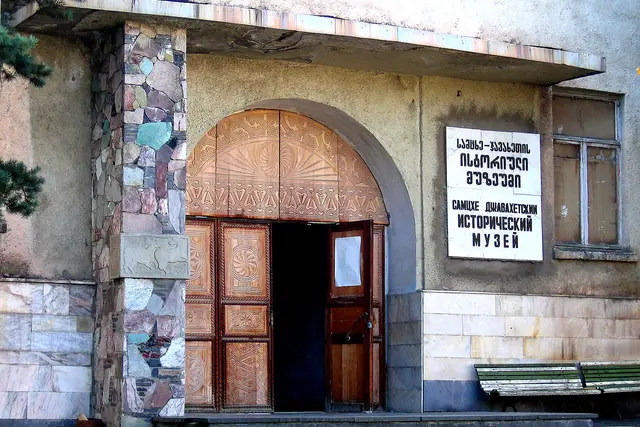
Samtskhe-Javakheti History Museum: Akhaltsikhe Travel Guide
 attraction
Vardzia: Akhaltsikhe Travel Guide (4.8★)
 hidden gem