Ten days on Gezira Island
For ten days in November, film takes over the Cairo Opera House grounds. The complex sits on Gezira Island in the middle of the Nile. The water runs on both sides, and the lattice of Cairo Tower stands just to the north.
The Opera House itself is a white building with domes, finished in 1988 with Japanese support. It replaced the old Khedivial Opera House, which burned down in 1971. During the festival its courtyards and halls hold screenings, panels and red-carpet arrivals. Ticket holders queue at the hall doors while the traffic on the Qasr al-Nil Bridge carries on just beyond the gates.
The 47th edition: dates and setting
The Cairo International Film Festival runs from November 11 to November 20, 2026. This is its 47th edition. The festival began in 1976, which makes it Egypt’s oldest film festival and one of the longest-running in the Arab world.
It is also the region’s most prestigious. Cairo holds accreditation from FIAPF, the international federation of film producers, as a competitive feature film festival. That puts it in the same category as Cannes, Berlin and Venice, and for decades it was the only Arab or African festival with that status.
This edition is held at the Cairo Opera House. The organiser publishes the full programme, daily screening schedule and ticket details on the festival’s official website.
The Golden Pyramid race
Every edition builds towards the Golden Pyramid, the festival’s top prize. It goes to the best film in the International Competition. Around the main race sit sections that give the festival its regional character:
- International Competition: the main slate, in the running for the Golden Pyramid
- Horizons of Arab Cinema: new feature work from across the Arab world
- Critics’ Week: first and second features, often the riskiest titles in the programme
- Cairo Film Connection: the industry platform, where Arab projects in development meet producers and funders
For international visitors, Horizons of Arab Cinema is the section that is hardest to find anywhere else. Many of these films reach European or North American screens much later, if they reach them at all. Screenings usually carry subtitles, and directors often stay for a Q&A afterwards.
Getting a seat in the Main Hall
How you get in depends on which night it is. The opening and closing ceremonies are formal invitation affairs, with a red carpet and Egyptian film stars in evening wear. Ordinary daytime and evening screenings work much more like a public cinema.
What regular festival-goers usually do:
- Pick screenings from the published schedule and get tickets through the channels the festival lists, since popular premieres fill the larger halls.
- Get to the gate with time to spare. The Opera House grounds have security screening and bag checks at the entrance, and lines build before big premieres.
- Dress a step up for the Main Hall. The Opera House is known for a smart dress code at its formal performances. Daytime screenings are more relaxed, but gala nights are not.
- Stay for the Q&A. Audiences in Cairo talk back to filmmakers in a mix of Arabic and English. These sessions are often the liveliest part of the day.
Phones go fully silent inside, and ushers do enforce it. Greet staff with a simple “salam alaykum” or “shukran” (thank you). It goes a long way at a busy door.
Reaching the Opera House
The metro is the simplest way in. Opera station on Line 2 opens directly beside the Opera House grounds, one stop from Sadat station under Tahrir Square. Sadat is where Line 2 meets Line 1.
On foot from downtown, take the Qasr al-Nil Bridge from Tahrir Square. It is a short walk past the stone lions at the bridge’s eastern end, with the Nile on both sides. From Zamalek, the island’s northern half, it is an easy walk south or a quick taxi.
Ride-hailing apps are widely used in Cairo and save haggling over the fare. Evening traffic across the bridges is heavy, so the metro is often faster around premiere times.
November on the Nile
The dates suit the setting. Mid-November in Cairo usually means warm, dry days and much cooler evenings, so a light jacket earns its place after a late screening. The summer heat is gone and rain is rare.
Between films, the Opera grounds and the area around them reward a wander:
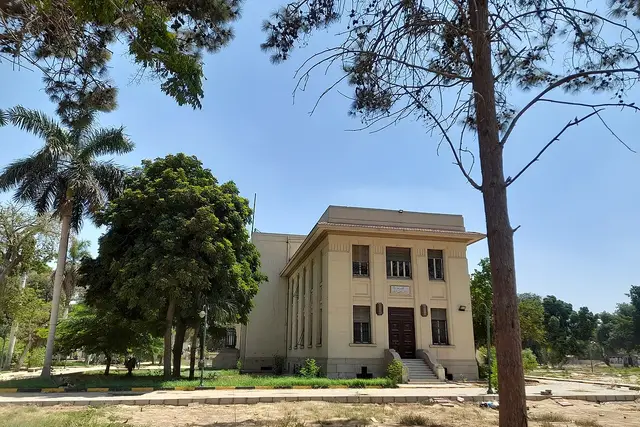
- Museum of Modern Egyptian Art, on the Opera House grounds, for twentieth-century Egyptian painting and sculpture
- Cairo Tower, a short walk north, with a viewing deck over the city and the river
- Zamalek, with tree-lined streets of cafés, galleries and bookshops
- Egyptian Museum on Tahrir Square, across the bridge
After the last screening
Festival nights often run late. Zamalek is the natural place to go afterwards. Its restaurants and cafés stay busy well into the night, and Cairo eats dinner late anyway.
The Nile Corniche on the downtown side fills with families and couples in the evening. Felucca sailboats tie up along the bank, and you can hire one for an hour on the water before or after a screening. Bargaining over the price is normal, and passengers usually agree the fare before stepping aboard.
Hotels along the Corniche and in Zamalek put festival visitors within walking distance or one metro stop of the Opera House. With ten days of programming, many visitors build a few days of screenings into a longer stay. The Giza pyramids and Islamic Cairo are a taxi ride away.
Frequently asked questions
When is the Cairo International Film Festival 2026?
The 47th edition runs from November 11 to November 20, 2026. The organiser publishes the daily screening schedule on the festival's official website.
Where is the festival held?
At the Cairo Opera House on Gezira Island, in the Nile between downtown Cairo and Zamalek. Opera station on Metro Line 2 opens beside the grounds.
Can international visitors attend screenings?
Yes. Regular screenings are open to the public, and films usually carry subtitles. The opening and closing ceremonies are formal invitation events. The festival lists ticket details on its official site.
What is the Golden Pyramid?
It is the festival's top award, given to the best film in the International Competition. Other sections include Horizons of Arab Cinema and Critics' Week.
What is there to do near the Opera House between films?
The Museum of Modern Egyptian Art is on the Opera grounds and Cairo Tower is a short walk north. Zamalek's cafés and galleries are close by, and the Egyptian Museum is across the Qasr al-Nil Bridge on Tahrir Square.
Plan your trip to Cairo
Egypt eSIM & staying connected →
Some links above are affiliate links — if you book through them, Wander Atlas earns a small commission at no extra cost to you. It's how we keep every guide free.