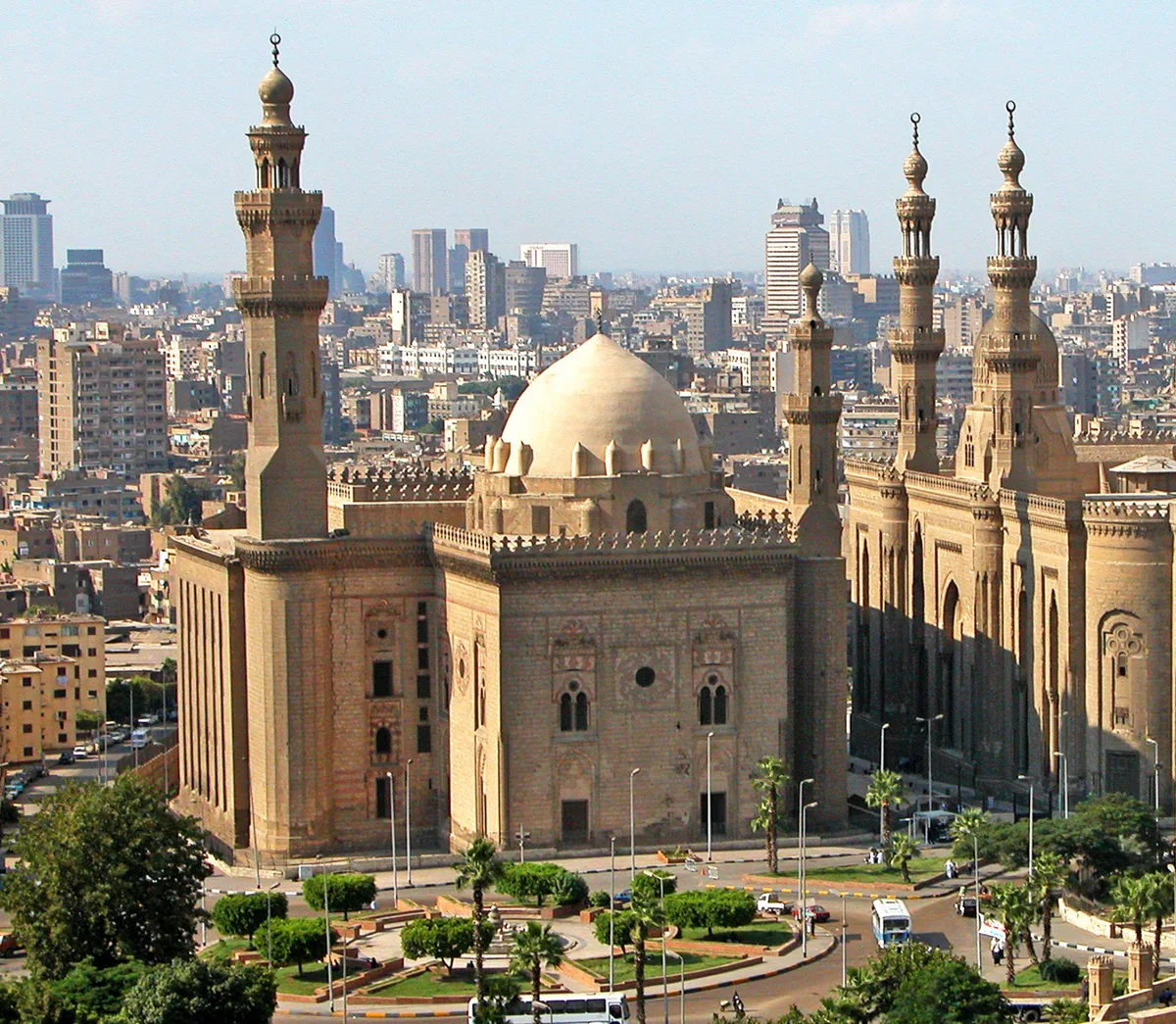
A Stone Cliff Below the Citadel
Look up before you go in. The entrance portal on the north side climbs close to 38 metres. Its muqarnas hood drips stone like honeycomb, and parts of its carving stop half-finished, outlines scratched into blocks that were never cut.
Sultan an-Nasir Hasan began the building in 1356. It was still unfinished when he was assassinated in 1361. Over six centuries later it remains one of the largest mosques of the Mamluk era, and what it lacks in finish it makes up in sheer mass.
Inside the Four Iwans
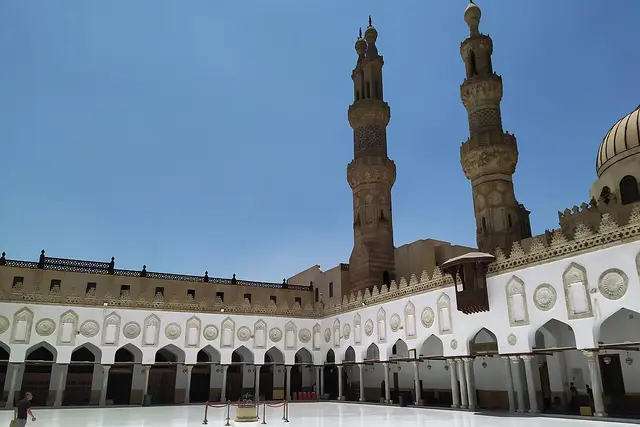
A dim, angled corridor turns you away from the street. Then you are in the open courtyard, the sahn, paved in stone and open to the sky. An ablution fountain under a domed canopy sits at its centre.
Four enormous vaulted halls, the iwans, open off each side. Each one housed a teaching school for one of the four Sunni schools of law:
- Shafi’i
- Hanafi
- Maliki
- Hanbali
Behind the iwans, hidden from the courtyard, the madrasas held student cells stacked several storeys high. The cruciform plan is why the building is studied as much as it is prayed in.
The Qibla Iwan and the Empty Tomb
The eastern iwan is the largest. It faces Mecca. Look for the band of Kufic inscription running along its walls and the long chains that once held glass lamps hanging from the vault.
A door beside the mihrab leads into the domed mausoleum. A carved wooden cenotaph sits at its centre. The sultan was never buried here, because his body was never recovered after his murder.
The building carries another scar. A minaret collapsed during construction in 1361 and killed a large number of people. The minarets you see now are not the full set the plan intended.

Getting to Midan Salah al-Din
No metro station is close enough to be useful. The simplest route is a taxi or ride-hailing car to Midan Salah al-Din, also called Midan al-Qal’a. Most drivers know it as the square below the Citadel.
From Downtown or Zamalek, the ride runs through old Islamic Cairo’s traffic. Travel times vary a great deal with the hour. If you come on foot from Bab Zuwayla, walk south along Darb al-Ahmar and Bab al-Wazir. It’s one of the best walks in the historic city.
Entering a Working Mosque
This is a place of prayer first and a monument second. The visit goes smoothly when you treat it that way.
- Dress: cover your shoulders and knees. Women should bring a headscarf. Attendants sometimes lend wraps, but don’t count on it.
- Shoes: expect to take them off or wear the cloth covers handed out at the courtyard threshold.
- Prayer times: visitors are asked to step aside or wait during the five daily prayers. The Friday midday prayer is the longest pause, so Friday mornings are the least predictable time to come.
- Tickets: buy at the kiosk at the entrance. The current price is posted there, and the ticket has commonly covered Al-Rifa’i as well, so ask.
- Attendants: custodians may offer to show you the echo in an iwan or point out details. This is offered in exchange for a tip. A polite “la, shukran” (no, thank you) is fine if you’d rather wander alone.
Google currently lists 9am–5pm. Hours here shift through the year, around Ramadan, and on religious holidays. Arriving soon after opening usually beats the tour groups that work the Citadel loop later in the morning.
Across the Square and Up the Hill
Walk out of the portal and Al-Rifa’i Mosque fills your view. It was built between 1869 and 1912 to echo Sultan Hassan’s scale. Inside are the tombs of members of Egypt’s royal family, including King Farouk, and of Mohammad Reza Pahlavi, the last Shah of Iran.
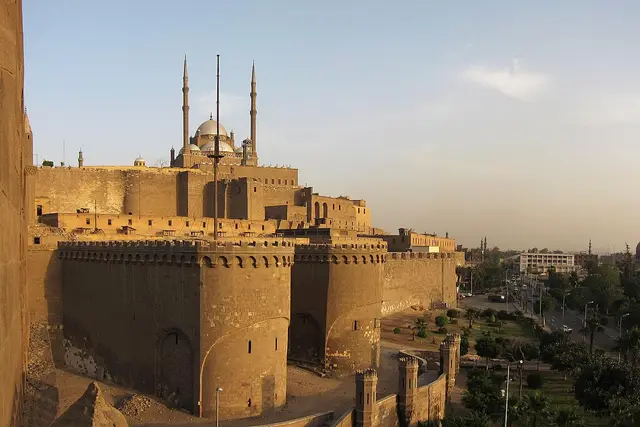
Uphill, the Citadel of Saladin and the Mosque of Muhammad Ali stand on the ridge. From the terraces up there, Sultan Hassan’s dome and minarets sit right below you.
About ten minutes’ walk north, the Blue Mosque of Aqsunqur is named for its blue tilework. Together these make a full morning. Give Sultan Hassan itself an hour, and longer if you want to sit in the courtyard and watch the light move across the iwans.
Frequently asked questions
How do I get to the Mosque-Madrasa of Sultan Hassan?
Take a taxi or ride-hailing car to Midan Salah al-Din (Midan al-Qal'a), the square below the Citadel. No metro station is conveniently close. On foot, you can walk south from Bab Zuwayla along Darb al-Ahmar.
What are the opening hours?
Google currently lists 9am–5pm. Hours change with prayer times, Ramadan and religious holidays, and visitors are asked to pause during prayers, especially the Friday midday prayer. Check before you go.
What should I wear?
Cover your shoulders and knees. Women should bring a headscarf. You will take off your shoes or wear cloth covers before stepping onto the courtyard stone.
How long should I spend there?
About an hour covers the portal, the courtyard, the four iwans and the mausoleum. Add time for Al-Rifa'i Mosque across the square and the Citadel uphill if you want a full morning.
What else is nearby?
Al-Rifa'i Mosque faces it directly, and the Citadel of Saladin with the Mosque of Muhammad Ali is just uphill. The Blue Mosque of Aqsunqur is about ten minutes' walk north along Bab al-Wazir.
Plan your trip to Cairo
Egypt eSIM & staying connected →
Some links above are affiliate links — if you book through them, Wander Atlas earns a small commission at no extra cost to you. It's how we keep every guide free.