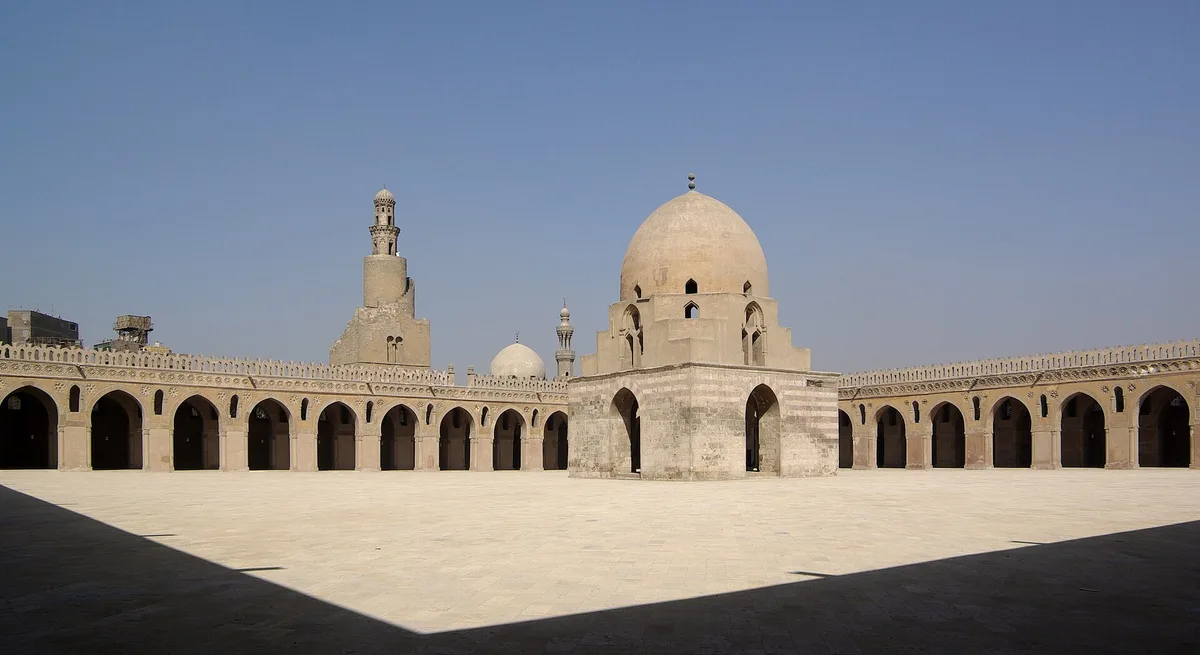
A courtyard you cross in minutes
Step through the gate and the space opens out. A huge square courtyard, paved and open to the sky, is ringed by rows of pointed arches in red brick finished with pale stucco. Your eye goes straight across it to a small domed fountain house in the middle, then up to the minaret beyond the far wall.
Ahmad ibn Tulun, the Abbasid governor of Egypt, built the mosque between 876 and 879. It is the oldest mosque in Cairo that still keeps much of its original form. By ground area it is also one of the largest in the city. The scale is the point: arcades stand five aisles deep on the prayer side, and the courtyard feels close to a public square.
Climbing the minaret
The minaret is the reason most people come. A stair winds around its outside, so you climb up the outer face of the tower and the city falls away below you. Its shape echoes the spiral minaret at Samarra in Iraq, where Ibn Tulun grew up. The tower you climb today dates largely from a Mamluk restoration in the late 13th century.
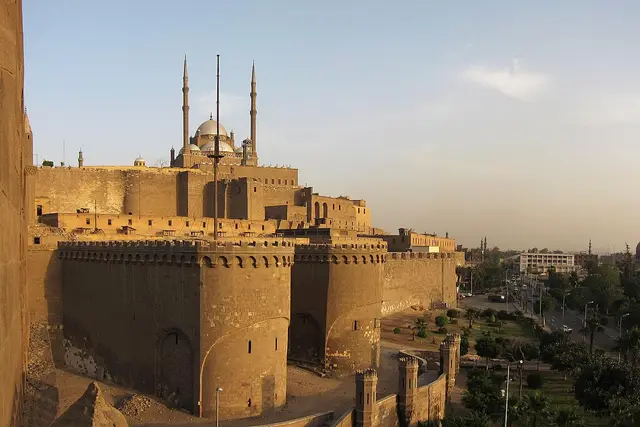
You reach it through the ziyada, the walled outer enclosure that wraps around the mosque. From the top you look across the courtyard toward the Citadel and the domes of Sultan Hassan. On a clear day you can see the edge of the desert. The steps are worn and have no railing in places. Wear shoes with grip and take the turns slowly.
Details at arm’s length
Once you’re back down, walk the arcades slowly. The beauty here is in the small things.
- Stucco ornament: carved bands and rosettes run along the arch edges and soffits. Many are original 9th-century work.
- Window grilles: pierced stucco screens line the outer walls. Each one has a different geometric pattern.
- Wooden frieze: a long band of sycamore wood carved with Qur’anic verses in Kufic script runs under the ceiling.
- The fountain house: Sultan Lajin added the domed ablution fountain at the centre during his restoration in 1296.
Late-afternoon light catches the stucco at a low angle and brings out the carving. The mosque closes at 4pm at present, though, so leave time before the doors shut.

Shoes, scarves and prayer times
This is a working mosque, and the routine at the door is simple once you know it.
- Footwear: attendants at the entrance usually tie cloth covers over your shoes, or ask you to take them off. A small tip for this is customary.
- Dress: cover shoulders and knees. Women should bring a scarf for their hair.
- Prayer: visitors are asked to step back during the five daily prayers. Friday midday prayer is the longest.
- Photography: it is generally fine in the courtyard. Never point a camera at someone who is praying.
The hours Google shows this week are 9am–4pm daily. Mosque visiting hours shift around prayer times, Ramadan and holidays, so check before you go. Getting there close to 9am usually means you share the minaret with fewer people, because tour groups tend to fit Ibn Tulun around the Citadel.
Reaching Ibn Tulun
The mosque stands on Ahmed Ibn Tolon Square in Sayyida Zeinab. The nearest metro stop is Sayeda Zeinab on Line 1. From there it is roughly a 20-minute walk east through busy streets. Most visitors take a taxi or ride-hailing car and ask for “Gami’ Ibn Tulun”.
From the Citadel or Sultan Hassan it is about a 15-minute walk west along Sharia al-Saliba. That makes it easy to combine with Islamic Cairo’s other big monuments on one morning.
Next door and down the street
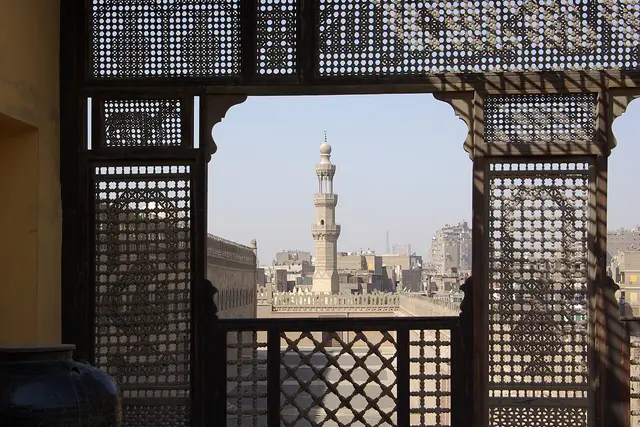
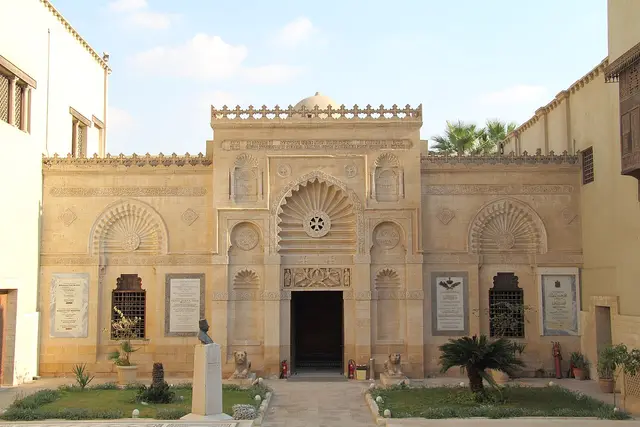
The Gayer-Anderson Museum is built right against the mosque’s outer wall. It is made of two Ottoman-era houses joined together, filled with a British army doctor’s collection. Its mashrabiya screens and rooftop sometimes appear in films, including the James Bond film The Spy Who Loved Me.
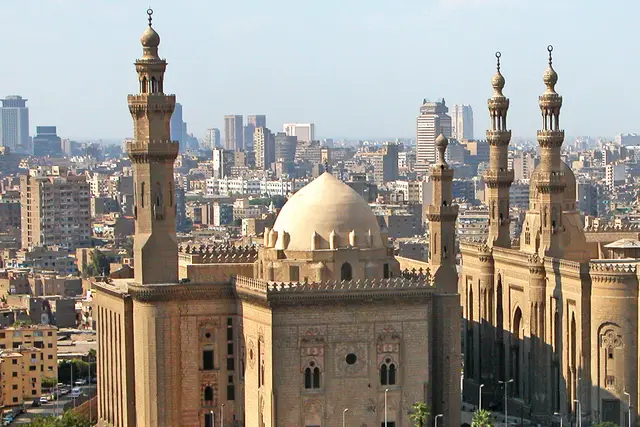
Walk east along Sharia al-Saliba and you pass the Sabil-Kuttab of Qaitbay and the twin complexes of Amir Shaykhu. The street ends at the Mosque-Madrasa of Sultan Hassan and the Al-Rifa’i Mosque, below the walls of the Citadel. Give Ibn Tulun itself 1–2 hours, and allow half a day for the whole stretch.
Frequently asked questions
How do I get to the Mosque of Ibn Tulun?
It is on Ahmed Ibn Tolon Square in Sayyida Zeinab. The nearest metro is Sayeda Zeinab on Line 1, then about a 20-minute walk. A taxi or ride-hailing car is easier. From Sultan Hassan or the Citadel it is roughly a 15-minute walk west along Sharia al-Saliba.
What are the opening hours?
Google currently lists 9am–4pm every day this week. Hours can change around prayer times, Ramadan and holidays, and visitors are asked to step back during Friday midday prayers, so check before you go.
Can you climb the minaret?
Yes. The spiral minaret has an outside staircase reached through the outer enclosure (ziyada). The steps are worn and have no railing in places, so wear shoes with grip.
What should I wear?
Cover your shoulders and knees. Women should bring a scarf to cover their hair. At the entrance, attendants usually tie cloth covers over your shoes or ask you to take them off.
How long should I spend, and what is nearby?
Allow 1–2 hours for the mosque and minaret. The Gayer-Anderson Museum is right next door, and Sharia al-Saliba leads to the Sabil-Kuttab of Qaitbay, Sultan Hassan, Al-Rifa'i and the Citadel.
Plan your trip to Cairo
Egypt eSIM & staying connected →
Some links above are affiliate links — if you book through them, Wander Atlas earns a small commission at no extra cost to you. It's how we keep every guide free.