A temple with its roof still on
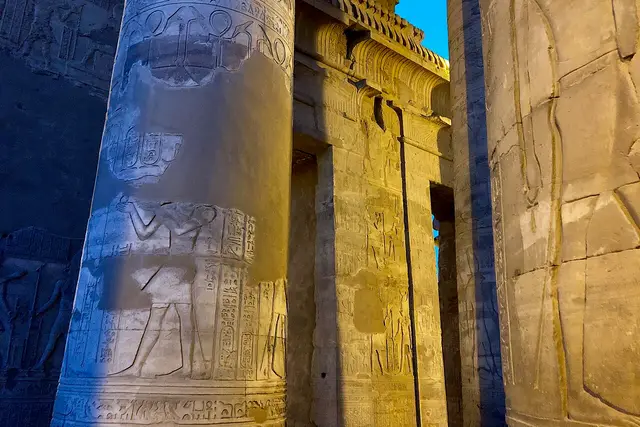
Most Egyptian temples are open to the sky. Edfu keeps its ceilings, so you walk from blazing forecourt into halls that get darker with every doorway. The effect is the one the priests planned: light thins as you near the god.
Building began under Ptolemy III in 237 BC and finished around 57 BC. That makes the Temple of Horus late by pharaonic standards and very well preserved. Drifting desert sand buried it for centuries. Auguste Mariette had it cleared in the 1860s, and the walls came out with their carving crisp.
What to look for, front to back
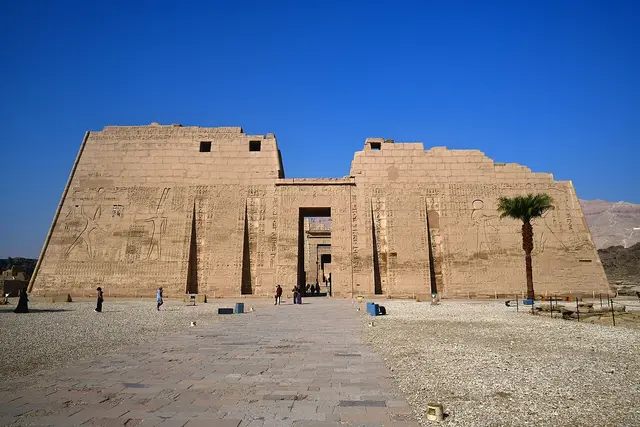
The gateway pylon rises roughly 36 metres. On its face a giant Ptolemy XII smites his enemies while Horus and Hathor watch. Allow 1.5–2 hours to see the rest without rushing:
- The granite falcons. Statues of Horus in his falcon form guard the entrance, and another stands in the courtyard. This is the shot everyone queues for.
- The great courtyard. Columns line three sides. Each capital is carved with a different plant design.
- The hypostyle halls. Smoke still blackens parts of the ceilings, and some faces in the reliefs were hacked away in later centuries.
- The sanctuary. A polished granite shrine from the reign of Nectanebo II sits at the far end, older than the temple around it. A replica of the sacred barque stands in front of it.
- The ambulatory. Follow the passage between the inner temple and the enclosure wall. Reliefs there tell how Horus defeats Seth, who is shown as a tiny hippopotamus.
- The Nilometer and birth house. Both lie off the main axis. Most groups skip them.

Getting to Edfu
Edfu sits on the Nile’s west bank, about 110 km south of Luxor and roughly midway to Aswan. Most visitors come off a Nile cruise, because nearly every Luxor–Aswan boat moors here. From the riverbank, horse-drawn calèches carry people the short distance through town to the temple gate.
Coming independently? Edfu is a common stop on Luxor–Aswan day tours by car. Its railway station is on the east bank, so you’ll need a taxi over the bridge. Tickets are sold at the visitor centre by the entrance, and the current price is posted there.
Beating the cruise crowds
This is one of the busiest sights on the Nile, so timing matters more than anything else. Weekdays are usually quietest from 8am to 10am, and weekends from 9am to 10am. At the moment the gates open at 7am, or 6am on Wednesdays and Sundays. Hours shift through the year, so check the official antiquities site before you go.
- Fix the calèche fare before you climb in. Agree whether it covers waiting time and the ride back.
- Expect baksheesh. Guards may offer to point out a carving or let you into a side chamber, then expect a tip in return. Carry small Egyptian pound notes, or politely say no up front.
- Get the order right. Start at the sanctuary and work outward while groups bunch up in the courtyard. Do the ambulatory last, when the light along the outer wall is softer.
- Cover shoulders and bring water. Shade ends once you leave the halls, and there is little of it in the forecourt.
Frequently asked questions
When is the quietest time to visit Edfu Temple?
Weekdays are typically quietest between 8am and 10am, and weekends between 9am and 10am. Large cruise groups usually fill the courtyard outside those windows.
What are Edfu Temple's opening hours?
At the moment it opens at 7am (6am on Wednesdays and Sundays) and closes at 5pm. Hours shift through the year, so check the official antiquities site for this month's times.
How long do I need at Edfu Temple?
Plan on 1.5–2 hours to see the pylon, courtyard, hypostyle halls, sanctuary and the Horus-and-Seth reliefs in the outer ambulatory.
How do I get to Edfu Temple from the cruise boat?
Horse-drawn calèches wait at the riverbank and take you through town to the temple. Agree the fare, including waiting time and the return trip, before you set off.
Is Edfu worth it if I'm not on a cruise?
Yes. Edfu is about 110 km south of Luxor and is a common stop on day tours by car between Luxor and Aswan, often paired with Kom Ombo.
Plan your trip to Edfu
Egypt eSIM & staying connected →
Some links above are affiliate links — if you book through them, Wander Atlas earns a small commission at no extra cost to you. It's how we keep every guide free.