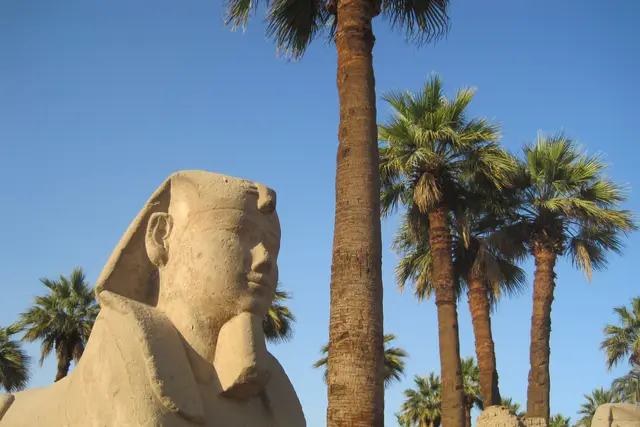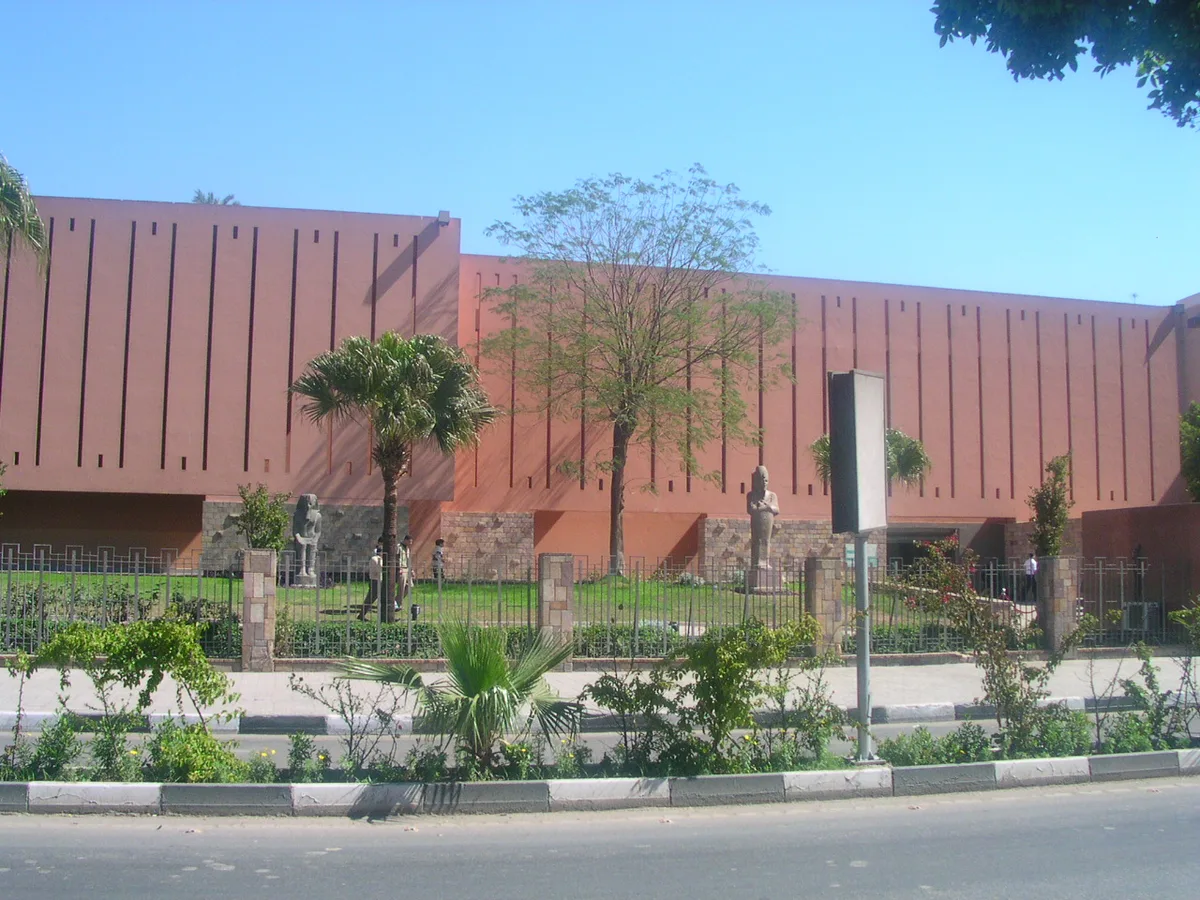
Most of Luxor has you squinting at sandstone in hard sunlight. Luxor Museum turns that around. The halls are kept dark, and each statue stands under its own beam of light, so a pharaoh’s face comes out of the black at eye level, close enough to read the chisel marks.
It’s a small collection by Egyptian standards, and that is the point. Instead of the crowded cases of Cairo, you get a few hundred objects chosen for quality, labelled in English and Arabic, with space around each one.
What the dark halls are holding
The museum opened in 1975 on the Corniche, the riverside road along the Nile’s east bank. The building is low and modern and sits back from the road behind a front garden. Inside, the ground floor and upper gallery lead you through pieces from Theban temples and tombs, from small everyday objects up to colossal sculpture.
A few pieces people come specifically to see:
- Thutmose III in green-black stone, one of the finest royal portraits to survive from the New Kingdom.
- Amenhotep III with the crocodile god Sobek, a double statue carved in pale calcite.
- The reconstructed Akhenaten wall, rebuilt from hundreds of small sandstone blocks (talatat) that were recovered at Karnak, showing the king and Nefertiti’s era in its relaxed, elongated style.
- A small group of objects from Tutankhamun’s tomb, which is a reminder that not everything went to Cairo.
The cachette hall
This room is the reason the museum is on so many Luxor itineraries. In 1989, workers in the court of Luxor Temple found a buried cache of statues. Priests had hidden them there in antiquity, and many were in remarkable condition. The best of them now stand in a dedicated hall here.
The star is a striding statue of Amenhotep III in red quartzite, its surface still crisp. Give this room unhurried time. Afterwards, walk south to Luxor Temple and stand in the court where these figures lay underground for centuries.
Two royal mummies, quietly displayed
A separate hall, added in 2004, holds two royal mummies. One is generally identified as Ahmose I, the king who drove the Hyksos out of Egypt. The other is often attributed to Ramesses I, founder of the dynasty that produced Ramesses II.
The surrounding displays cover the military campaigns of the early New Kingdom, with weapons and related objects. The room is calm and low-lit, and visitors tend to lower their voices without being told. If you’ve already seen the larger mummy galleries in Cairo, this one still feels different because there are only two bodies to look at.

The split-shift day
The museum runs two sessions. At the moment it opens 9am–2pm, closes through the hottest part of the afternoon, and reopens 5pm–8pm. Museum hours in Egypt shift with the season and around holidays, so confirm this month’s times on the official Egyptian antiquities site before you plan around them.
That afternoon gap works in your favour. You can spend a morning on the West Bank tombs, rest through the heat, and visit here once the sun is low. In the evening the Corniche fills with walkers and horse carriages, so an evening visit fits neatly before dinner by the river.
Weekends are the exception. BestTime’s forecast flags weekend 11am–2pm and 5pm–8pm as the busiest stretches, which covers most of both sessions. On a Saturday or Sunday, aim for the first couple of hours after the 9am opening, before that busy window starts.
Getting there along the Corniche
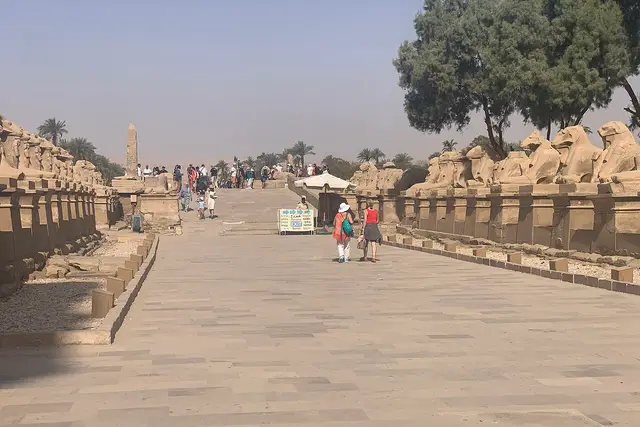
The address is Kornish Al Nile, Luxor City. The museum is north of Luxor Temple, on the stretch of riverside road heading towards Karnak. That puts it between the two big east-bank temples, so it slots into either visit.
- On foot: walk north along the Corniche from Luxor Temple. The river is on your left the whole way.
- By caleche: the horse-drawn carriages along the Corniche will take you. Agree the fare and the route before you get in.
- By taxi or ride from the West Bank: cross by the public ferry or a felucca to the east bank landing near Luxor Temple, then walk or ride north.
Plan on 1.5–2 hours inside. Add more if you read every label in the cachette hall.
At the ticket window and in the galleries
Buy your ticket at the window by the entrance. Have Egyptian pounds in small notes ready in case card payment isn’t working that day. Current prices are posted at the window and on the official antiquities site.
- Guides at the gate: men offering a tour may approach you outside. A polite “la, shukran” (no, thank you) is enough if you want to go alone.
- Photography: the rules on cameras and phones have changed over the years, so ask at the ticket office what’s currently allowed, especially in the mummy hall.
- Pace: the dim lighting rewards slow walking. Let your eyes adjust in the first room before you move on.
- Tipping: if a guard points out a detail and expects something, a small tip in pounds is customary. You can decline by walking on.
Pairing it with the rest of the east bank
The museum works best as context for the temples, not as a replacement. Visit in the morning and Karnak’s halls make more sense in the afternoon, especially once you’ve seen Thutmose III and Amenhotep III face to face.
Or reverse it. Do Luxor Temple first, then walk up the Corniche for the evening session and see the statues that were buried beneath its court. Either way, the walk between them along the Nile is part of the day.
Frequently asked questions
When is the quietest time to visit Luxor Museum?
The forecast doesn't name a specific quiet window. It does flag weekends 11am–2pm and 5pm–8pm as the busiest hours. On weekends, go in the first couple of hours after the 9am opening. Weekdays avoid those weekend peaks altogether.
What are the opening hours?
At the moment it opens in two sessions, 9am–2pm and 5pm–8pm, with a closure in between. Hours change with the season and around holidays, so check the official Egyptian antiquities site before you go.
How long should I spend at Luxor Museum?
Allow about 1.5–2 hours. Give the most time to the cachette hall with its Luxor Temple statues and to the royal mummies hall.
How do I get there from Luxor Temple?
Walk north along the Corniche (Kornish Al Nile) with the Nile on your left. The museum is on the riverside road between Luxor Temple and Karnak. You can also take a caleche or a taxi. Agree the caleche fare before you set off.
What should I not miss inside?
Don't miss the red quartzite statue of Amenhotep III in the cachette hall, the Thutmose III statue, the calcite statue of Amenhotep III with Sobek, the reconstructed Akhenaten talatat wall, and the two royal mummies.
Plan your trip to Luxor
Egypt eSIM & staying connected →
Some links above are affiliate links — if you book through them, Wander Atlas earns a small commission at no extra cost to you. It's how we keep every guide free.