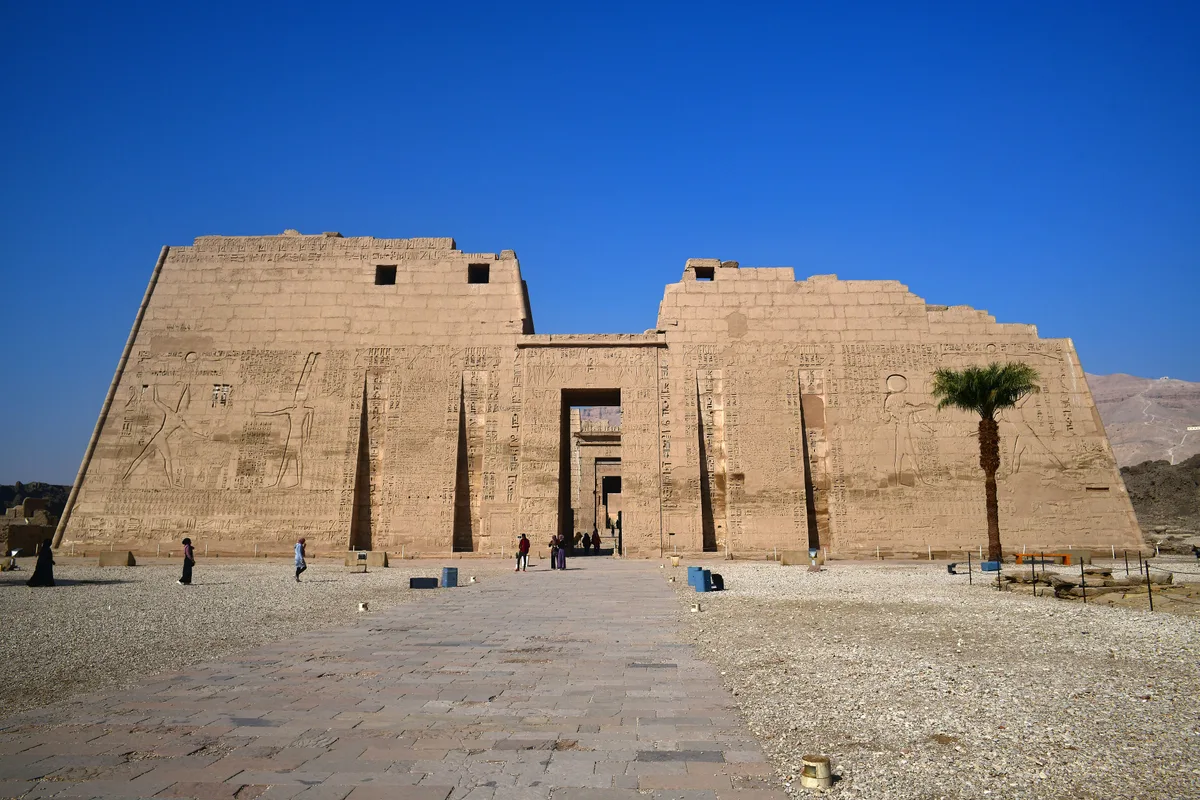
A fortress gate, then a pharaoh’s war diary
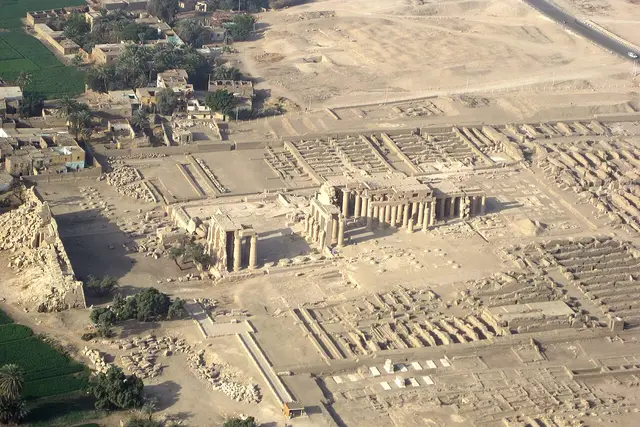
The entrance is a fortified gate. Ramesses III built his mortuary temple behind a tall stone gatehouse modelled on a Syrian migdol, a kind of fortress tower. You walk under it before you reach the temple proper. Inside, the scale goes up fast: the first pylon is covered in sunk relief of the king smiting rows of captives, cut deep enough to throw hard shadows.
The temple dates to the 20th Dynasty, in the 12th century BC. It is one of the best-preserved temples on the West Bank. Far fewer people come here than to the Valley of the Kings, so for long stretches you may have whole courts to yourself.
What to look for, in order
Work from the front of the temple to the back. Keep looking up.
- First pylon: battle scenes and the king’s titles, carved on a huge scale.
- First court: reliefs of Libyan campaigns, including scribes counting severed hands of the dead.
- Second court: Osiride pillars, with original blue, red and yellow paint still on the reliefs and ceilings.
- North outer wall: the sea battle against the Sea Peoples, one of the earliest naval battles shown in art. Walk around outside to find it.
- Small Amun temple: an older 18th Dynasty shrine inside the enclosure, begun under Hatshepsut and Thutmose III.
Look at the mudbrick enclosure walls too. Later the site held the Coptic town of Djeme, and you can still see where Christians chiselled out figures.
Crossing to Al Bairat
There is no metro on the West Bank. You can take the public ferry from the East Bank corniche and pick up a taxi on the far side. You can also drive across the Luxor Bridge to the south, which is the easier option with a driver for the day.
The temple sits at the edge of farmland and the village, close to several other sites:
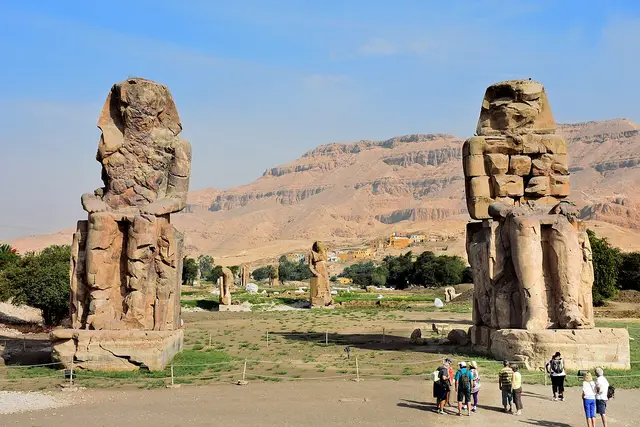
- the Colossi of Memnon, a few minutes’ drive away
- Deir el-Medina, the workmen’s village
- the Valley of the Queens
Medinet Habu fits easily into a day with Deir el-Medina and the Ramesseum, the mortuary temple of Ramesses II, for comparison. Opening hours were not confirmed for this guide, so check them before you set out.
Dealing with the temple guardians
Expect friendly guardians, called ghaffirs, near the darker side rooms. Some will point out a painted ceiling or a well-preserved relief, then wait for baksheesh. That is a tip, and it is normal here. Carry small Egyptian pound notes so you are not hunting for change. If you would rather look on your own, a polite “la, shukran” (no, thank you) is enough.
Shade is scarce in the open courts. Morning light hits the eastern face of the first pylon, so arriving soon after opening gives you cooler air and the best-lit carving. A late-afternoon visit gives a softer light inside the courts.
Photo rules and ticket details are posted at the entrance and on the official Egyptian antiquities website. Check there rather than trusting older advice. Wear shoes with grip, because the worn flagstones get slippery where they have been polished smooth.
Frequently asked questions
Where exactly is the Mortuary Temple of Ramesses III?
It is at Medinet Habu on Luxor's West Bank, in Al Bairat near Al Qarna. It sits a short drive from the Colossi of Memnon, close to Deir el-Medina and the Valley of the Queens.
How do I get there from the East Bank?
You can take the public ferry across the Nile from the corniche and then a taxi. You can also drive over the Luxor Bridge, which is simplest with a driver hired for the day.
How long should I spend at Medinet Habu?
Allow 1.5–2 hours. That gives you time for the pylons, both courts, the painted reliefs, the small Amun temple and a walk around the outside to see the Sea Peoples battle relief.
When is the best time of day to visit?
Early morning is coolest, because the open courts have little shade. The first pylon also faces east and gets the morning light. Hours were not confirmed for this guide, so check before you go.
Is it worth visiting if I've already seen Karnak?
Yes. Its painted reliefs are among the best preserved in Luxor, and it also has a fortified gate and war scenes you won't see at Karnak. It usually draws far smaller crowds.
Plan your trip to Luxor
Egypt eSIM & staying connected →
Some links above are affiliate links — if you book through them, Wander Atlas earns a small commission at no extra cost to you. It's how we keep every guide free.