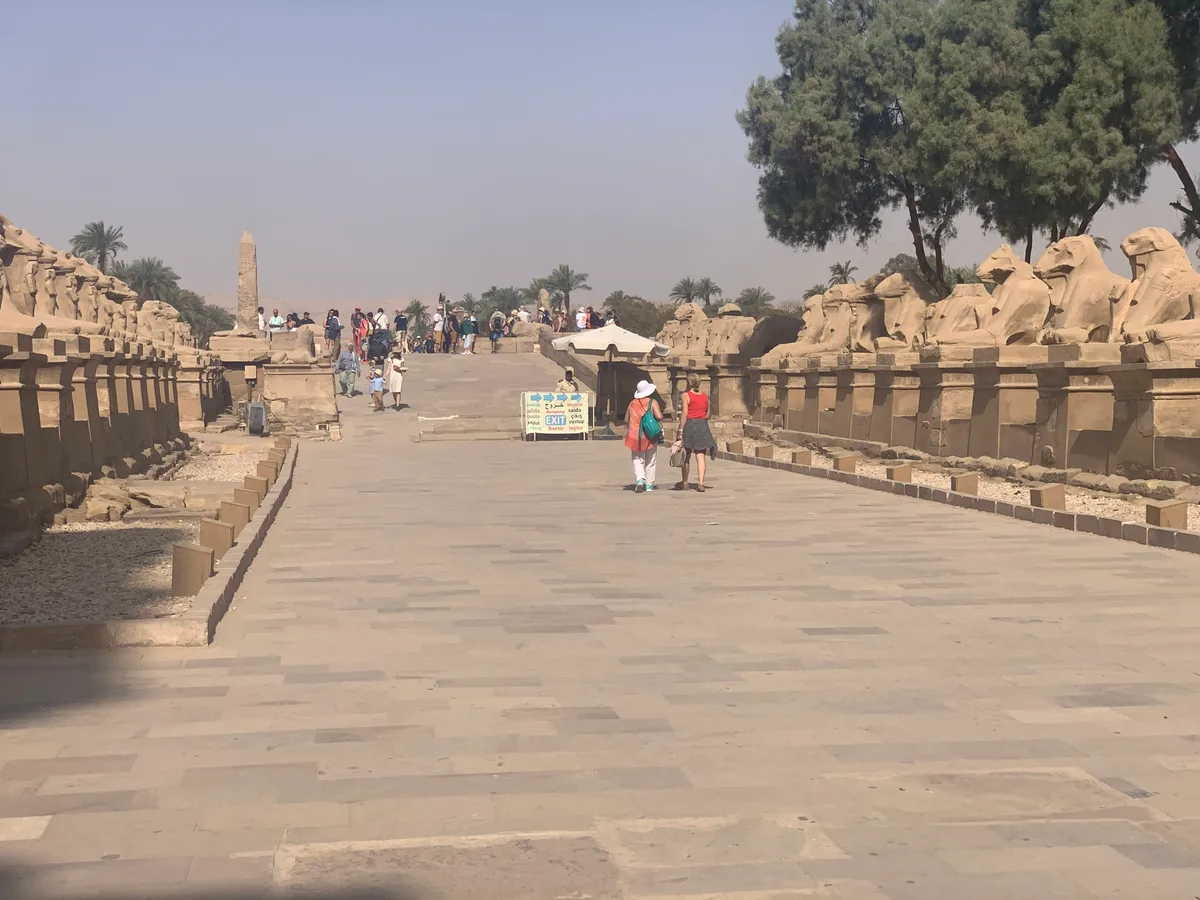
Two rows of stone sphinxes face each other across a sandstone road. Behind them, Luxor carries on as usual: apartment blocks, satellite dishes, horse carriages clopping along the side streets. The Avenue of the Rams is the processional way that once tied Karnak to Luxor Temple. Today it cuts straight through the middle of a working city.
Most visitors see only the stubs at either end, the sphinxes outside Luxor Temple and the ram-headed rows in front of Karnak’s first pylon. The stretch between them is the quieter part. That’s the reason to come.
A road built for a god
The avenue was a stage. During the annual Opet Festival, the sacred barques of Amun, Mut and Khonsu were carried from Karnak south to Luxor Temple. Priests, musicians and crowds followed them along this route.
What you walk on today was largely laid out under the 30th-Dynasty pharaoh Nectanebo I, although the route itself is older. By most estimates it was once lined by well over a thousand sphinxes. Over the centuries the modern town grew over it. Long stretches stayed buried under houses and roads until excavators uncovered them again, piece by piece.
Rams at one end, human faces at the other
The sphinxes change as you go, and this is the detail worth slowing down for.
- Near Luxor Temple: the sphinxes have human heads and lion bodies. Many carry the face of Nectanebo I.
- Near Karnak: the heads become rams, the animal of Amun. Small figures of the king stand between their front paws, under the god’s protection.
- In between: many sphinxes survive only as bases, broken bodies or empty plinths. You read the full length of the avenue from the rhythm of the pedestals as much as from the statues.
Look closely at the plinths too. Some still show weathered carving, and the wear on each statue is different. It feels less like a museum row than a crowd of individuals.
How the avenue sits in the city
You don’t walk through countryside here. In many places the ancient road lies below the level of today’s streets, so you look down into it from the modern pavement or walk along it in a sunken corridor. Cross streets interrupt it, so the walk comes in segments.
That makes it a good way to see Luxor itself. You pass the backs of houses, small mosques and corner shops. The 2.7 km between the two great temples suddenly feels like a real distance, the same distance the processions covered.
Walking the processional way
Treat this as a walk with a direction, not a stop. A few habits make it much better:
- Start at opening. The site opens at 6:00 AM at the moment, and the early hours are the coolest. By late morning the stone and sand reflect the heat back up at you, and there’s almost no shade.
- Walk one way. Go from Luxor Temple north to Karnak, or the reverse, and get a taxi or calèche back. Doubling back on foot in the sun is where the walk turns into a slog.
- Carry water and cover up. In this case it’s the most useful advice there is. A hat and long, light sleeves do more than sunscreen on a stretch this exposed.
- Small notes for baksheesh. Site guardians sometimes point out a carving or a good angle and expect a small tip. Carry low-denomination Egyptian pounds for this.
- Agree calèche fares first. Settle the price and the destination with horse-carriage drivers before you climb in. Settle it again if you add a stop.
- Check tickets at the entrance. Arrangements for entry have changed over time. Ask at the gate or check the official Egyptian antiquities website rather than relying on old blog posts.
Dress modestly: shoulders and knees covered. It’s practical in the sun, and it’s also respectful when the route passes close to homes and mosques.
Pairing it with the two temples
The avenue makes the most sense as the link between the temples. Here’s one sensible sequence:
- Arrive at Karnak early and give it two to three hours. It’s huge, and the Hypostyle Hall alone takes time.
- Walk the avenue south toward Luxor Temple, allowing roughly an hour or more with stops.
- End at Luxor Temple, which sits on the Corniche by the Nile in the town centre.
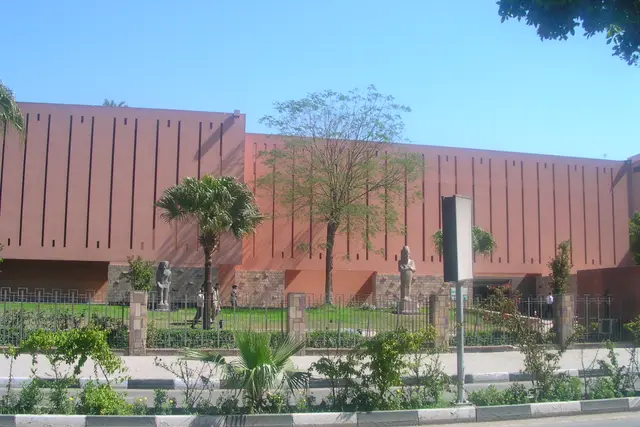
Luxor Temple is known for being lit up in the evening, but the avenue currently closes at 5:00 PM. So do the walk in daylight and save any evening visit for the temple itself. The Luxor Museum is also on the Corniche between the two sites if you want a cooler indoor break.
When to go, and how long to stay
Luxor’s cooler months, roughly October to April, are the comfortable time for a long walk outdoors. Summer heat is serious here, so in those months stick strictly to the first hours after opening.
Walking the whole avenue at an easy pace, with time to look at the sphinxes, takes about one to two hours. If you only want a taste, the stretch nearest Luxor Temple shows the human-headed sphinxes. The Karnak end shows the rams. Twenty minutes at either end will do.
Why it stays quiet
Tour groups usually go straight into Karnak and Luxor Temple, then leave by coach. Few of them walk the space in between. That’s why the middle of the avenue can feel almost empty while both temples are full.
It’s a rare thing in Luxor: a major ancient monument where you can go at your own pace. You can stand in the middle of the road and look along a line of sphinxes without anyone stepping into your view.
Frequently asked questions
How do I get to the Avenue of the Rams?
It runs between Luxor Temple, on the Corniche in central Luxor, and Karnak Temple, about 2.7 km north. Most people walk from one temple to the other. You can reach either end by taxi or by calèche (horse carriage), but agree the fare before you set off.
What are the opening hours?
At the moment it opens 6:00 AM–5:00 PM every day of the week. Hours at Egyptian sites can shift, so check the official antiquities website or ask at the entrance before you go.
What is the best time of day to walk it?
Go right at opening. There's almost no shade along the route, and the heat builds quickly from late morning, especially in summer. October to April is the most comfortable season.
How long does it take?
Walking the full length one way with stops takes about one to two hours. If you only visit the ends, the human-headed sphinxes near Luxor Temple or the ram-headed ones near Karnak, 20–30 minutes is enough.
Can I combine it with Karnak and Luxor Temple?
Yes, and that's the best way to see it. Do Karnak early, walk the avenue south, and finish at Luxor Temple on the Corniche. The avenue closes at 5:00 PM, so walk it in daylight.
Plan your trip to Luxor
Egypt eSIM & staying connected →
Some links above are affiliate links — if you book through them, Wander Atlas earns a small commission at no extra cost to you. It's how we keep every guide free.