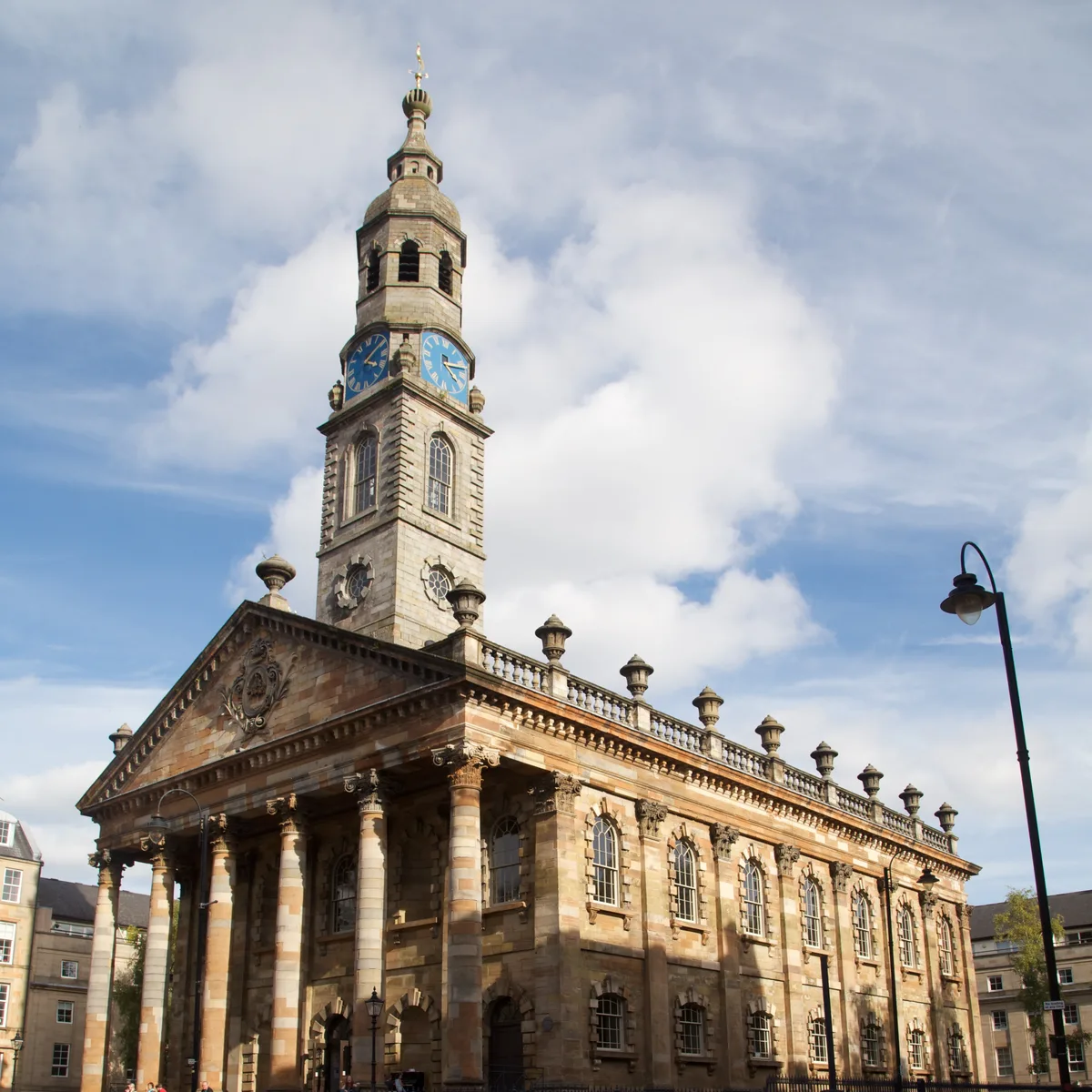
A portico of tall Corinthian columns holds up a pediment, and a stone steeple rises above it. Then you notice where you are standing: a quiet square of flats a few streets back from the Saltmarket, nowhere near the grand avenues you’d expect for a church like this. St Andrew’s in the Square went up between 1739 and 1756. It is one of the finest Georgian churches in Scotland, and plenty of Glaswegians have never been inside.
A Georgian church boxed in by flats
Architect Allan Dreghorn worked with master mason Mungo Naismith. They looked to London’s St Martin-in-the-Fields, and you can see it in the temple front and the steeple above it. The church was built when Glasgow was getting rich on Atlantic trade. The merchants of that era paid for it, and many of them worshipped here.
Today the square around it is mostly modern residential blocks. That gives the place its odd charm. The building stands in its own small open space, and you can walk the whole way round it in a couple of minutes. Do it before you go in. The side elevations and the tall round-headed windows look best from the corners of the square.
Under the gallery and the plaster ceiling
The interior is one big, bright rectangle. A gallery runs round three sides on slim columns, so the main floor feels open and the upper level looks straight down at it. That layout is why it works so well as a concert hall today. Sound carries and nobody sits far from the action.
Look up. The ceiling is decorated with rococo plasterwork usually credited to Thomas Clayton, the stuccoist behind some of Scotland’s best 18th-century interiors. Scrolls, foliage and ornament spread across the white plaster. Give it time: in a ten-minute visit this is the detail people walk past.
The building fell into poor repair in the late 20th century. It was rescued by the Glasgow Building Preservation Trust and reopened around the turn of the millennium as a centre for Scottish culture. The restoration is the reason you can stand in it at all.
Ceilidh nights under the steeple
The editorial description puts ceilidhs alongside concerts, weddings and receptions, and that sets this place apart from a museum church. A ceilidh is a Scottish social dance night. A live band plays and a caller shouts out the steps for reels and jigs like the Gay Gordons or Strip the Willow, so beginners can keep up.
A few things to know if you go:
- Nobody expects you to know the steps. The caller walks the room through each dance before it starts.
- Dress for movement. These dances are fast and involve a lot of spinning, so wear flat shoes.
- Events keep their own hours. Evening concerts and dances run outside the weekday daytime schedule. Check the venue’s listings for dates, times and tickets.
- Private hires close the building. Weddings and receptions book the hall, which is one more reason to check before you make a special trip.
Getting to St Andrew’s Square
The address is 1 St Andrew’s Square, Glasgow G1 5PP. The square sits just east of the Saltmarket, south of Glasgow Cross and the Tolbooth Steeple. From Glasgow Cross, head down the Saltmarket and turn left along St Andrew’s Street. The steeple shows you the way.
Nearest rail and subway options:
- Argyle Street station (low-level trains) is the closest, about ten minutes’ walk east along Argyle Street and the Trongate.
- St Enoch subway station is a little further west, on Glasgow’s circular Subway line.
- High Street station is a short walk north of Glasgow Cross.
- Glasgow Central is roughly 15–20 minutes’ walk if you arrive by mainline train.
Walking in on a weekday
This is a working venue, not a staffed attraction. That changes how you visit.
- Come between 10am and 4pm, Monday to Friday. That’s the current schedule, and it’s closed on Saturday and Sunday. Mid-morning is the safest bet in case setup for an evening event starts later in the day.
- Ask before you wander. If someone is at the door or desk, say you’d like a look at the interior. Rehearsals, setup and private bookings sometimes take over the main hall.
- Keep your voice down if music is playing. Musicians often rehearse in the space, and the acoustics carry everything.
- Ask before photographing a set-up hall. A room dressed for a wedding is someone’s private event.
- Combine it with the area. Allow 20–40 minutes for the building alone, more if you stop to look at the ceiling properly.
Because the building is under the radar, you’ll often have the square nearly to yourself. You won’t find tour coaches or a ticket desk queue here, just a doorway and a large room.
Glasgow Cross and the Green, next door
St Andrew’s is a good anchor for a walk through the oldest part of the city. The Tolbooth Steeple at Glasgow Cross is a few minutes away. It’s a 17th-century tower that marks the old heart of the burgh. From there the Trongate leads west into the Merchant City, with its grid of streets named after the same trading families who built this church.
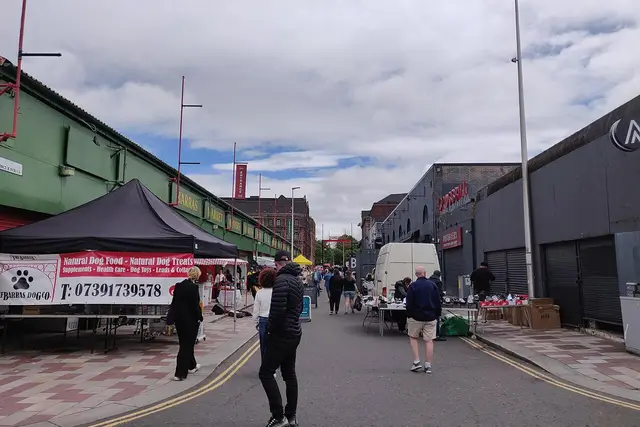
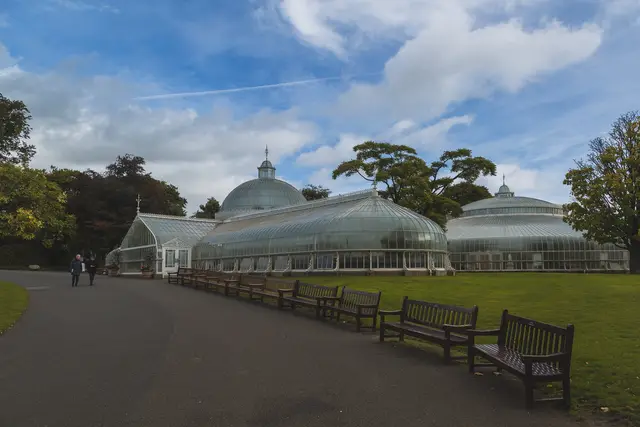
Go south from the square and you reach Glasgow Green, the city’s oldest park. It is home to the People’s Palace and Winter Gardens, a museum of everyday Glasgow life with a glasshouse attached. Head east instead and you’re close to the Barras, the long-running market in the Calton. The Barras is at its liveliest at weekends, when this church is closed, so it works best as a separate trip.
Fitting it into a Glasgow day
Plan this as a weekday morning stop, then make for the Green or the Merchant City. If your trip only covers a weekend, you’ll still see the portico and steeple from the square, but the interior is the real reward.
If you’re in town for a few days, look at the event listings before you arrive. A ceilidh or concert here shows you the building doing what it was restored for. The gallery fills up, the plaster ceiling sits over a dance floor, and the band plays a few streets from where Glasgow began.
Frequently asked questions
When can I go inside St Andrew's in the Square?
At the moment it opens 10am–4pm Monday to Friday and is closed on Saturday and Sunday. Concerts and ceilidhs run on their own schedule, and private hires can close the hall, so check the venue's listings before a special trip.
How do I get there by public transport?
Argyle Street station (low level) is about ten minutes' walk away via Argyle Street and the Trongate. St Enoch subway station and High Street station are also within walking distance. The square is just east of the Saltmarket, south of Glasgow Cross.
How long should I spend there?
Allow 20–40 minutes to walk round the square and see the galleried interior and plaster ceiling. An evening event will obviously take longer.
Do I need to know how to dance to go to a ceilidh?
No. A caller explains each dance before the band starts, so first-timers can follow along. Wear flat shoes, because the dances involve a lot of spinning.
What else is nearby?
The Tolbooth Steeple at Glasgow Cross is a few minutes' walk away. Glasgow Green and the People's Palace and Winter Gardens are just to the south, and the Merchant City lies to the west along the Trongate.
Plan your trip to Glasgow
United Kingdom eSIM & staying connected →
Some links above are affiliate links — if you book through them, Wander Atlas earns a small commission at no extra cost to you. It's how we keep every guide free.