Why go
There’s a specific kind of thrill that only a 24-hour race delivers: the sense that the event never actually stops. You can watch bikes scream down the Mistral straight at 2pm on Saturday, wander off for dinner, come back at 3am, and the same fight for position is still grinding on under floodlights, riders swapping out in pit lane like a relay team that never sleeps.
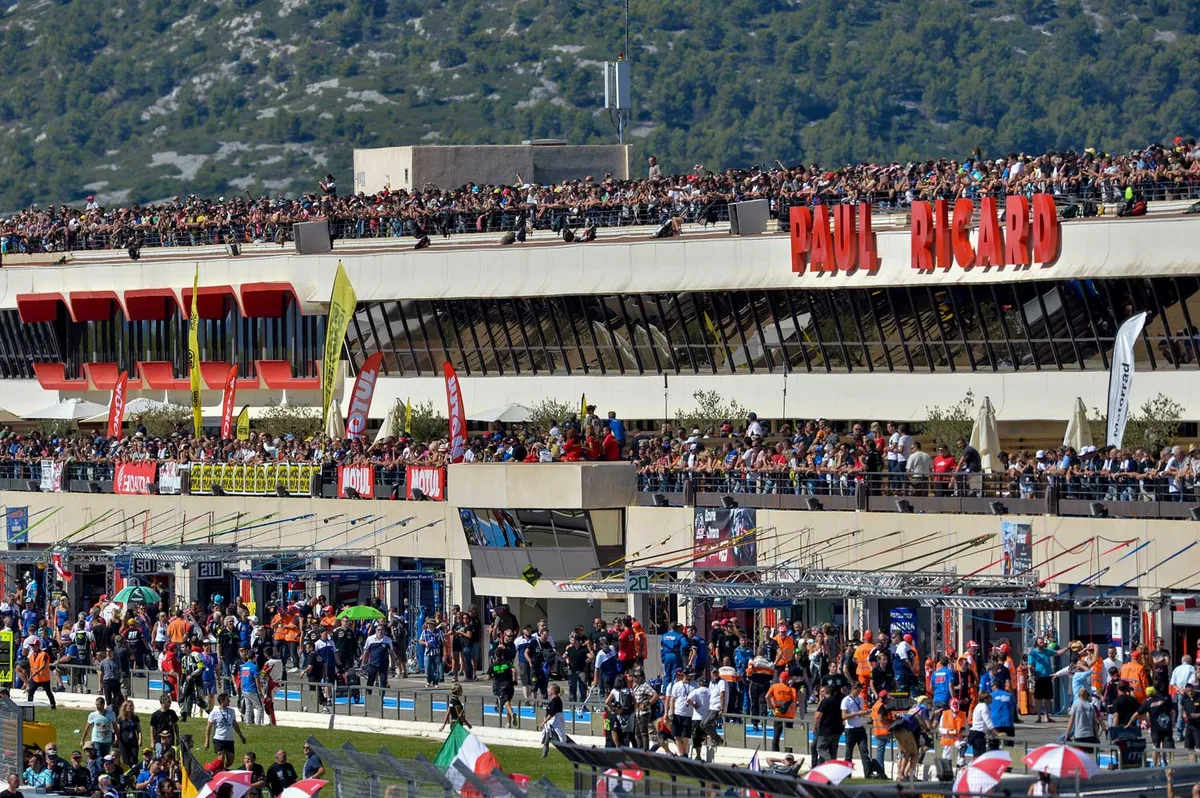
The Bol d’Or is the oldest and most storied round of the FIM Endurance World Championship, and as the season finale it usually carries championship stakes, with teams arriving to defend points, not just pride. Circuit Paul Ricard’s long, technical layout, with its distinctive blue-and-red runoff asphalt, gives sightlines most circuits can’t match, so a single grandstand seat or a walk around the fence covers several corners’ worth of action.
Getting there
Circuit Paul Ricard sits inland from the Mediterranean coast near Le Castellet, in the Var department of Provence, roughly midway between Marseille and Toulon. Marseille Provence Airport is the most practical international gateway; from there it’s a drive of well under an hour to the circuit. For those coming by train, Marseille-Saint-Charles or Toulon stations connect to the wider TGV network, but there’s no direct rail line to the track itself, so a rental car, taxi, or one of the shuttle services organizers typically run from nearby towns during the event covers the gap.
Driving means local traffic restrictions and dedicated event parking areas around the circuit, which is standard for a race weekend here, and the approach roads slow to a crawl on race day.
What to see and do
The centrepiece was 24 hours of continuous racing, with the classic drama of pit stops, rider changes, and the slow attrition that decides who’s left running at the finish. Practice and qualifying sessions were scheduled for Thursday and Friday, which is when the paddock and garages are easiest to get close to, long before the grandstands fill for the race itself.
The paddock area is where endurance-specific machinery can be seen up close. These aren’t sprint bikes, they’re built and set up for a full day and night of abuse, and the fast pit-stop choreography during the race is a draw in its own right. A field of endurance bikes at full throttle down the Mistral straight is genuinely loud, even from a distance.
When to go
The race was set for September, early autumn in Provence. Warm days and noticeably cooler nights are typical for the season, and layers make the difference for anyone trackside into the small hours. This is a night race, and one of its most memorable windows is the stretch from dusk through the first couple of hours of darkness, when the floodlights come on and the character of the event shifts.
The Saturday-into-Sunday overnight period was billed as the heart of the race. The final laps on Sunday afternoon, when the championship is often mathematically decided, draw their own dedicated crowd.
How to visit like a local
Regulars treat the Bol d’Or as a weekend, not a day trip. Many bring camping gear and stay on-site or nearby, since disappearing for a hotel room mid-race means missing hours of action. Camping guidance called for layers and a decent sleeping setup for the cooler night temperatures. Food and drink stalls were planned to operate throughout the 24 hours, with the mid-race lull in the small hours, well after the first-night rush and before the Sunday-morning build-up to the finish, flagged as the quietest time to grab something.
Not every vendor at a circuit this size accepts card payment reliably, so regulars carry cash as well. The mistake first-timers make is treating it like a sprint race and leaving after a few hours. The real spectacle of endurance racing is watching how strategy, fatigue, and mechanical wear reshape the leaderboard overnight, which is why regulars budget for at least one full darkness-to-dawn cycle.
Frequently asked questions
What are the exact dates of the 2026 Bol d'Or?
It was scheduled for September 17-20, 2026 at Circuit Paul Ricard.
How do I get to Circuit Paul Ricard without a car?
There is no direct rail line to the track. The usual gateways are Marseille Provence Airport and the train stations at Marseille-Saint-Charles or Toulon, with a rental car, taxi, or event shuttle service covering the last leg.
How long should I plan to stay?
The format fills a full weekend: practice and qualifying on Thursday and Friday, then the 24-hour race from Saturday into Sunday. Many visitors camp on-site so the overnight hours aren't missed.
Is it cold at night in September?
Days are typically warm, but Provence nights in mid-to-late September cool down noticeably, which matters for anyone trackside into the small hours.
Do I need to buy tickets in advance?
Endurance racing events like this typically sell tiered tickets — grandstand, general admission and camping packages — and a popular finale weekend can sell out, so walk-up access is never a given.
Plan your trip to Le Castellet
Some links above are affiliate links — if you book through them, Wander Atlas earns a small commission at no extra cost to you. It's how we keep every guide free.