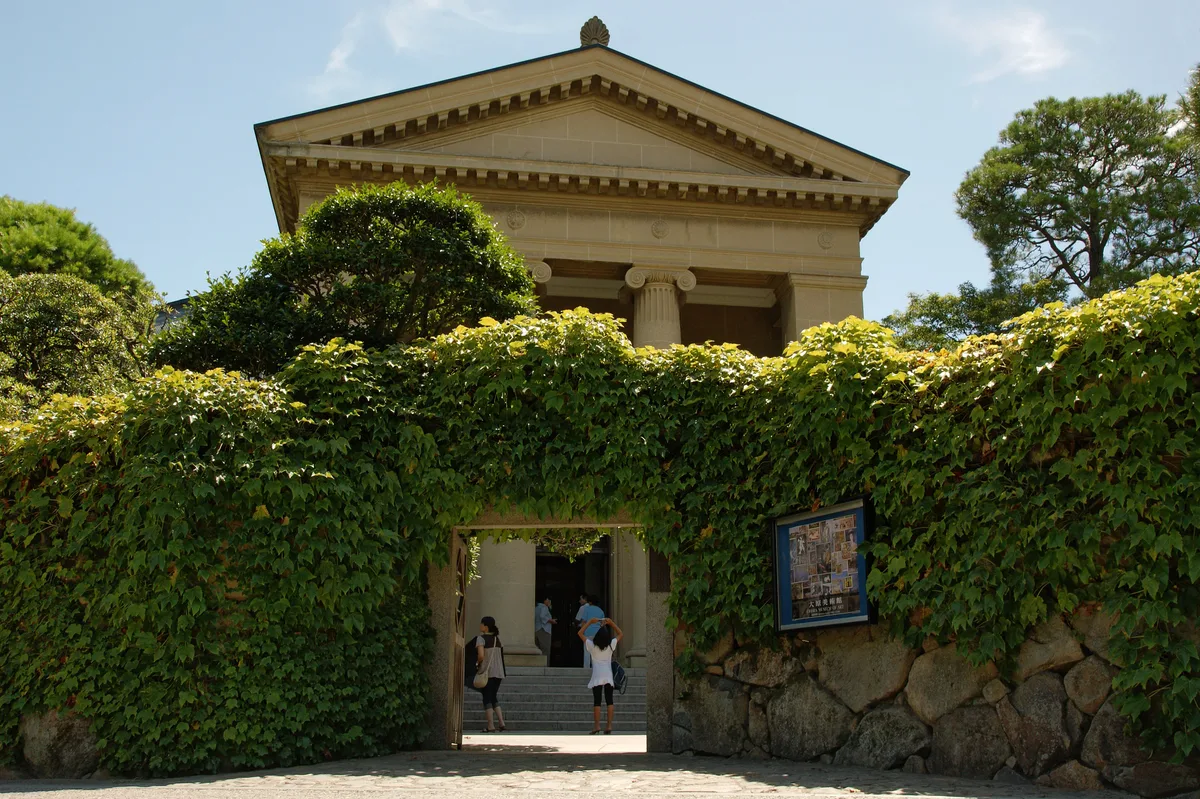
Stone columns rise above a canal lined with willows. That is the façade of the Ōhara Museum of Art: a Greek-temple front with Ionic columns, set down among the white-walled storehouses of Kurashiki. Two Rodin bronzes stand guard by the entrance. The building looks like it was shipped in from another century and another continent, and in a sense the collection was.
A textile fortune and a painter with a budget
The museum opened in 1930 and is Japan’s oldest private art museum. It was founded by Ōhara Magosaburō, the industrialist behind the Kurashiki spinning business that made this town rich.
The buying was done by his friend, the painter Kojima Torajirō. Ōhara sent him to Europe, and Kojima came back with works so that Japanese artists could see Western painting without sailing to Paris. Once you know that, the collection reads as a deliberate teaching kit, not a rich man’s trophy shelf.
What hangs in the main building
The main building holds the Western collection, and it is the reason most people come. The rooms are calm and quite compact, so you can see it all properly in about an hour.
Look for these:
- El Greco’s Annunciation, the painting most often named as the museum’s treasure
- Monet’s Water Lilies, which Kojima bought from the painter himself
- Works by Gauguin, Matisse and Modigliani, among other French and European moderns
- Rodin sculptures, both inside and at the entrance
Japanese readers know this as the place where they first saw an El Greco in their own country. That gives the room a quiet weight even on a crowded day.
Rice granaries turned craft rooms
Most visitors do the main building and leave. That is a mistake: the ticket covers the other galleries too, and the best of them is the Craft Art Gallery, set in old storehouses across the canal.
Here the dark timber beams and thick walls frame the Japanese folk-craft (mingei) movement. You will find ceramics by Hamada Shōji, Kawai Kanjirō and Bernard Leach, and woodblock prints by Munakata Shikō. The Asiatic Art Gallery sits in the same complex with older pieces from across Asia.
The Annex, behind the main building, picks up the Japanese story. It covers modern and contemporary Japanese painting, the “modern Japanese paintings” half of the museum’s reputation. Budget 2–3 hours if you want all of it without hurrying.

Getting to the Bikan Quarter
Take the train to JR Kurashiki Station. From Okayama Station it is a short ride on the JR San’yō Line, which makes this an easy half-day trip from Okayama city or a stop between Hiroshima and Osaka by shinkansen.
From Kurashiki Station’s south exit, walk down Chūō-dōri for about 15 minutes. Turn into the Bikan Historical Quarter when you reach the canal. The museum address is 1-chōme-1-15 Chūō, and it faces the water near the stone bridges, so you cannot miss the columns.
The quarter is meant for walking. If you drive, use one of the paid car parks on the edge of the district rather than trying to get close.
Beating the weekend tide
This is one of Kurashiki’s best-known sights, and weekends show it. The busiest stretch on weekends is 10am–4pm, which is nearly the whole day. Tour groups and day-trippers fill the main building’s small rooms, and the El Greco gets a crowd around it.
How to work around it:
- On weekends, be at the door at 9am. Do the main building first, while it is still quiet.
- Go on a weekday if you can. At the moment the museum is open Tuesday to Sunday, 9am–5pm.
- Don’t come on a Monday. It is currently closed then. Japanese museums often change this when a Monday is a public holiday, and hours can shift through the year, so check the official site for this month’s schedule.
- Weekend afternoons: the last hour before closing is your other option. You will have to choose between the main building and the craft galleries.
Inside the galleries: the house rules
Buy one ticket at the entrance, then keep it with you. You will show it again at the Annex and the craft galleries across the canal. The current price is posted at the ticket window and on the museum’s official site.
A few things that are standard here:
- No photography in the galleries. Take your photos of the façade and the Rodins outside.
- Speak quietly. Japanese gallery-goers are close to silent, and these rooms carry sound.
- Big bags and umbrellas usually go into the lockers or the umbrella stand by the door, as is normal in Japanese museums.
- Card payment is common at major museums in Japan, but carry some yen for the small shops and snack stands in the Bikan Quarter.
After the last gallery
Leave by the front steps and you are already on the canal path. Right next to the museum is Café El Greco, the ivy-covered building named after the painting you just saw, and a long-standing stop for museum visitors.
From there, walk along the Kurashiki River past the white-walled kura storehouses, or cross a bridge to the red-brick Ivy Square. The Ōhashi House, a preserved merchant residence, is a short walk south. All of it is within ten minutes on foot, so the museum fits neatly into a full day in Kurashiki.
Frequently asked questions
How do I get to the Ōhara Museum of Art from Okayama?
Take the JR San'yō Line from Okayama Station to Kurashiki Station, a short ride. Then walk about 15 minutes from the south exit down Chūō-dōri to the canal in the Bikan Historical Quarter. The museum is at 1-chōme-1-15 Chūō.
When is the quietest time to visit?
Weekends are busiest from 10am to 4pm, so on a Saturday or Sunday arrive at the 9am opening and see the main building first. A weekday visit, Tuesday to Friday, is the better choice if you have it. The museum is currently closed on Mondays.
How long should I spend there?
Allow about an hour for the main building's Western collection. Plan 2–3 hours if you also want the Annex, the Craft Art Gallery and the Asiatic Art Gallery, which share the same ticket.
What are the must-see works?
El Greco's Annunciation and Monet's Water Lilies are in the main building, along with Gauguin, Matisse, Modigliani and Rodin. Across the canal, the Craft Art Gallery holds ceramics by Hamada Shōji, Kawai Kanjirō and Bernard Leach, plus prints by Munakata Shikō.
What else is nearby?
The museum sits on the canal in the Bikan Historical Quarter. Café El Greco is next door, the red-brick Ivy Square is across the river, and the Ōhashi House merchant residence is a short walk south.
Plan your trip to Okayama
Japan eSIM & staying connected →
Some links above are affiliate links — if you book through them, Wander Atlas earns a small commission at no extra cost to you. It's how we keep every guide free.
Related guides
 hidden gem
 Kurashiki Bikan Historical Quarter: Okayama Travel Guide
 hidden gem
 Hayashibara Museum of Art: Okayama Travel Guide (4.0★)
 attraction
 Okayama Orient Museum: Travel Guide (4.3★)
 attraction