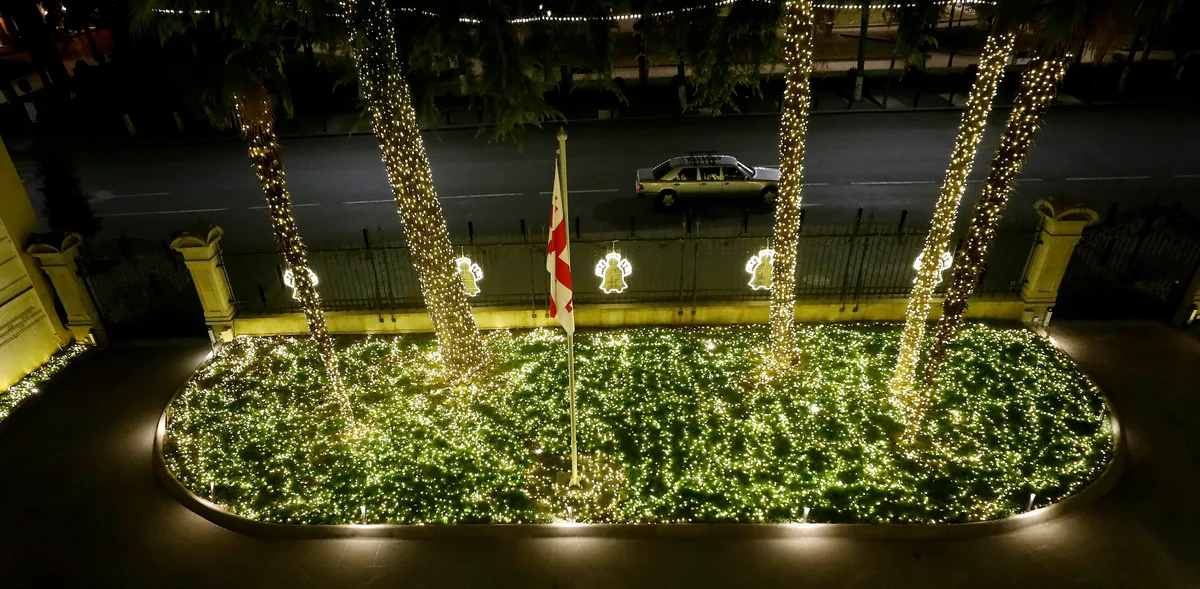
Five weeks, two Christmases
This market runs longer than most. The Tbilisi Christmas Market and New Year Village opens on December 12, 2026 and runs to January 14, 2027.
That end date isn’t random. Georgia’s Orthodox Church celebrates Christmas on January 7. Many families also mark Old New Year, Dzveli Akhali Tseli, on the night of January 13–14. So the village goes on being busy well after Western Europe has taken its decorations down.
In practice the season has three peaks:
- Mid to late December: the market is new, and the weekday evenings are calmer.
- December 31: the city concert, then fireworks at midnight.
- January 6–7: Christmas Eve and Christmas Day, when the streets fill with church processions as well as stall-browsers.
Where the village sets up
Earlier editions spread across central Tbilisi rather than sitting on one enclosed site. The stretch of Rustaveli Avenue, between Freedom Square and Rose Revolution Square, is lit up every winter. Wooden stalls have usually clustered on the squares along it.
From the metro, Line 1 gets you there. Get off at Liberty Square (Tavisuplebis Moedani) or Rustaveli and you come up next to the avenue. Many visitors walk the whole strip in about 20 minutes, passing the Parliament building and the Opera House on the way.
The exact stall locations for this edition are the organiser’s to set, so this guide doesn’t fix them to a square.
Tickets and getting in
You don’t buy a ticket for a street. Seasonal markets of this kind in Tbilisi are open-air, and people simply walk in off the pavement.
Any paid element, such as a ticketed stage or a ride, is up to the organiser and the individual operators. None is listed in the facts behind this guide, so no figure appears here. Where a stall sells food or crafts, the price is written on a board or label at the counter.
What fills the stalls
Expect Georgian winter staples more than imported German Glühwein culture, though mulled wine does turn up. Look for these:
- Churchkhela: strings of walnuts dipped in thickened grape juice. They hang in rows like candles.
- Gozinaki: walnut and honey brittle, cut into diamonds. It’s the traditional New Year sweet.
- Chichilaki: a small tree made from a hazelnut or walnut branch, shaved into pale curls. It’s the Georgian alternative to a fir tree.
- Khachapuri and grilled corn: warm street food for standing about on a cold night.
- Felt and enamel crafts: handmade scarves, slippers and minankari cloisonné jewellery.
Tbilisi winters are cold but not alpine. Evenings often sit around freezing, and snow in the city centre is unusual. Most people come after dark, when the lights are on and the avenue looks its best.
New Year’s Eve and the nights after
December 31 is the main event. The city stages its New Year’s Eve concert, and the crowd builds through the evening towards midnight.
At midnight the sky goes chaotic. Fireworks are fired from balconies and hillsides all over Tbilisi, not just from one official barge. Some residents watch from higher ground such as Mtatsminda or the Narikala area instead. From up there the whole bowl of the city flashes at once.
The days after are quieter. Many Georgians spend January 1 and 2 at home, visiting family over long supra feasts. The market then fills up again for Christmas on January 7.
Paying, toasting and moving through the crowd
Georgia uses the lari (GEL). Cards and phone payments are accepted all over central Tbilisi, but small craft and churchkhela stalls often prefer cash, and an ATM is never far from Rustaveli. Prices at food stalls are fixed. Haggling over a craft piece is fine if you keep it friendly.
A few words go a long way:
- Gilotsavt Akhal Tsels: Happy New Year.
- Gaumarjos: cheers, said whenever a glass goes up.
- Madloba: thank you.
On New Year’s Eve, many locals travel in by metro rather than taxi, because traffic on the avenue grinds to a halt near midnight. Watch out on that night: fireworks get lit at street level, and people keep a step back from anyone holding a lighter.
If you visit in early January, churches near the avenue hold Christmas Eve services, such as Kashveti, opposite the Parliament. Visitors who step inside usually stand quietly at the back. Women typically cover their heads, and nobody wears shorts.
Frequently asked questions
When does the Tbilisi Christmas Market / New Year Village run?
It runs from December 12, 2026 to January 14, 2027. The season covers New Year's Eve, Orthodox Christmas on January 7 and Old New Year on the night of January 13–14.
Do you need a ticket to visit?
Tbilisi's seasonal markets are open-air, and people usually walk in from the street. Any ticketed extras are up to the organiser and the operators, and stall prices are on boards at each counter.
How do I get there by metro?
Earlier editions centred on Rustaveli Avenue. Line 1 serves it at Liberty Square (Tavisuplebis Moedani) and Rustaveli stations, which sit at either end of the lit-up stretch.
What happens on New Year's Eve?
The city holds a New Year's Eve concert in the centre. At midnight, fireworks go off from balconies and hills all across Tbilisi. Many people watch from higher ground such as Mtatsminda or around Narikala.
What should I eat or buy at the market?
Try churchkhela (walnuts dipped in grape juice), gozinaki (honey-walnut brittle) and khachapuri. Look out for a chichilaki too, the shaved hazelnut-branch tree Georgians use at New Year.
Plan your trip to Tbilisi
Georgia eSIM & staying connected →
Some links above are affiliate links — if you book through them, Wander Atlas earns a small commission at no extra cost to you. It's how we keep every guide free.
Related guides
 event
China Moses Tbilisi Concert: Dates, Tickets & Venue (Tbilisi)
 event
Feast of the 100,000 Holy Martyrs of Tbilisi: Dates, Tickets & Venue (Tbilisi)
 Ended
Kovacs Tbilisi Concert: Dates, Tickets & Venue (Tbilisi)
 event