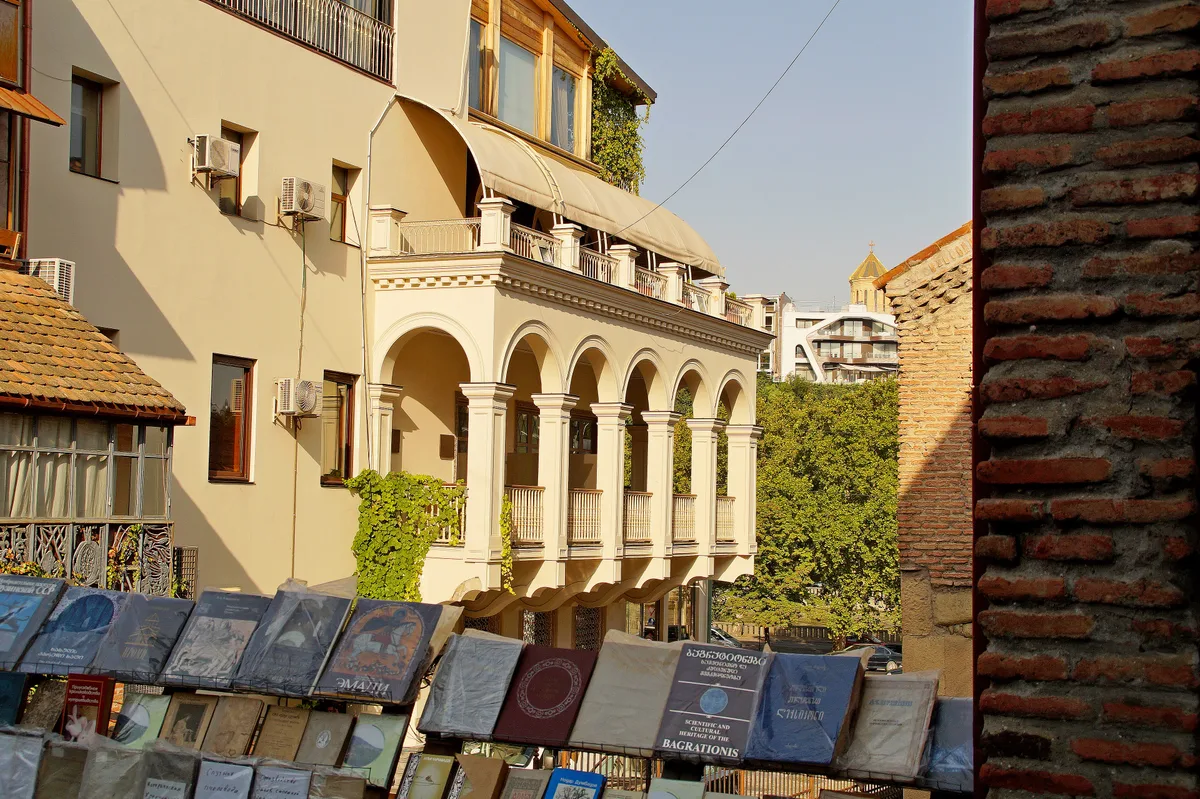
Three days of books in mid-November
Tbilisi Book Days runs from Friday 13 to Sunday 15 November 2026. That means one working day and a full weekend, so the fair gets two kinds of visitor: people slipping in after the office, and people who give it a whole Saturday.
This is an annual book fair built around readings. It also has a strong English-language programme, which matters if you don’t read Georgian. You can follow a session, ask a question and leave with something you can actually read on the plane home.
What the English-language programme means for you
The English strand is the reason many international visitors come. Georgian literature has its own script and a long tradition, and most of it reaches outsiders only through translation. A fair that programmes in English puts you in the room with that conversation, not outside it.
In practice, a festival-goer who doesn’t read Georgian usually does three things:
- picks English-language sessions from the printed or online schedule
- looks for Georgian authors in English translation on the stalls
- uses Georgian-language readings to hear the language aloud, even without understanding it
That last one is worth doing. Spoken Georgian has clustered consonants and a rhythm unlike any language around it. Hearing a poet read it is a different experience from seeing it on a sign.
A city that writes in its own alphabet
Georgian script is the first thing that makes a book fair here feel unlike one in Berlin or London. The modern alphabet, Mkhedruli, has 33 letters with rounded, looping shapes and no capital letters. UNESCO added the living culture of Georgia’s three writing systems to its intangible heritage list in 2016.
The national epic is Shota Rustaveli’s The Knight in the Panther’s Skin, written in the 12th century. Rustaveli’s name is everywhere in the city: on the main avenue, the national theatre and a metro station. It is a fair guess you will find the poem on a stall in several translations.
Georgia also had its moment on the world publishing stage in 2018, as Guest of Honour at the Frankfurt Book Fair. That push brought far more Georgian writing into English and German. Those translations are exactly what an international reader goes looking for at Tbilisi Book Days.
Venue, tickets and getting across town
The organiser publishes the venue, the daily schedule and the ticket links on its official site. That page is the one source for where the fair sits this year and how entry works.
Tbilisi is easy to move around on a fair weekend. The metro is cheap, frequent and deep underground, with long escalators. Line 1 runs through the centre with stops at Liberty Square and Rustaveli, the two stations nearest the old-town end of Rustaveli Avenue.
Ride-hailing apps, Bolt above all, are how most visitors cover the distances the metro doesn’t. The ride usually beats waving down a street taxi and haggling over the fare.
Moving through a Tbilisi book fair
A few habits make the three days smoother.
- Paying: cards and contactless work widely in central Tbilisi. Smaller stalls and secondhand sellers often prefer cash in Georgian lari, so many visitors carry some.
- Language: a “gamarjoba” (hello) and “madloba” (thank you) goes a long way with stallholders, even if the rest of the chat is in English.
- Signings and readings: attendees typically drift towards a session room before it starts. The popular names fill seats quickly.
- Luggage: book-buyers flying out usually bring a foldable tote. Hardbacks in an unfamiliar script are heavy, and Georgian editions are hard to find abroad.
Friday is the working-day session. Locals with jobs tend to come at the weekend, so visitors who want room to browse the stalls often aim for the Friday.
Dry Bridge and the booksellers of Rustaveli Avenue
The fair is only part of a bookish weekend here. The Dry Bridge market, near the Mtkvari river, is Tbilisi’s open-air flea market. Sellers lay out Soviet-era books, old maps, enamel badges and paintings on blankets and folding tables. It is at its fullest at weekends, which fits the fair’s Saturday and Sunday.
Rustaveli Avenue is the city’s main boulevard. Along it you’ll find the Rustaveli Theatre, the Georgian National Museum and the old Parliament building. Prospero’s Books, an English-language bookshop with a café in its courtyard, sits on the avenue and is a long-standing stop for readers.
Together they make an easy loop: the fair, a walk down Rustaveli and a browse at Dry Bridge, all in a day.
November in Tbilisi
Mid-November is late autumn here. Days are cool, evenings are colder, and grey, damp spells are common. Fair-goers dress in layers they can peel off indoors, because halls full of people and stalls warm up fast.
The shoulder season works for visitors. The summer crowds have gone from the old town and the sulphur baths in Abanotubani. Grape-harvest season has just ended, so the new wine is starting to appear in wine bars and restaurants. Most visitors give the fair one full day and spend the rest of a long weekend on the city.
Frequently asked questions
When is Tbilisi Book Days 2026?
It runs from Friday 13 to Sunday 15 November 2026, one weekday followed by a full weekend.
Where is Tbilisi Book Days held, and how do I get tickets?
The organiser publishes the venue, daily schedule and ticket links on its official site. Central Tbilisi is easy to reach on metro Line 1 (Liberty Square and Rustaveli stations) or by Bolt.
Is there anything for visitors who don't speak Georgian?
Yes. The fair has a strong English-language programme of readings and talks, and the stalls usually carry Georgian literature in English translation.
How long should I spend at the fair?
Most visitors give it one full day of sessions and browsing. They spend the rest of the weekend on the city, often at the Dry Bridge market and the bookshops along Rustaveli Avenue.
What else is there for book lovers nearby?
The Dry Bridge flea market sells secondhand and Soviet-era books, especially at weekends. Prospero's Books on Rustaveli Avenue is a well-known English-language bookshop with a courtyard café.
Plan your trip to Tbilisi
Georgia eSIM & staying connected →
Some links above are affiliate links — if you book through them, Wander Atlas earns a small commission at no extra cost to you. It's how we keep every guide free.
Related guides
 event
China Moses Tbilisi Concert: Dates, Tickets & Venue (Tbilisi)
 event
Feast of the 100,000 Holy Martyrs of Tbilisi: Dates, Tickets & Venue (Tbilisi)
 Ended
Kovacs Tbilisi Concert: Dates, Tickets & Venue (Tbilisi)
 event