Shinjuku Golden-Gai: Tokyo Travel Guide (4.3★)
When to visit Japan: month-by-month weather, crowds and holidays →
✓ Facts verified via Google Places · Sep 22, 2026
At a glance
Live foot-traffic data via BestTime.app
How this guide is made
Produced with AI assistance and reviewed against live data sources. Facts such as hours, ratings, and location come from Google Places; images are licensed or public domain. Details can change — please verify before visiting. Editorial policy
Six alleys, maybe two hundred bars, most of them fitting five or six people if everyone breathes in. That’s Golden-Gai in one sentence, and it’s the reason the district feels like nowhere else in Shinjuku.
What the alleys actually look like
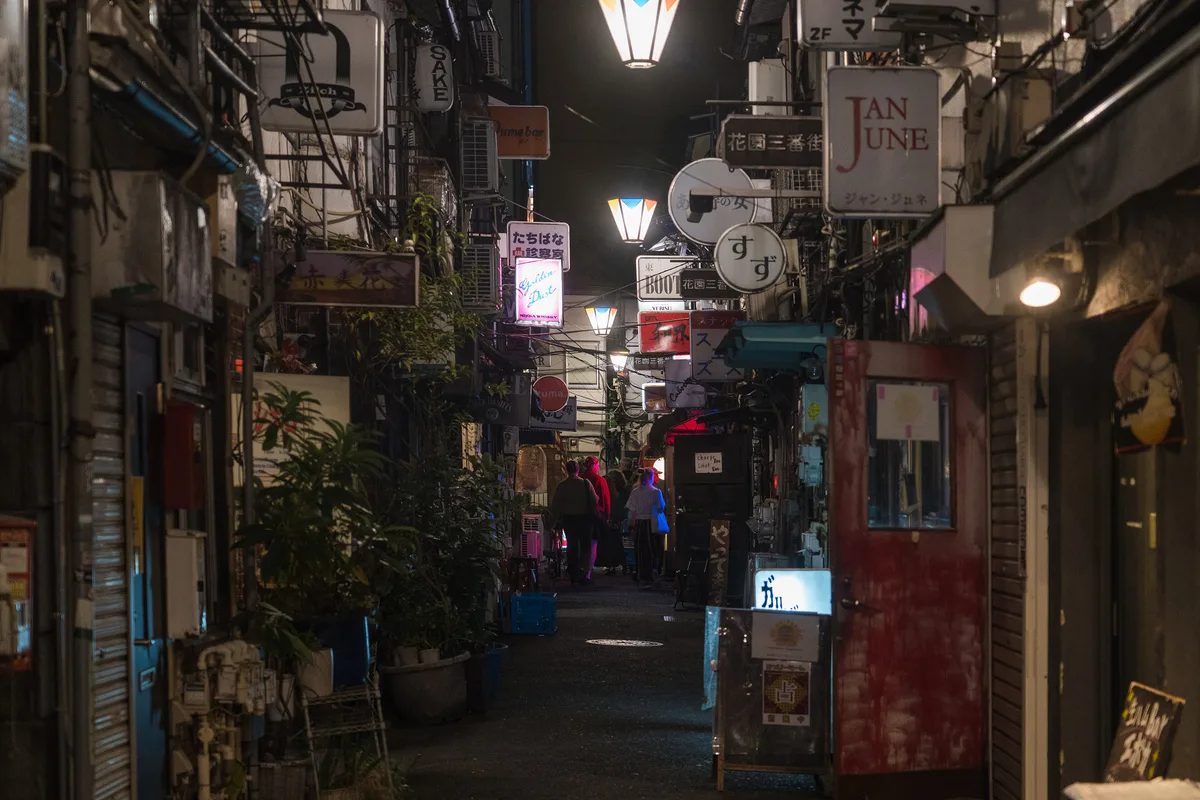
The buildings are two-storey, timber-framed, thrown up in the postwar decades and never rebuilt into anything bigger. Walk the lanes and you’re reading a wall of hand-painted signs, most in Japanese only, stacked in narrow doorways with steep stairs to second-floor rooms.
Each bar has its own theme, owner and regulars: one might be devoted to 1980s Japanese rock, another to a single mama-san’s decades of collected vinyl. There’s no unifying decor because there’s no single owner behind Golden-Gai; it’s roughly 200 independent, often one-person operations.
Finding it from Kabukicho
Golden-Gai sits at the northeast edge of Kabukicho, a short walk from Shinjuku Station’s east exit. Seibu Shinjuku Station is even closer, just a few minutes on foot.
Look for the gap between Kabukicho’s neon towers and the quieter Hanazono Shrine grounds; the alleys are tucked into that seam, easy to miss if you’re not looking for a low, dim row of doorways.
When to go
The district itself never closes, since it’s a public street grid, not a single venue. But the bars run their own clocks, typically opening in the evening and running late.
Weekends between 7pm and 11pm are the busiest window by far; expect shoulder-to-shoulder alleys and queues outside the smaller bars. If you want to actually see the architecture and read the signage without a crowd, come on a weekday between 7am and 3pm, or a weekend morning before 2pm, when most shutters are down and the lanes are nearly empty.
That daytime quiet is also the best time for photos: the paper lanterns and hand-painted signs without a wall of shoulders in front of them.
Picking a bar without wasting your night
Some bars post a cover charge or seat charge on a small sign by the door; others don’t, and either way it’s rarely written in English. A few basic habits save you a lot of standing around:
- Look for a laminated sign or handwritten note in English near the entrance; its absence usually means the owner doesn’t expect (or particularly want) non-Japanese-speaking drop-ins that night.
- Bars with five or six stools fill fast; if it’s full, the polite move is to leave immediately, not to hover in the doorway.
- Cash is safer than card. Many of these are one-person operations without a card reader.
- If a bar has an English sign welcoming tourists, that’s usually a genuine invitation, not just tolerance.
Beating the Golden-Gai crowds
This isn’t a quiet corner of Tokyo anymore; it’s a very popular stop on most Shinjuku itineraries, and the alleys show it after dark. Arriving right after most bars open, rather than at peak evening hours, gets you a stool instead of a wait.
Sticking to one or two bars for the whole night, rather than alley-hopping, also matters here: seats are scarce, and owners remember the difference between someone settling in and someone popping in for a photo. If you just want to look, walk it in daylight instead, when the lanes are close to empty and nobody’s territory is being disturbed.
What’s around it
Hanazono Shrine borders Golden-Gai to the east, a working Shinto shrine with a small night market on shrine festival days. Kabukicho’s main strip, with its arcades, izakaya towers and the Robot Restaurant building, is a few minutes’ walk southwest.
If Golden-Gai’s tiny seats feel too tight, Omoide Yokocho, another postwar alley cluster known for yakitori skewers, sits on the opposite side of Shinjuku Station and makes a good comparison stop on the same night.
Frequently asked questions
How do I get to Shinjuku Golden-Gai?
Walk from Shinjuku Station's east exit toward Kabukicho, or use Seibu Shinjuku Station, which is even closer. The alleys sit at the northeast edge of Kabukicho, near Hanazono Shrine.
When is Golden-Gai least crowded?
Weekdays between 7am and 3pm, or weekend mornings before 2pm, are quietest since most bars haven't opened yet. Avoid weekend evenings between 7pm and 11pm, when the alleys are at their busiest.
Do I need to speak Japanese to get into a bar?
Not always. Some bars post English signs welcoming visitors; if there's no English signage at the door, it's often a sign the owner isn't expecting non-Japanese-speaking walk-ins that night.
How long should I spend at Golden-Gai?
An hour or two is enough to walk the six alleys and settle into one bar. Most visitors pick a single spot for the evening rather than hopping between bars, since seating is limited to a handful of stools each.
What's nearby if Golden-Gai is full?
Omoide Yokocho, another postwar alley cluster known for yakitori, is on the opposite side of Shinjuku Station. Hanazono Shrine is a short walk east of Golden-Gai.
Plan your trip to Tokyo
Some links above are affiliate links — if you book through them, Wander Atlas earns a small commission at no extra cost to you. It's how we keep every guide free.
Related guides
This spot is Day 4 of our Tokyo 5-day itinerary