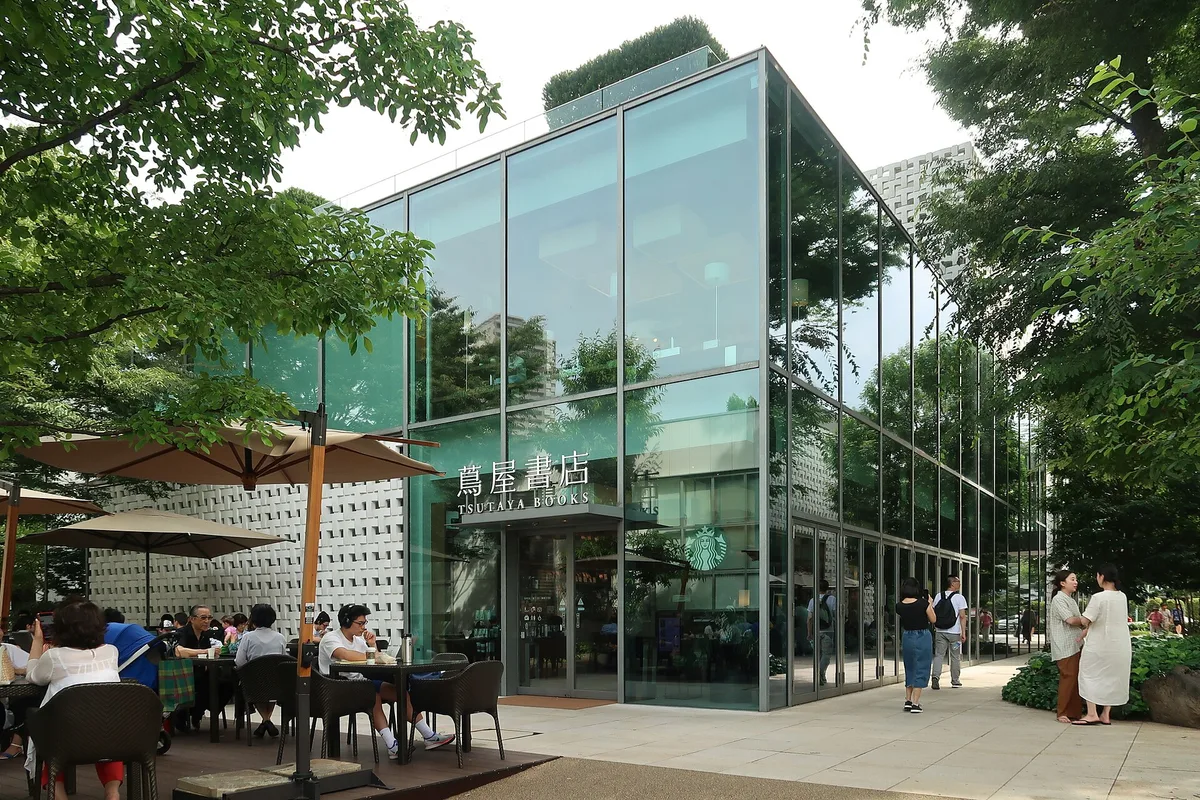
Three white pavilions on Kyu-Yamate-dori
From the street you see three low, white buildings. Their facades are covered in a lattice of small interlocking “T” shapes, the bookshop’s initial repeated until it reads as texture. Glass runs along the ground floor, so the shelves are visible from the pavement. Trees line the walkways between the buildings.
This is Daikanyama T-Site, the complex where Tsutaya Books occupies the first and second floors of buildings 1 to 3. The address is Sarugakuchō 17-5, on the quieter, residential side of Shibuya. Don’t expect a secret: this is one of the most-reviewed bookshops in Tokyo, and it is busy on most days.
Walking Magazine Street
The covered corridor that threads through all three buildings is the spine of the place. Bookshop staff and fans call it Magazine Street. It is lined with magazines in Japanese and other languages: fashion, interiors, cars, photography, food, travel. Many titles are hard to find outside Japan.
Branching off it, each building takes on its own subjects. The shop is arranged by interest rather than by publisher, so a cooking shelf can hold cookbooks, food essays and travel writing together. Expect deep sections like these:
- Art, design and architecture, including large-format photo books
- Travel, with guidebooks and maps shelved near the travel literature
- Cars and motoring
- Cooking and food culture
- Humanities and literature
You can lose track of which building you are in, which is half the pleasure. Signs at each entrance show the subject map.
Upstairs: music, film and the café
The second floor slows down. According to the shop’s own description it carries music and movies as well as books. The upper rooms feel more like a library than a store, with low lighting and armchairs placed among the shelves.
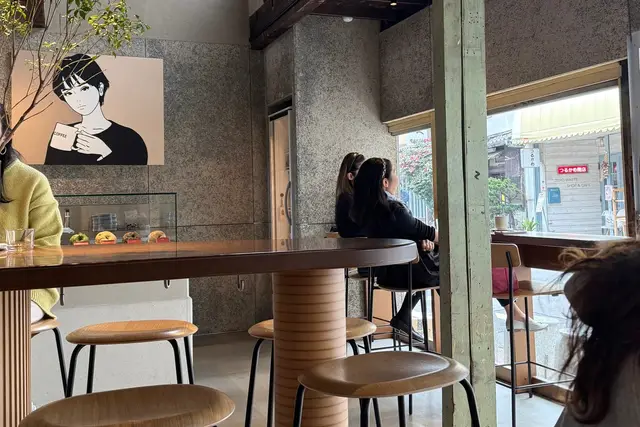
There is a café in the complex too. Tsutaya is known for letting you browse with a coffee nearby, and many visitors take a pile of magazines to a table before deciding what to buy. Rules on carrying unpaid books into seating areas can vary by zone, so follow the signs at the café entrance.

Browsing manners on the shop floor
Japanese bookshops have their own etiquette, and it applies here. Keep your voice low upstairs, where people sit and read for long stretches. Put books back where you found them rather than leaving them on the armchairs.
Photography is a common sticking point. Many Japanese bookshops ask customers not to photograph book pages or magazine spreads, and signs here may limit photos inside. The buildings’ exteriors and walkways are where most people take their pictures.
At the register, a few things help:
- Staff will usually ask if you want a paper cover (kabā) on a paperback. It is free, and a simple “hai, onegaishimasu” or “daijōbu desu” (no thanks) is all you need.
- Cards and transit IC cards such as Suica are widely accepted at large Japanese chains; carry a backup in case one fails.
- No tipping, here or in the café.
Beating the crowds at T-Site
There’s no crowd forecast for this shop, but the timing logic is simple. It opens at 9am, earlier than most of Daikanyama’s boutiques. Arriving in the first hour usually means quieter aisles and an easy café seat. Weekend afternoons draw the shopping crowd from Shibuya and Nakameguro, so expect more people then.
The late close works in your favour. Right now it stays open until 10pm every day of the week. An evening visit after dinner nearby is a good alternative if mornings don’t fit. The lit glass walls make the walk up from the station pleasant after dark.
Getting to Daikanyama
The nearest stop is Daikanyama Station on the Tokyu Toyoko Line, one stop from Shibuya. From there it is roughly a five-minute walk along Kyu-Yamate-dori to T-Site. Trains from Shibuya take only a few minutes.
If you are on the JR Yamanote Line, Ebisu Station is about a 15–20 minute walk, mostly uphill through residential streets. You can also walk from Nakameguro Station (Tokyu Toyoko and Tokyo Metro Hibiya lines) in a similar time. That walk makes it easy to pair the bookshop with the Meguro River.
Making an afternoon of Daikanyama
The bookshop sits on a stretch of Kyu-Yamate-dori known for low-rise architecture. A few things are close enough to pair with it:
- Hillside Terrace: Fumihiko Maki’s group of low buildings, built in phases from the late 1960s onwards, with galleries and shops along the same road.
- Kyu-Asakura House: a wooden Taisho-era residence from 1919 with a garden, a few minutes’ walk away and a sharp contrast to T-Site’s glass.
- Meguro River, Nakameguro: about 10–15 minutes downhill, lined with cherry trees, cafés and small shops.
Plan for 1–2 hours inside Tsutaya and about half a day for the neighbourhood. A good loop is the bookshop in the morning, lunch nearby, then down to Nakameguro for the afternoon.
Frequently asked questions
How do I get to Tsutaya Books Daikanyama?
Take the Tokyu Toyoko Line one stop from Shibuya to Daikanyama Station, then walk about five minutes along Kyu-Yamate-dori. Ebisu Station (JR Yamanote Line) and Nakameguro Station are each roughly a 15–20 minute walk.
What are the opening hours?
Google currently lists 9:00am–10:00pm, Monday to Sunday. Hours can change, so check the official T-Site page before a late visit.
When is the quietest time to visit?
We have no crowd forecast for this shop. Arriving soon after the 9am opening, before most nearby boutiques open, usually beats the weekend afternoon shopping crowd. A weekday evening visit is another calmer option.
How long should I spend there?
Plan on 1–2 hours to walk Magazine Street, browse the subject sections across the three buildings and stop at the café. Add half a day if you want to see Hillside Terrace, Kyu-Asakura House and Nakameguro too.
Are there English-language books?
Yes. The magazine selection includes many foreign titles, and the art, design, architecture and photography sections are very visual, so they're easy to enjoy without reading Japanese.
Plan your trip to Tokyo
Japan eSIM & staying connected →
Some links above are affiliate links — if you book through them, Wander Atlas earns a small commission at no extra cost to you. It's how we keep every guide free.