
A noodle bowl at the foot of Peace Bridge
Peace Bridge carries Chinggis Avenue over the railway tracks. It is the concrete link between central Ulaanbaatar and the southern districts. It went up in 1958 with Chinese assistance, so a bowl of northwest Chinese noodles at its foot fits the place.
This restaurant sits at the bridge’s Khan-Uul end, in HUD 1st khoroo. It is a small, consistently well rated halal kitchen that most visitors walk straight past. You come for one thing, a bowl of beef noodle soup in the Lanzhou style. Everything else is secondary.
One clear, two white, three red: reading the bowl
Lanzhou beef noodles come with a five-part rule that cooks in Gansu repeat like a proverb. It is the quickest way to judge any bowl that carries the city’s name:
- Clear: the beef broth should be clear, not cloudy.
- White: thin slices of white radish float in it.
- Red: a slick of chilli oil sits on the surface.
- Green: chopped coriander and garlic shoots go on top.
- Yellow: the noodles have a faint yellow tint from the alkaline dough.
The tradition belongs to the Hui, China’s Chinese-speaking Muslims, which is why Lanzhou noodle shops are halal almost everywhere you find them. Beef is the protein, and pork is never on the table.
In Ulaanbaatar, a city built on mutton and buuz dumplings, a light, clear broth makes a real change. It is lighter than the mutton soups and hearty enough for a January morning.
Choosing how thick you want the noodles
In the classic style, the dough is hand-pulled to order and you choose the thickness. Whether this kitchen offers the full range is something to check at the counter. The standard Lanzhou options, from thinnest to widest, are:
- Maoxi (毛细): hair-thin, cooks in seconds.
- Xi (细) and erxi (二细): thin and medium-thin, the everyday choice.
- Sanxi (三细): a slightly thicker round noodle.
- Jiuyezi (韭叶): flat, the width of a chive leaf.
- Kuan (宽) and dakuan (大宽): wide ribbons that hold more chilli oil.
If you don’t say anything, you will usually get a medium-thin round noodle. First-timers rarely go wrong with erxi. Flat noodles hold up better if you eat slowly.

Walking down Chinggis Avenue
Ulaanbaatar has no metro, and its traffic is notoriously bad. Walking is often the quickest way here from the centre. From Sükhbaatar Square, head south down Chinggis Avenue and cross Peace Bridge over the tracks. The walk takes roughly 20 minutes.
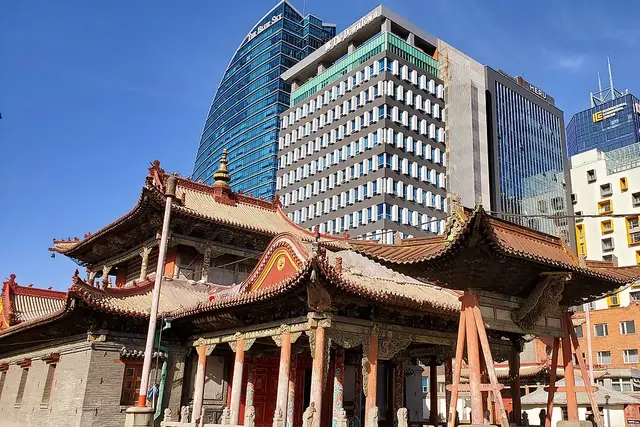
On the way you pass the Choijin Lama Temple Museum, a short detour east of the avenue. If you take a taxi or ride-hailing car, show the driver the plus code WW46+4H9 or the words “Peace Bridge, Khan-Uul”. Street addresses in the city are unreliable, but everyone knows the bridge.
In winter the open stretch over the railway is the coldest part of the walk. Cover your face and hands for it.
Ordering, paying and halal manners
Staff are likely to speak Mongolian and possibly Chinese. English is not something to count on. A few words help:
- Goimon (гоймон): noodles, in Mongolian.
- Ükhriin makh (үхрийн мах): beef.
- Lamian (拉面): hand-pulled noodles, if Chinese gets a response.
- Pointing at a menu photo or a neighbour’s bowl works everywhere.
Card payment is common in Ulaanbaatar, and locals often pay through bank apps or QPay. Still, keep some tögrög on you in case the terminal is down. Tipping is not customary in Mongolia, and nobody will expect it. Prices are moderate. Check the menu for current prices.
Because the kitchen is halal, don’t bring outside food, especially anything with pork. Don’t expect beer with your noodles either; if you want a drink, ask what they serve rather than assuming. Slurping is normal. Chilli oil and vinegar are the usual extras at a Lanzhou counter, so ask if you don’t see them.
A 9am bowl, and the Sunday problem
The opening hours are the useful quirk here. At the moment the restaurant opens at 9am and closes at 11pm, Monday through Saturday. That means hot broth for breakfast, a time when much of the city’s dining scene is still shut.
Eating noodle soup in the morning is completely normal in Lanzhou itself, and it makes sense in a capital with long, cold winters. At the other end of the day, an 11pm close catches you after a late performance or a long day trip.
Sunday it is closed. Don’t plan a weekend lunch around it without checking first. A bowl takes 20–30 minutes to eat at an unhurried pace. This is a quick stop, not an evening out.
Before or after: what’s near the bridge
The bridge is a natural stop between the centre and the south of the city. Pair the meal with:
- Bogd Khan Palace Museum: the winter palace of Mongolia’s last monarch, further south off Chinggis Avenue.
- Choijin Lama Temple Museum: a Buddhist temple complex now hemmed in by tower blocks, back towards the centre.
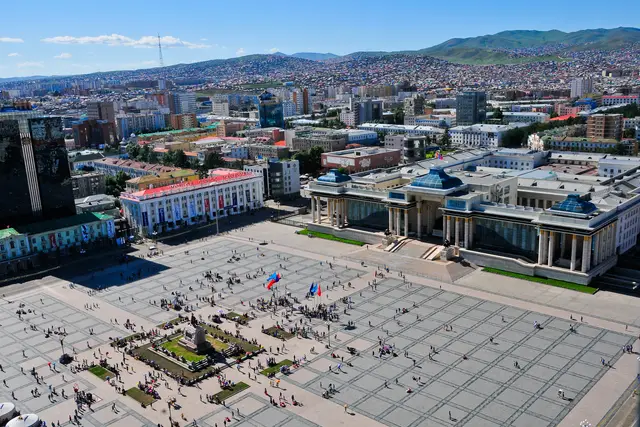
- Sükhbaatar Square: the parliament building and the Chinggis Khaan statue, about 20 minutes north on foot.
- Zaisan Memorial: the hilltop Soviet-era monument at the far southern end of the city, best reached by car.
Museum and memorial hours change through the season, so check each official site before you go. A bowl of noodles here before heading south to Zaisan sets you up well for the climb.
Frequently asked questions
Where exactly is Lanzhou Beef Noodles (Halal restaurant) in Ulaanbaatar?
It is at Peace Bridge, on the Khan-Uul (HUD 1st khoroo) side, plus code WW46+4H9. From Sükhbaatar Square, walk south down Chinggis Avenue and cross the bridge over the railway, which takes roughly 20 minutes.
Is it open on Sundays?
No. At the moment it opens 9am–11pm Monday to Saturday and is closed on Sunday. Check before you go, as hours can change.
Can I eat breakfast there?
Yes. Doors currently open at 9am, so a bowl of beef noodle soup works as a warm breakfast. Noodles in the morning are completely normal in Lanzhou itself.
Do I need to speak Mongolian or Chinese to order?
It helps, but it isn't essential. Pointing at menu photos works, and the words 'goimon' (noodles) and 'lamian' (hand-pulled noodles) are useful. Tipping is not expected in Mongolia.
What else can I see nearby?
The Choijin Lama Temple Museum and Sükhbaatar Square are north towards the centre. The Bogd Khan Palace Museum and the Zaisan Memorial are to the south along the same main road.
Plan your trip to Ulaanbaatar
Mongolia eSIM & staying connected →
Some links above are affiliate links — if you book through them, Wander Atlas earns a small commission at no extra cost to you. It's how we keep every guide free.
Related guides
 attraction
 Ulaanbaatar Park: Travel Guide
 attraction
 Choijin Lama Temple Museum: Ulaanbaatar Travel Guide (4.4★)
 trendy
 State Department Store: Ulaanbaatar Travel Guide (4.3★)
 attraction