
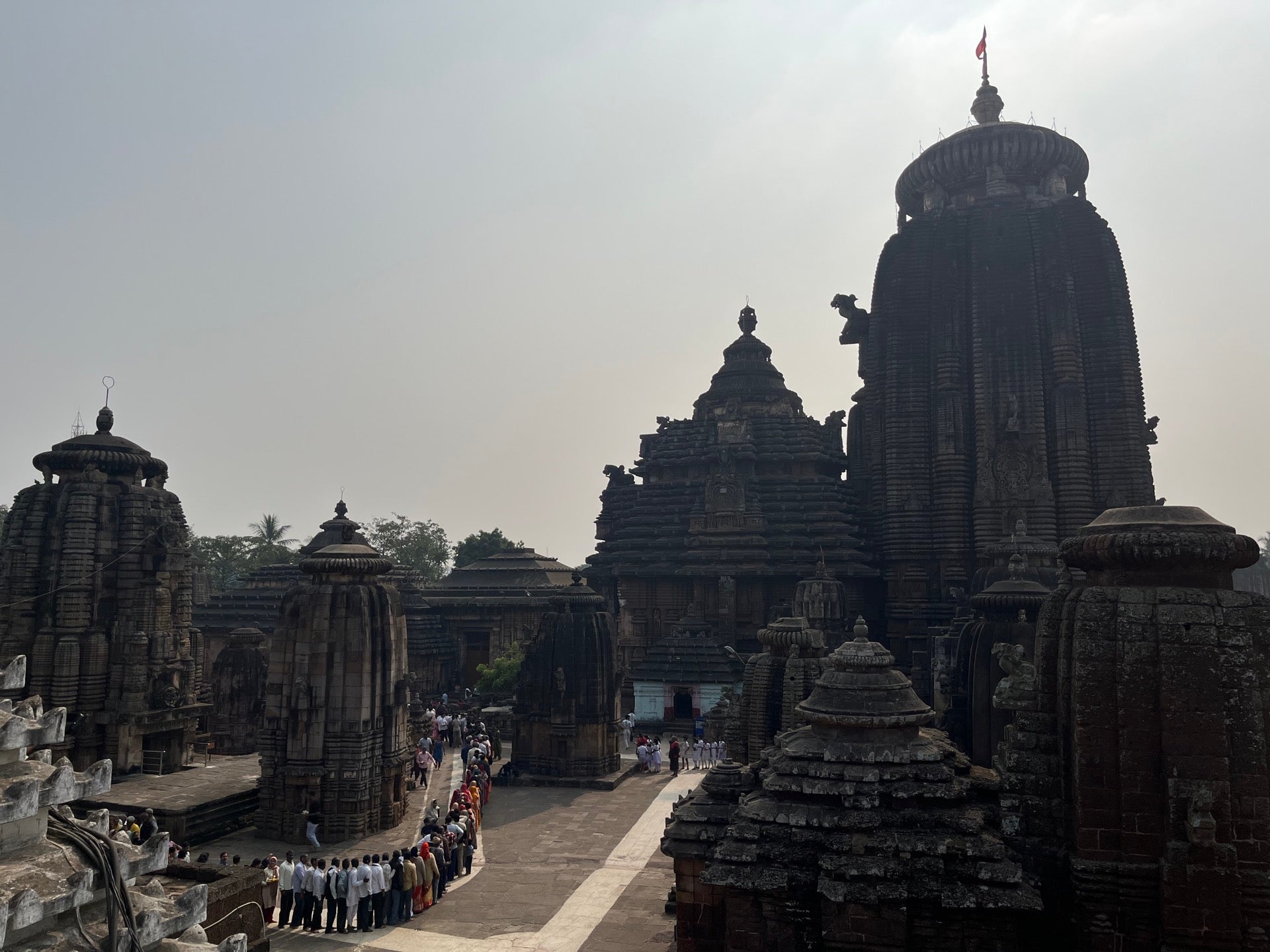
Lingaraj Temple sits on a walled compound in Old Town, a part of Bhubaneswar that still feels like a separate settlement from the newer state capital built around it. The main tower, or deul, rises about 55 metres over the courtyard, carved from local sandstone and laterite blocks that have gone soft grey and green with a thousand years of monsoons.
It’s the largest and most complete of the temples that once numbered in the hundreds across this old temple city, and it’s still a working shrine, not a monument behind glass.
The temple is dedicated to Harihara, a combined form of Shiva and Vishnu, which is part of why it draws such a broad cross-section of pilgrims. Odisha’s Kalinga-style architecture is on full display here: a tall curvilinear tower over the sanctum, a stepped assembly hall in front, and a jagamohana porch where deities are dressed and offerings are made before the crowd files past.
Getting inside the compound
The temple sits on Lingaraj Temple Rd in Old Town, a short auto-rickshaw ride from Bhubaneswar’s main railway station or Kalinga Stadium area. There’s no metro line here; taxis and autos are the normal way in, and most drivers know the temple by name.
Opening hours run 6:30am to 7:30pm every day of the week, so there’s no early or late exception to plan around. Give yourself 45 minutes to an hour inside if you want to walk the perimeter and take in the smaller shrines, closer to 20 minutes if you’re just viewing the main tower from the platform.
The platform, and who can go where
Non-Hindu visitors are not permitted inside the main sanctum, a rule that has held here for decades and is enforced by temple staff at the threshold. Instead, there’s a raised viewing platform just outside the boundary wall, built specifically so visitors can see the tower and courtyard activity without entering.
This isn’t a workaround or a consolation prize, it’s the accepted way most outside visitors experience the temple, and guides stationed near the platform will point out the assembly hall and sanctum roofline from there. Bring a zoom lens or binoculars if the carving detail is what you’re after, since the platform sits at some distance from the tower itself.
Beating the weekend crush
Lingaraj draws heavy numbers year-round, and it is not a quiet, undiscovered spot; expect company at almost any hour. The measured quiet spells are 7am to 8am on both weekdays and weekends, right after opening, before tour groups and the bulk of pilgrims arrive.
Weekends between 5pm and 7pm are the hours to avoid. That’s when the courtyard and platform area fill up fastest, particularly as evening aarti approaches and local families arrive after work. If you can only come on a Saturday or Sunday, shifting to the 7am slot instead of the evening will save you real time in the queue.
What to wear, what to bring, how to move through
Dress modestly: covered shoulders and knees for both men and women, nothing sleeveless or overly short. Footwear comes off before the inner precincts, so slip-on shoes or sandals make the whole process faster than laced-up boots.
A few practical notes locals and repeat visitors follow:
- Small denomination notes are useful for donations to individual shrine priests along the walk
- Photography is generally restricted near the inner sanctum, though the platform view is usually fine to photograph
- Priests may offer to guide you around for a fee; agreeing to a price upfront avoids confusion later
- The stone courtyard gets hot underfoot by mid-morning in dry season, so early visits are kinder on bare feet
Beyond the main tower
The compound holds dozens of subsidiary shrines packed into the courtyard, dedicated to various forms of Shiva, Parvati, and other deities, along with a sacred tank called Bindusagar just outside the temple walls. Many visitors walk the short distance to Bindusagar after Lingaraj, since local tradition holds that the tank’s water carries a drop from every sacred body of water in India.
If you’re building a half-day around Old Town’s temple cluster, Mukteswar Temple and Rajarani Temple are both within easy reach and worth pairing with Lingaraj for a fuller sense of Kalinga-era stonework across different centuries.
Plan your trip to Bhubaneswar
India eSIM & staying connected →
Some links above are affiliate links — if you book through them, Wander Atlas earns a small commission at no extra cost to you. It's how we keep every guide free.
Related guides
 attraction
 Odisha State Museum: Bhubaneswar Travel Guide (4.5★)
 attraction
 Udayagiri and Khandagiri Caves: Bhubaneswar Travel Guide
 hidden gem
 Ekamra Haat: Bhubaneswar Travel Guide (4.3★)
 hidden gem