Udayagiri and Khandagiri Caves: Bhubaneswar Travel Guide
✓ Facts verified via Google Places · Aug 29, 2026
At a glance
Opening hours
- Monday: 6:30 AM – 7:30 PM
- Tuesday: 6:30 AM – 7:30 PM
- Wednesday: 6:30 AM – 7:30 PM
- Thursday: 6:30 AM – 7:30 PM
- Friday: 6:30 AM – 7:30 PM
- Saturday: 6:30 AM – 7:30 PM
- Sunday: 6:30 AM – 7:30 PM
Live foot-traffic data via BestTime.app
How this guide is made
Produced with AI assistance and reviewed against live data sources. Facts such as hours, ratings, and location come from Google Places; images are licensed or public domain. Details can change — please verify before visiting. Editorial policy
Why go
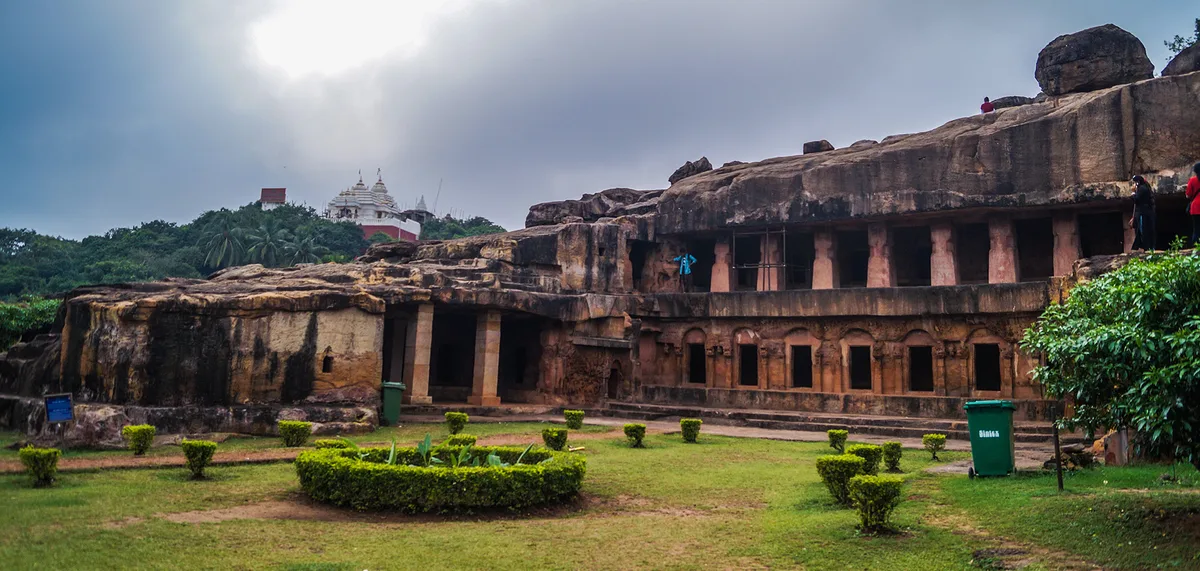
Two low, scrub-covered hills rise on the outskirts of Bhubaneswar, and cut straight into their sandstone are dozens of cells, verandas, and courtyards hollowed out more than two thousand years ago for Jain monks. This isn’t a reconstruction or a museum diorama. You’re walking through the actual chiselled rooms where ascetics sat out the monsoon, tracing carved friezes of elephants, dancers, and hunting scenes that have weathered but not vanished.
It’s one of the oldest surviving rock-cut architectural complexes in India, older than most of the temples Bhubaneswar is famous for, and the fact that a working Jain temple still crowns Khandagiri means the site hasn’t fully calcified into a ruin. You’ll likely see a handful of pilgrims climbing past the caves toward it.
Getting there
The caves sit about 6-7 km west of Bhubaneswar’s city center, an easy 15-20 minute auto-rickshaw or cab ride from Master Canteen or the railway station. If you’re coming by train, Bhubaneswar Railway Station is the main hub, and most drivers know the site simply as “Udayagiri Khandagiri.” There’s no metro here, so ride-hailing apps or a pre-negotiated auto are the practical options; a return trip is easy to combine with a stop at the Odisha State Museum or Dhauli’s peace pagoda on the same half-day out.

What to see
Udayagiri, the larger of the two hills, is where you’ll spend most of your time. Cave 1, Rani Gumpha (“Queen’s Cave”), is the showpiece (a double-storeyed excavation wrapped in relief carvings of battle scenes, elopements, and courtly processions, its pillared verandas still legible after two millennia of wear. Cave 14, Hathi Gumpha (“Elephant Cave”), carries a long Prakrit inscription attributed to King Kharavela of the Mahameghavahana dynasty, one of the most important early historical inscriptions in eastern India) even if you can’t read the script, a guide or the on-site signage will walk you through what it records.
Climb to the top of Udayagiri and you get a wide, unglamorous but honest view over the surrounding plain and quarries.
Cross the road to Khandagiri and the mood shifts: fewer coach groups, a steeper scramble up bare rock, and at the summit an 18th-century Jain temple that’s still in active use, incense and bells included. The caves here are smaller and less decorated than Udayagiri’s, but the walk up is worth it for the temple alone and for looking back across at Udayagiri’s carved face from a distance.
When to go
The site opens early in the morning and stays open through the day, and the difference between a good and a crowded visit here is almost entirely about timing. Weekday mornings tend to be the calmest, and even weekend mornings stay manageable until midday. The crunch comes between 12pm and 5pm on weekends, when tour buses and family groups arrive en masse. Plan around that window rather than into it.
Early morning is also simply more comfortable physically: the rock holds heat, there’s minimal shade on the climbs, and Odisha’s afternoon sun by mid-morning in the warmer months is no joke.
How to visit like a local
Go early on a weekday, when the site tends to be quieter and the light is soft enough for photographs of the carvings without harsh glare. This is a genuinely well-visited landmark, not an undiscovered spot, so if you can’t do a weekday, at least front-load a weekend visit before noon to dodge the 12-5pm crush.
Wear shoes you can slip off easily, since you’ll remove them before entering the temple at Khandagiri’s summit, and carry water. There’s little shade once you’re climbing. Small tips for informal guides hovering near the entrance are common if you want the Hathi Gumpha inscription or the Rani Gumpha panels explained in more depth; agree on a rate before starting, since this isn’t formally regulated.
The most common visitor mistake is treating Udayagiri as the whole trip and skipping Khandagiri. The second hill takes only another 30-40 minutes and its temple-top view back across at the caves is one of the better photo spots on site.
Frequently asked questions
What are the opening hours?
Daily, 6:30am to 7:30pm, with no weekly closing day.
How long should I plan to spend here?
Around 90 minutes to two hours to see the main caves on both hills; add 30-40 minutes if you want to fully explore Khandagiri's temple summit.
When is it quietest?
Any time between 7am and 7pm on weekdays is calm, and weekend mornings before noon are still manageable. Avoid weekends between 12pm and 5pm, when it's busiest.
How do I get there from central Bhubaneswar?
It's about a 15-20 minute auto-rickshaw, taxi, or ride-hail trip (roughly 6-7 km) from the railway station or Master Canteen area; there's no direct metro or rail link to the site.
Is there an entry fee?
There's typically a modest entry ticket with a separate (higher) rate for foreign visitors and an extra camera fee, but confirm current pricing at the gate since rates change periodically.
Plan your trip to Bhubaneswar
Some links above are affiliate links — if you book through them, Wander Atlas earns a small commission at no extra cost to you. It's how we keep every guide free.
Related guides
 attraction
 Lingaraj Temple: Bhubaneswar Travel Guide (4.7★)
 attraction
 Odisha State Museum: Bhubaneswar Travel Guide (4.5★)
 hidden gem
 Regional Museum of Natural History: Bhubaneswar Travel Guide
 Ended
Ended