
What you’re actually booking
Start with what the name means. Google lists borjomi-park as an inn, not as the town’s famous mineral-water park, and its address is 5 Ketevan Tsamebuli St. Searches for “Borjomi park” mix the two up all the time. Make sure you know which one you’re looking for.
It’s a small place with a modest number of reviews, and guests rate it consistently well. That makes it a quieter find than the bigger hotels along the river. We can’t vouch for the rooms, breakfast or facilities, so check the current listing for those. What we can describe is the town you’ll wake up in.
Borjomi from the doorstep
Borjomi sits in a narrow, pine-covered gorge of the Mtkvari River in the Samtskhe-Javakheti region. The town spreads along both banks, and the valley walls rise steeply on either side. Wherever you’re standing, you see forested slopes.
Much of the centre was built when Borjomi was a spa resort under the Russian Empire, and later a Soviet one. You’ll see two things side by side:
- Carved wooden balconies and pastel 19th-century villas
- Concrete sanatorium blocks from the Soviet years
Because the town is compact, most of the sights covered here are walkable from wherever you stay in the centre. Check the map distance from Ketevan Tsamebuli St to the park gates before you decide whether you need a taxi.
Filling your bottle at the spring
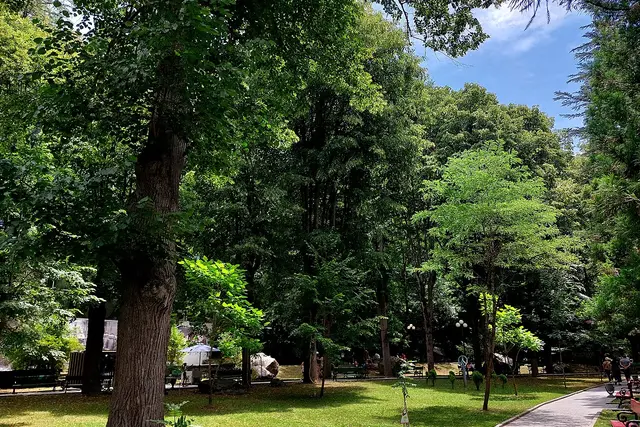
This is the ritual Borjomi exists for. Inside Borjomi Central Park, often called the Mineral Water Park, a pavilion with taps pours the town’s famous water straight from the source. It’s naturally fizzy, and the bottled version is sold across the former Soviet world.
Straight from the tap, it isn’t cold and refreshing. It comes out lukewarm, salty and sharply mineral, closer to medicine than table water. Most people take a small cup, pull a face and then go back for more. Bring an empty bottle if you want to carry some up the path.
Entry rules and any fee for the park are posted at the gate.
Up the gorge to the sulphur pools
The park’s main path follows the Borjomula stream deeper into the gorge. Expect footbridges, old pavilions and dense forest. Keep walking for roughly 3 km and you reach the open-air sulphur pools.
These are warm, stone-lined pools fed by natural springs, set among the trees at the top of the valley. They smell of sulphur, as all sulphur baths do. Bring your own towel and swimwear, and have a change of clothes ready for the walk back.
The walk up takes most people under an hour at an easy pace, with a gentle, steady climb. Give the whole loop, with time in the water, around half a day. Pool hours change by season, so ask locally before you set off late in the afternoon.

Getting to Borjomi from Tbilisi
Borjomi is about 160 km west of Tbilisi. Your three main options:
- Marshrutka (minibus): the usual route. Minibuses leave from Didube bus station in Tbilisi and take around 2.5–3 hours.
- Train: a slower, cheaper ride on the line through the Mtkvari valley. Good if you have time and like a view from the window.
- Taxi or private driver: the most flexible option. Many travellers combine it with a stop at Gori or Uplistsikhe on the way.
From Kutaisi or Batumi, change at Khashuri, where the Borjomi road leaves the main east–west highway. Check departure times shortly before you travel, because schedules change.
Checking in at a small Georgian inn
Arriving at a place this size works differently from a hotel. There may be no 24-hour desk, so:
- Message ahead with your arrival time. Do it through the platform you booked on, and do it again on the day if your marshrutka runs late.
- Have the address in Georgian script or as a map pin. Taxi drivers in Borjomi recognise street names more readily than an English listing title.
- Learn two words. Gamarjoba (hello) and madloba (thank you) go a long way. Russian is widely understood among older Georgians, and English less so outside tourist businesses.
- Carry some lari in cash. Cards work in many Borjomi shops and restaurants, but small guesthouses, minibuses and market stalls often prefer cash.
Tipping is modest in Georgia. Many restaurants add a service charge to the bill, so look for it before adding more. Hosts at family-run places often offer homemade wine or fruit. Accepting a small glass is the polite answer, even if you only sip it.
Beyond the town: Likani, the national park and the Kukushka
Staying a second night pays off, because the best of Borjomi is outside the centre.
Borjomi-Kharagauli National Park is one of the largest protected areas in the Caucasus, and among the oldest. Its visitor centre at the edge of town hands out maps and registers hikers for its trails, which range from a few hours to multi-day routes with shelters.
Likani, just west of Borjomi, is home to the Romanov family’s former summer palace. It’s a turreted stone building beside the river, and you can usually only view it from outside. On the way, look for the Firuza house, the blue-trimmed wooden house built for a Persian consul and one of the town’s most photographed buildings.
The Kukushka is a narrow-gauge train that climbs slowly from Borjomi to the ski resort of Bakuriani. It crosses an Eiffel-era iron bridge and winds through forest. The ride is about the journey, not the speed. Check the current timetable at the station, since services run only a few times a day.
When to come
Each season gives you something different:
- May–June: green slopes and comfortable walking weather.
- September–October: the gorge’s mixed forest turns gold.
- Summer: the town is liveliest, with weekend visitors from Tbilisi.
- Winter: quieter and colder, with snow on the hills. Bakuriani’s slopes are a short ride up the Kukushka line.
Plan two nights to cover the park, the sulphur pools and one trip out of town without rushing.
Frequently asked questions
Is borjomi-park the same as Borjomi Central Park?
No. borjomi-park is listed as an inn at 5 Ketevan Tsamebuli St. Borjomi Central Park, also called the Mineral Water Park, is the town's spring and gorge park. Check the map distance between the two before you arrive.
How do I get to Borjomi from Tbilisi?
Most people take a marshrutka from Didube bus station, which takes around 2.5–3 hours. There's also a slower train, or you can hire a taxi or driver for the roughly 160 km trip. From western Georgia, change at Khashuri.
How long should I stay in Borjomi?
Two nights works well. That gives you half a day for the Mineral Water Park and the walk to the sulphur pools, plus a day for the national park, Likani or the Kukushka train to Bakuriani.
What should I bring for the sulphur pools?
Bring swimwear, a towel, a change of clothes and an empty bottle for spring water on the way. The pools are about 3 km up the park path, and their hours vary by season, so check locally first.
What time can I check in?
Check-in times aren't published here. Message the host through your booking platform with your arrival time, especially if you're coming by marshrutka, since there may be no 24-hour desk.
Plan your trip to Borjomi
Georgia eSIM & staying connected →
Some links above are affiliate links — if you book through them, Wander Atlas earns a small commission at no extra cost to you. It's how we keep every guide free.
Related guides
 attraction
Borjomi Central Park: Travel Guide (4.5★)
 hidden gem
Gogia Fortress: Borjomi Travel Guide (4.5★)
 attraction
Akhaltsikhe (Rabati) Castle: Travel Guide (4.7★)
 attraction