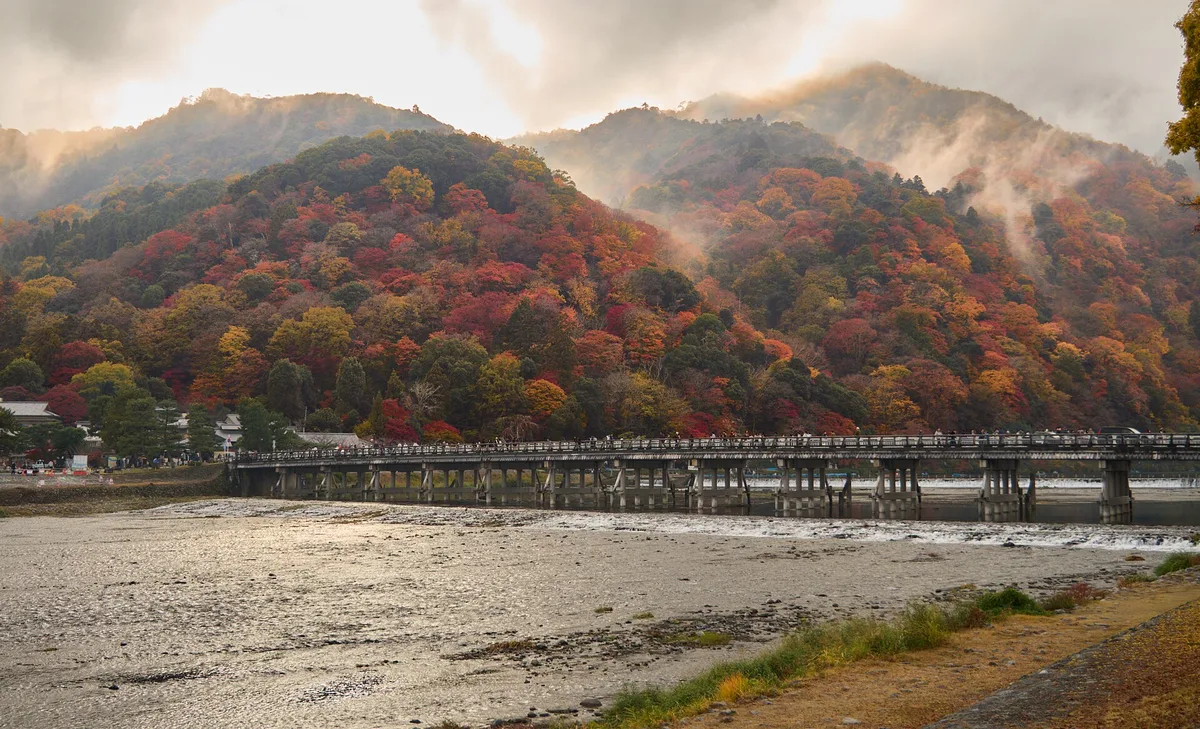
Where Kyoto meets the mountains
The city simply ends here. Low, forested hills rise straight from the far bank of the Katsura River, and the long wooden-railed span of Togetsukyo Bridge crosses toward them. Above the river this stretch is called the Hozu, and below it the Oi. Rowing boats are tied along the bank. Rickshaw pullers wait at the end of the bridge.
Arashiyama spreads across both banks of the river, in Kyoto’s Ukyo Ward. The north side, Sagano, holds the bamboo grove and most of the temples. The south side climbs into the hills of Iwatayama. Expect crowds from the start: this is one of the most visited corners of Kyoto, and nobody will mistake it for a secret.
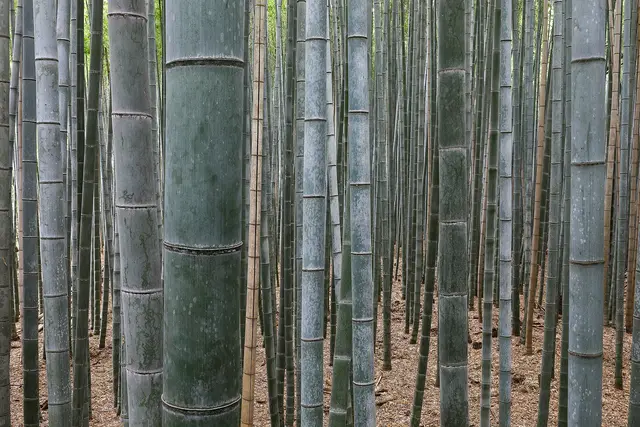
The bamboo grove at first light
The bamboo path is shorter than the photos suggest. It runs a few hundred metres from beside Tenryu-ji’s north gate toward Okochi Sanso, the hillside villa of the silent-film actor Denjiro Okochi. Fences of dried brushwood line both sides. Behind them, green stalks rise far overhead and close into a canopy, so the light down on the path stays filtered even at midday.
The grove is an open public path, not a ticketed site. That means you can walk it before the shops and temples open. Arriving early gives you the one thing the afternoon cannot: an empty view down the lane. Once the tour groups reach it, the path becomes a slow shuffle between two walls of phones.
- Enter from the Tenryu-ji end and walk uphill toward Okochi Sanso.
- Look for a gap in the crowd rather than stopping mid-path for photos.
- Continue north afterwards; the crowds thin quickly past the grove.
Up the hill to the macaques
The monkeys live on the south bank. Iwatayama Monkey Park sits on the hillside above the river, reached by a steep climb that takes most people around 20 minutes. Take water. The path switchbacks through woodland with benches along the way.
At the summit, Japanese macaques roam a clearing that looks east over the whole of Kyoto. You buy food inside a small hut and feed the monkeys through the wire mesh. The hut is the only place feeding is allowed. Outside it, the monkeys wander freely around visitors.
Staff post a few firm rules at the entrance. Follow them:
- Don’t stare directly into a monkey’s eyes.
- Don’t touch the monkeys or crouch down to their level.
- Keep food and plastic bags out of sight outside the hut.
Opening times shift with the seasons and the weather, and the park can close in heavy rain. Check the official site before you start the climb.

Tenryu-ji and the temples beyond the grove
Tenryu-ji anchors the district. It was founded in 1339 and is now part of the Historic Monuments of Ancient Kyoto UNESCO World Heritage listing. Its garden, designed by the Zen monk Muso Soseki, sets a pond against the borrowed backdrop of the Arashiyama hills. It is one of the oldest surviving gardens of its kind in Japan.
Most visitors turn back after the bamboo. Keep walking north instead and the lanes go residential and quiet. Along the way:
- Nonomiya Shrine, beside the grove, with a torii gate of unbarked black wood.
- Jojakko-ji, climbing a mossy slope, famous in autumn.
- Gio-ji, a small nunnery temple carpeted in moss.
- Adashino Nenbutsu-ji, with thousands of small stone statues in rows.
Temple hours change through the year, so check each one’s official site for the current month.
Getting to Arashiyama by rail
Three railways serve the district, each with its own station:
- JR Sagano Line (San-in Line) from Kyoto Station to Saga-Arashiyama Station, the quickest option from the main hub. It is about a 10-minute walk to the grove.
- Keifuku Randen tram from Shijo-Omiya to Arashiyama Station, right on the main street. The station platforms are lined with the Kimono Forest of lit fabric pillars.
- Hankyu Arashiyama Line, changing at Katsura, to Hankyu Arashiyama Station on the south bank, a short walk from the bridge and the monkey park.
IC cards such as ICOCA work on all three. Kyoto city buses also run here, but they crawl through traffic and fill up on busy days, so take the train.
Moving through Saga without the crush
Arashiyama is very popular, so beating the crowds is the main skill. Day-trip groups and tour coaches tend to arrive mid-morning and gather on the main street, the bridge and the bamboo grove. Starting at the grove right after sunrise, then working outward, usually keeps you ahead of them.
Do the loop in reverse of the crowd. If you are there by late morning, head north to Gio-ji and Adashino first, or cross the river to the monkeys. Save Togetsukyo for the late afternoon, when the light drops low over the hills.
The main street is lined with food stalls. Eat beside the stall where you bought the food rather than strolling with it, which is considered bad manners in Kyoto’s crowded lanes. Bins are scarce, so carry your rubbish back with you. Card and mobile payment is widely accepted, though smaller temples and stalls may still want cash. Tipping is not part of local practice.
Seasons on the Hozu River
The best time to visit depends on the river. Early April brings cherry blossom along the banks. In November, maples turn the hillsides red and the grove path draws its biggest crowds of the year. Summer evenings bring cormorant fishing (ukai) on the river, with boats lit by fire baskets. Winter is the quietest season.
The best arrival is by water. The Sagano Scenic Railway, an open-sided sightseeing train, runs up the gorge to Kameoka. From there, Hozugawa river boats bring you back down the rapids to Arashiyama, polled by boatmen. Both run seasonally and book up in autumn, so reserve ahead.
For a meal, the Saga area is known for yudofu, tofu simmered at the table in a pot of kombu broth. Tenryu-ji’s Shigetsu restaurant serves shojin ryori, Buddhist vegetarian cuisine, within the temple grounds. Prices for both are posted at the door and on their official sites.
Frequently asked questions
How do I get to Arashiyama from Kyoto Station?
Take the JR Sagano Line (San-in Line) to Saga-Arashiyama Station, then walk about 10 minutes to the bamboo grove. Alternatives are the Keifuku Randen tram to Arashiyama Station or the Hankyu line, changing at Katsura, to Hankyu Arashiyama on the south bank.
When is the best time to visit Arashiyama to avoid crowds?
Arrive early in the morning, ideally on a weekday. The bamboo grove is an open public path you can walk before tour groups arrive. Autumn foliage in November and cherry blossom in early April are the most crowded periods.
How long should I spend in Arashiyama?
A half day covers the bamboo grove, Tenryu-ji and Togetsukyo Bridge. Allow a full day if you add the monkey park climb, the northern temples such as Gio-ji and Adashino Nenbutsu-ji, or the Sagano train and Hozu river boat trip.
What should I know before visiting Iwatayama Monkey Park?
It sits on the south bank of the river, up a steep walk of about 20 minutes. Feed the macaques only from inside the hut at the top, don't stare into their eyes or touch them, and keep food out of sight. Hours vary by season and weather, so check the official site first.
Is the Arashiyama bamboo grove free to walk?
Yes, the bamboo path is a public lane, not a ticketed site. Tenryu-ji's garden and Okochi Sanso at the top of the path charge admission, and both post their current fees at the gate and on their official sites.
Plan your trip to Kyoto
Japan eSIM & staying connected →
Some links above are affiliate links — if you book through them, Wander Atlas earns a small commission at no extra cost to you. It's how we keep every guide free.