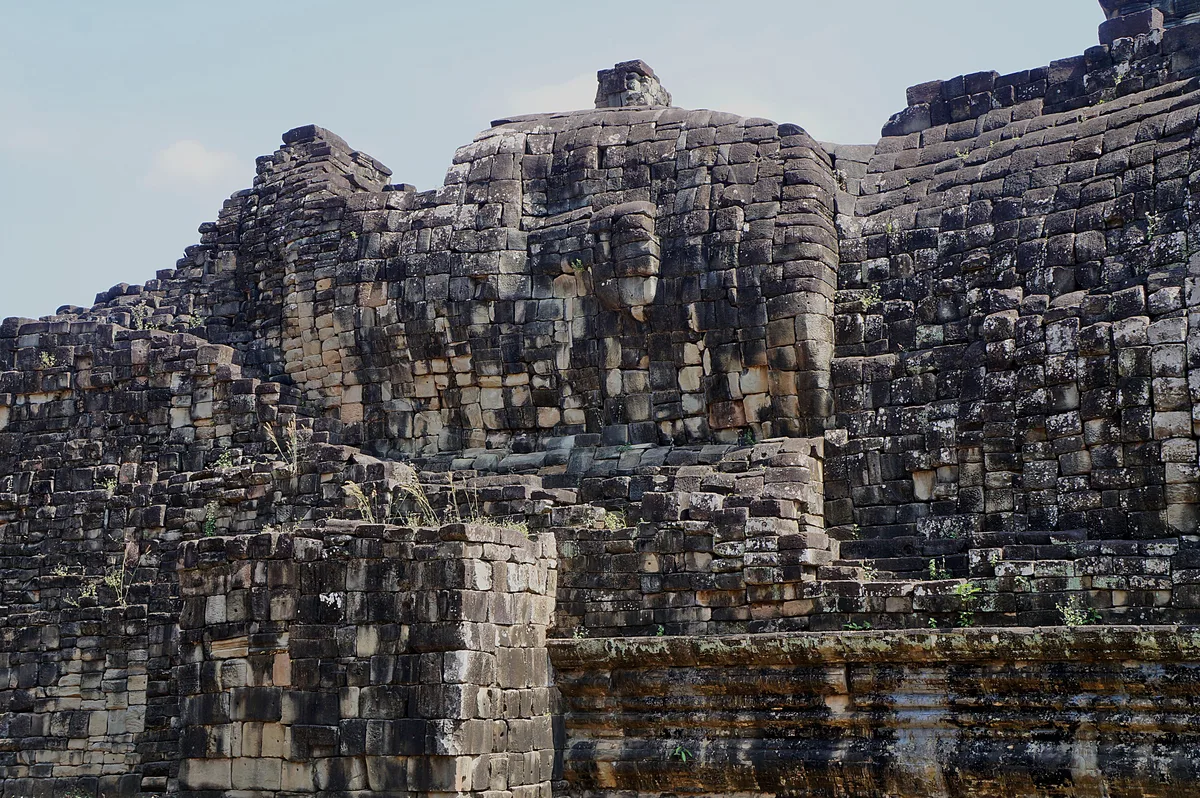
Why Baphuon still stands out
Baphuon is the temple most tour groups walk straight past. It’s a three-tiered pyramid built in the mid-11th century under King Udayadityavarman II, dedicated to Shiva, and it predates the Bayon by over a century.
What strikes you first is the scale of the reconstruction. French archaeologists spent decades piecing it back together using the anastylosis method, numbering and re-fitting tens of thousands of original sandstone blocks after the structure had partially collapsed. The result feels less polished than Angkor Wat, more raw and geological, like a hill made of carved stone rather than a finished monument.
Getting there and getting in
Baphuon sits inside Angkor Thom, the walled city just north of Angkor Wat, roughly a 10-minute tuk-tuk ride from central Siem Reap. Most visitors reach it on foot from the Bayon, heading northwest past the Royal Palace enclosure. It’s about a 5-minute walk between the two.
You’ll need the standard Angkor Archaeological Park pass to enter; there’s no separate ticket for Baphuon. Tuk-tuk drivers know it well and usually build it into a “small circuit” itinerary alongside the Bayon, Elephant Terrace, and Terrace of the Leper King.
The site is open daily from 5:00 AM to 6:30 PM, so an early entry for sunrise elsewhere in Angkor still leaves plenty of time to reach Baphuon before the heat sets in.
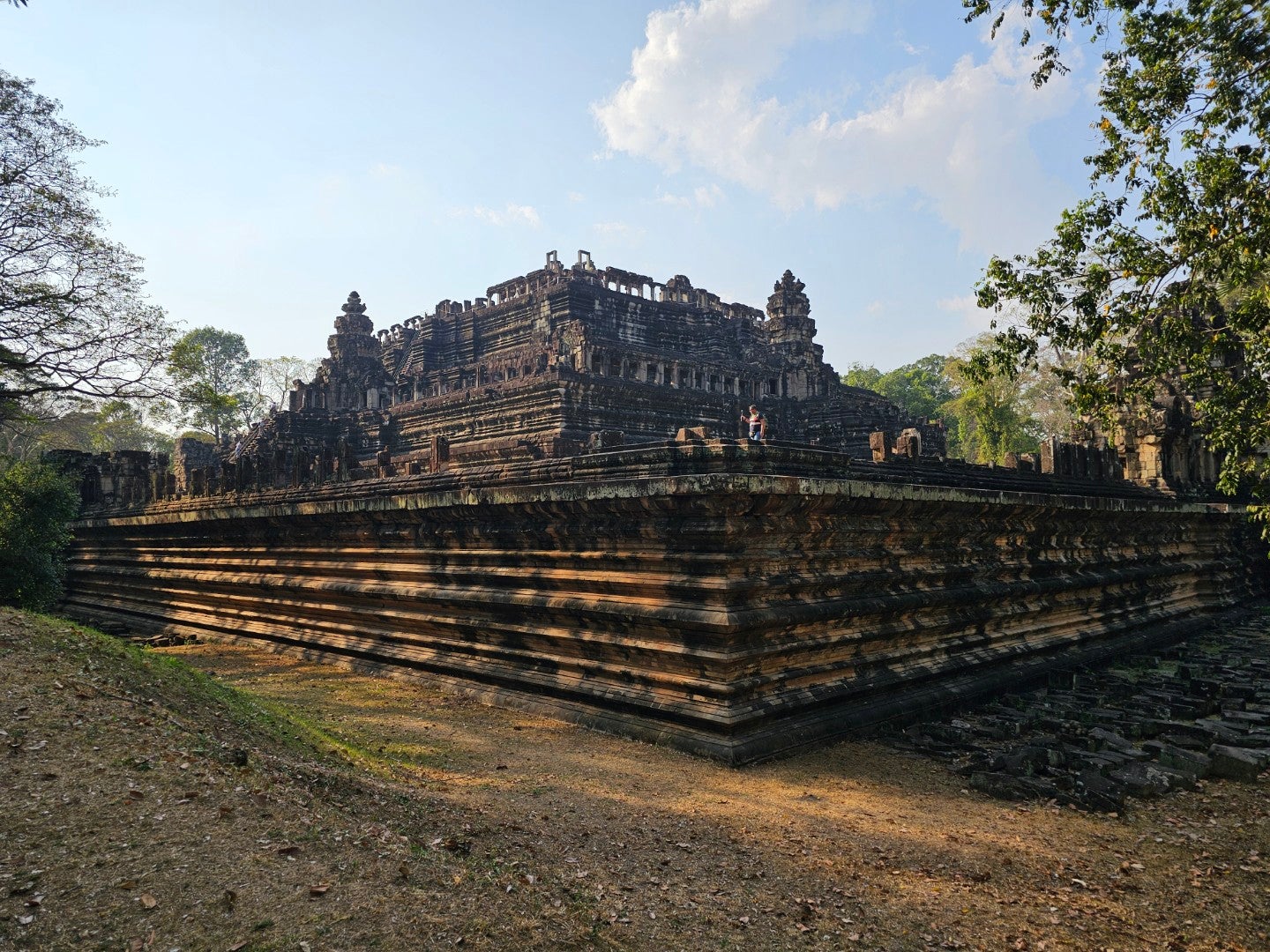
What you’ll actually see
The climb is the main event. A steep wooden staircase with a handrail, added for safety and noticeably less punishing than the original stone steps, takes you up the western face to the top terrace.
From there, the view opens across the treetops of Angkor Thom toward the Bayon’s stone faces in the distance. On the second level, look for the reclining Buddha reliefs built into the western wall centuries after the original Hindu construction, a physical record of Angkor’s shift from Hinduism to Buddhism.
Give yourself:
- 10 minutes to circle the base and take in the scale
- 15-20 minutes for the climb and the summit terrace
- 5-10 minutes descending carefully on the return stairs
When to go
Baphuon gets a fraction of the foot traffic that piles up at Angkor Wat’s sunrise viewpoint or the Bayon’s carved faces. Even so, tour buses cluster through Angkor Thom mid-morning, so the terrace clears either right after opening or in the later afternoon light, closer to 4-5 PM.
The dry season, roughly November through February, brings cooler temperatures that make the stair climb far more comfortable. April and May are brutally hot; the wet season (June-October) cools things down but brings sudden downpours that turn the stone steps slick.
How to visit like a local
Cambodians visiting Angkor generally move at their own pace rather than following a scripted circuit, and Baphuon rewards that approach. It’s a stop to linger at, not rush through.
- Pay for your Angkor Pass in US dollars or by card at the official ticket office before entering; don’t buy from anyone else.
- Wear closed shoes with real grip. The staircase is steeper and narrower than it looks from below.
- Tip tuk-tuk drivers and guides in small US dollar bills; card payment isn’t an option on the road.
- Skip the crowds by visiting after the Bayon rush, not before it. Most groups do Bayon first and Baphuon second, so reverse the order.
- Bring water and a hat; there’s little shade once you’re on the exposed upper terrace.
The single biggest mistake visitors make is skipping Baphuon entirely because it’s not on the postcard shortlist. Given its size and the effort that went into rebuilding it, it deserves more than the ten minutes most itineraries allow.
Nearby, while you’re there
Once you’re back down, the Terrace of the Elephants and Terrace of the Leper King are both a few minutes’ walk north, easy to combine with Baphuon before heading toward the south gate of Angkor Thom or back to the Bayon.
Frequently asked questions
How much time should I spend at Baphuon Temple?
Plan for 30-45 minutes, including the climb up and down the steep summit staircase and time to walk the base.
Is Baphuon Temple included in the Angkor Pass?
Yes — there's no separate ticket. Any valid Angkor Archaeological Park pass (1-day, 3-day, or 7-day) covers entry.
What's the best time of day to visit Baphuon?
Right after the 5:00 AM opening or later in the afternoon, around 4-5 PM, when tour groups have thinned out from the mid-morning rush through Angkor Thom.
Is the climb to the top difficult?
The stairs are steep but fitted with a modern handrail. Wear closed, grippy shoes and take it slowly, especially on the descent.
What's nearby if I want to keep exploring Angkor Thom?
The Bayon is a 5-minute walk southeast, and the Terrace of the Elephants and Terrace of the Leper King are just north of Baphuon.
Plan your trip to Siem Reap
Cambodia eSIM & staying connected →
Some links above are affiliate links — if you book through them, Wander Atlas earns a small commission at no extra cost to you. It's how we keep every guide free.
Related guides
 attraction
 South Gate Angkor Thom: Siem Reap Travel Guide (4.9★)
 attraction
 Phnom Bakheng Temple: Siem Reap Travel Guide (4.6★)
 attraction
 Preah Khan Temple: Siem Reap Travel Guide (4.8★)
 attraction
 Angkor Wat: Siem Reap Travel Guide (4.8★)
This spot is Day 1 of our Siem Reap 3-day itinerary