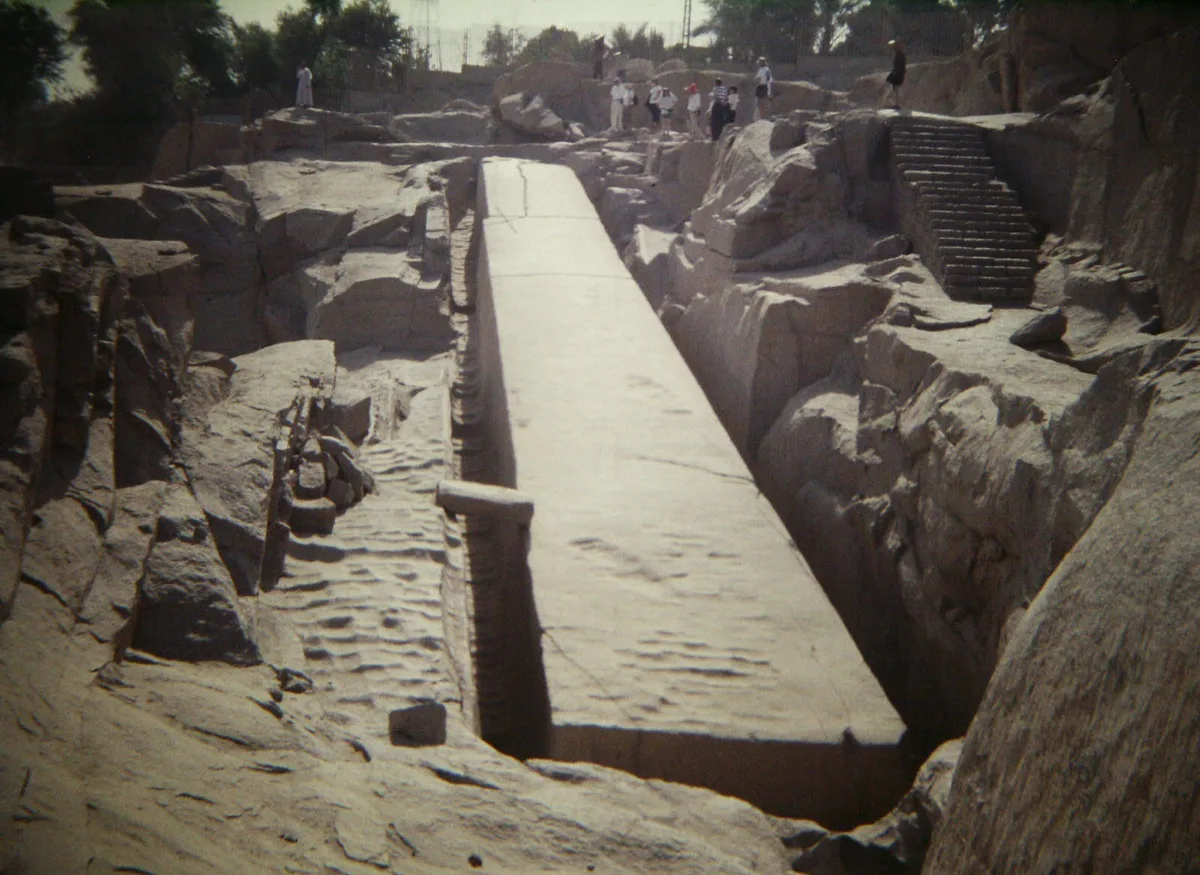
A monument still lying in the ground
The obelisk never left its quarry. It lies on its side in the pink-grey Aswan granite. Three faces have been cut free and the fourth is still part of the bedrock, so you are looking at a work site the stonecutters walked away from roughly 3,500 years ago.
Had it been raised, it would have stood about 42 metres tall and weighed something like 1,200 tonnes. That makes it larger than any obelisk the ancient Egyptians ever erected. The work is often linked to the reign of Hatshepsut, whose builders were quarrying here for monuments at Karnak.
Reading the cracks and tool marks
The reason it was abandoned is visible from the walkway. A long fissure runs across the shaft, and once granite cracks like that, a single piece can’t be lifted without breaking. Nobody was going to drag a broken obelisk down to the Nile, so they stopped.
Look closely and the quarry tells you how the work was done:
- Pounding trenches around the shaft, where workers bashed the granite away with balls of harder dolerite rather than cutting it.
- Scooped hollows along the trench walls, each roughly one worker’s reach wide.
- Faint ochre marking lines in places, left by the people laying out the cuts.
- Wedge slots on nearby rock faces. Some are ancient and some came from later quarrying.
Getting to the Northern Quarries
The site is on the southern edge of town, inland from the Corniche. It sits beside the old Fatimid Cemetery, with its domed mud-brick tombs, and isn’t far from the Nubian Museum. Walking from the riverfront means a long, hot slog uphill through residential streets. Most visitors take a taxi or come with a driver.
Plenty of people fit it into a morning loop with the Aswan High Dam and Philae Temple. Those are the other two stops on nearly every half-day tour from town. If you hire a taxi yourself, settle the fare and the stops before you get in, and agree on how long the driver will wait at each one.

Working the heat and the tour groups
This is a very popular site with very little shade. The quarry is bare granite in a bowl, and it reflects the sun back at you. The site currently opens at 7am, and arriving near then gives you the coolest air and the best odds of reaching the viewing platform before the tour coaches. Those coaches tend to follow the same High Dam and Philae circuit.
The listed closing time right now is 4pm, though hours change with the season. Don’t plan a late-afternoon visit without checking first. In the hottest months, a dawn start isn’t optional. Bring a hat and more water than you think 45 minutes needs.
Ticket office, guards and the bazaar lane
The ticket office is at the entrance, and current prices are posted there and on the official Egyptian antiquities website. Some Egyptian sites now take cards at the window, but not every one does. Carry some Egyptian pounds as a backup, plus small notes for tips.
A few things to expect once you’re inside:
- The route is fixed. Paths and stairs lead you around and above the obelisk. Stay on them, because the trench edges are uneven.
- Site guards may offer to point things out or show you a good photo angle. That usually ends with a request for baksheesh. A small tip is normal if you accept, and a polite “la, shukran” (no, thank you) is fine if you don’t.
- Souvenir stalls line the exit. Vendors can be persistent. Walking on steadily while saying a friendly “shukran” works better than stopping to explain.
Fitting it into an Aswan day
One visit is enough here. Between 30 and 60 minutes covers the walkway, the platform view and the surrounding quarry faces. It works best as the first stop of a morning, because it’s the most exposed site on the usual circuit.
Afterwards, the Nubian Museum is close by and has air conditioning. Its collection explains the region the quarries supplied. Later in the day, a felucca on the Nile or the crossing to Elephantine Island makes a cooler second half once the heat on the granite becomes too much.
Frequently asked questions
How long do I need at the Unfinished Obelisk?
Most visitors spend 30–60 minutes. That covers the walkway around the obelisk, the raised viewing platform and the tool-marked quarry faces nearby.
What time does the Unfinished Obelisk open?
It currently opens at 7am and closes at 4pm. Hours change with the season, so check the official Egyptian antiquities site for this month's times.
How do I get there from central Aswan?
Take a taxi or go with a tour driver. The site is in the Northern Quarries on the southern edge of town, near the Fatimid Cemetery and the Nubian Museum. Agree the fare before you set off.
What can I combine it with?
It's usually paired with the Aswan High Dam and Philae Temple on a half-day loop. The Nubian Museum is also close by and makes a good air-conditioned stop afterwards.
Is there shade at the site?
Hardly any. The quarry is open granite that reflects the heat, so go early in the day and bring a hat and plenty of water.
Plan your trip to Aswan
Egypt eSIM & staying connected →
Some links above are affiliate links — if you book through them, Wander Atlas earns a small commission at no extra cost to you. It's how we keep every guide free.