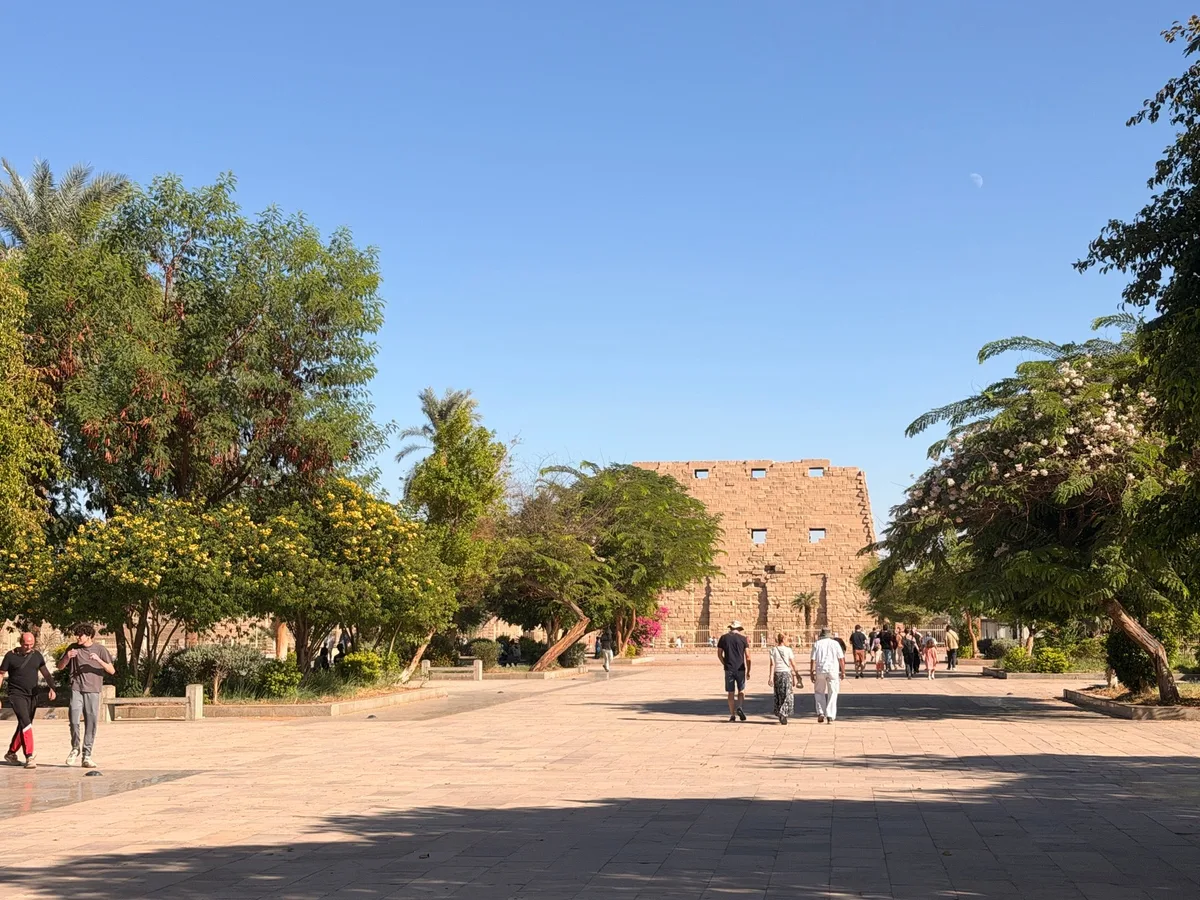
Through the avenue of rams
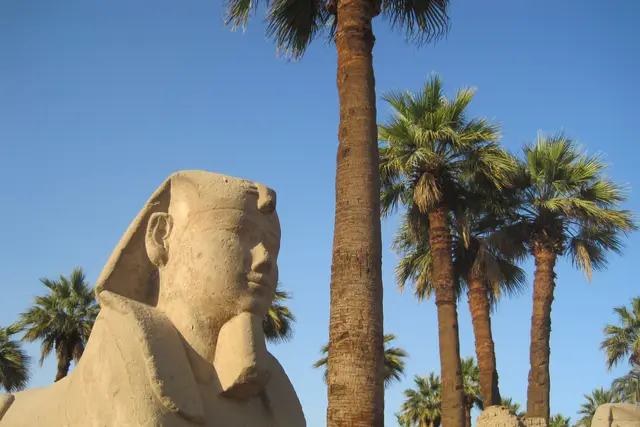
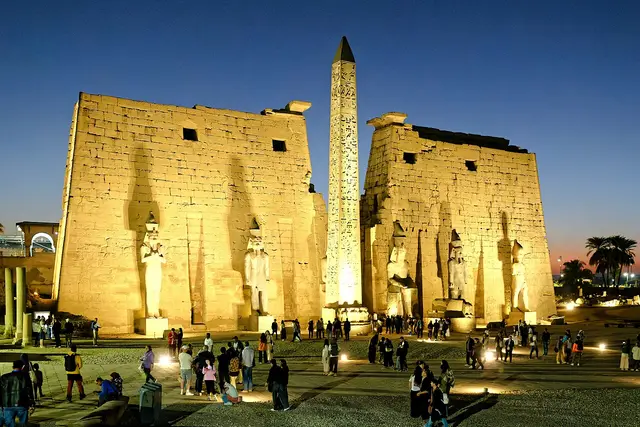
The approach is the first part of the visit. You walk up from the ticket area toward the First Pylon, a sandstone gateway so wide it looks more like a cliff than a wall. Ram-headed sphinxes line both sides of the path. Each one holds a small figure of a pharaoh between its front paws.
This is the Precinct of Amun-Ra, the largest of Karnak’s three walled precincts. Pharaohs kept adding to it for roughly two thousand years. That explains the layout: a long chain of gateways, courts and halls, each built by a different king trying to outdo the last.
Look at the inner face of the First Pylon. The gateway was never finished, and remains of the mud-brick building ramps still lean against it.
Inside the forest of 134 columns
The Great Hypostyle Hall is why most people come. It holds 134 sandstone columns in 16 rows. The central twelve rise about 21 metres and are topped with open papyrus capitals. Seti I and Ramesses II covered nearly every surface with carving, and the reliefs on the outer walls show their military campaigns.
The columns stand close together, so you never see the whole hall at once. You move between the shafts, and the sky shows only in strips above you. On some capitals and lintels the original paint survives in blues and ochres. Tilt your head back to find it.
Light comes in at a steep angle through the stone window grilles near the top of the hall. That gives the place a different look at each hour. Early morning is when the shadows between the rows are longest.
Hatshepsut’s obelisk, the lake and the scarab
Past the hall, the complex opens out. Hatshepsut’s red granite obelisk is the tallest ancient obelisk still standing in Egypt, at almost 30 metres. Its fallen twin lies in pieces nearby, so you can see the carving up close at eye level.
Further on, Thutmose III’s Festival Hall has the “botanical garden” room. Its walls show plants and animals he is said to have brought back from campaigns in Syria.
To the south is the rectangular Sacred Lake, where priests purified themselves. Beside it sits a large granite scarab on a pedestal, dedicated by Amenhotep III. You will see visitors walking circles around it. Local tradition says seven laps bring luck, and some say the luck is in love.

Beating the 9am coaches
Timing matters more here than at almost any other site in Luxor. It’s calmest from 7am to 8am on weekdays and weekends alike. At the moment the gates open at 6am, so arriving at opening gives you a quiet first hour in the Hypostyle Hall.
Try not to arrive between 9am and 1pm on weekends. That’s when the tour groups fill the main axis. A second peak usually comes between 3pm and 4pm. Opening hours shift through the year, so check the official Egyptian antiquities website for this month’s times before you go.
Some habits worth knowing:
- Guardians. Uniformed site guardians may wave you toward a carving or a closed-off corner. They expect a small tip for it. Decline politely and keep walking if you’d rather not.
- Guides. Licensed Egyptologist guides carry official ID. Hire one through your hotel or a reputable agency, not someone who walks up to you outside the gate.
- Tickets. Buy at the official ticket office. Check the official site for current payment methods. The Open Air Museum inside the complex has its own separate ticket.
- Dress. No dress code is enforced. Covered shoulders and knees are still respectful, and they protect you from the sun.
Getting up the Corniche
Karnak is on the east bank, roughly 3 km north of Luxor Temple along the Nile Corniche. Taxis and horse-drawn carriages (calèches) work the whole stretch. Agree the fare and whether the driver will wait before you get in. Haggling is normal.
The sphinx-lined processional avenue between Luxor Temple and Karnak has been excavated along its length. Some visitors walk it in the cooler early hours. If you stay on the west bank, the public ferry and private motorboats cross to the east bank. From there it’s a short ride north.
Pacing a site this size
Karnak covers a huge area, and very little of it is in shade. Three to four hours lets you see the Amun precinct properly without rushing. Shade is mostly limited to the Hypostyle Hall and the gateways. Summer days in Luxor regularly pass 40°C, so morning is the time to visit for comfort as well as crowds.
What to bring:
- More water than you think you’ll need
- A hat and sunscreen
- Shoes that grip on uneven stone and sand
- A charged phone (the reliefs need close-up photos)
- A torch, for reading carvings in darker sanctuaries
Some people like to start at the visitor centre near the entrance. Its model of the complex makes the jumble of courts much easier to follow once you’re inside.
Beyond the Amun precinct
Most visitors stay on the main east–west axis, and the outer parts of the site are much quieter. These are worth adding if you have energy left:
- Temple of Khonsu. A smaller, complete temple in the southwest corner. It’s easier to read than the main complex.
- Open Air Museum. Holds the reassembled White Chapel of Senusret I and the Red Chapel of Hatshepsut. Separate ticket.
- Precinct of Mut. South of the main temple, with statues of the lion-headed goddess Sekhmet.
Luxor Temple pairs naturally with Karnak. Many visitors go there later in the day, when its lighting makes it a good evening stop. Karnak also has an evening sound and light show with its own tickets and schedule, so check current show times locally.
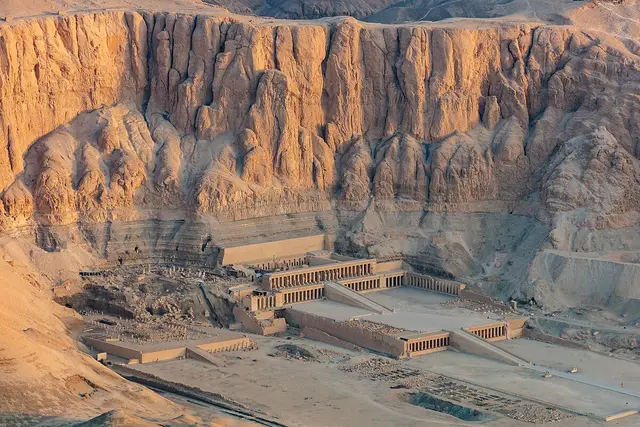
Across the river on the West Bank are the Valley of the Kings and the Temple of Hatshepsut at Deir el-Bahari. Most itineraries give them a separate early morning.
Frequently asked questions
When is the quietest time to visit Karnak?
It's usually calmest between 7am and 8am, on weekdays and weekends alike. Try not to arrive between 9am and 1pm or 3pm and 4pm on weekends, which are the busiest windows.
What are Karnak's opening hours?
At the moment it opens 6am–5pm. Hours change through the year and on some holidays, so check the official Egyptian antiquities website for this month's times.
How long do I need at Karnak?
Allow 3–4 hours for the Precinct of Amun-Ra, including the Great Hypostyle Hall, Hatshepsut's obelisk and the Sacred Lake. Add more time for the Open Air Museum or the Temple of Khonsu.
How do I get to Karnak from Luxor Temple?
It's about 3 km north along the Nile Corniche on the east bank. Take a taxi or calèche and agree the fare first, or walk part of the sphinx-lined avenue between the two temples early in the day.
Is there shade at Karnak?
Not much. The Hypostyle Hall and the gateways give some cover, but most of the site is open stone. Bring plenty of water and a hat, and visit in the morning.
Plan your trip to Luxor
Egypt eSIM & staying connected →
Some links above are affiliate links — if you book through them, Wander Atlas earns a small commission at no extra cost to you. It's how we keep every guide free.