Between a Pharaoh’s Knees
Luxor Temple doesn’t hide behind walls or a long approach road. It sits right on the Corniche, a few metres below today’s street level, so you look down into it from the pavement before you buy a ticket. Traffic, horse carriages and felucca touts work the riverfront on one side. On the other, sandstone columns rise out of a sunken precinct.
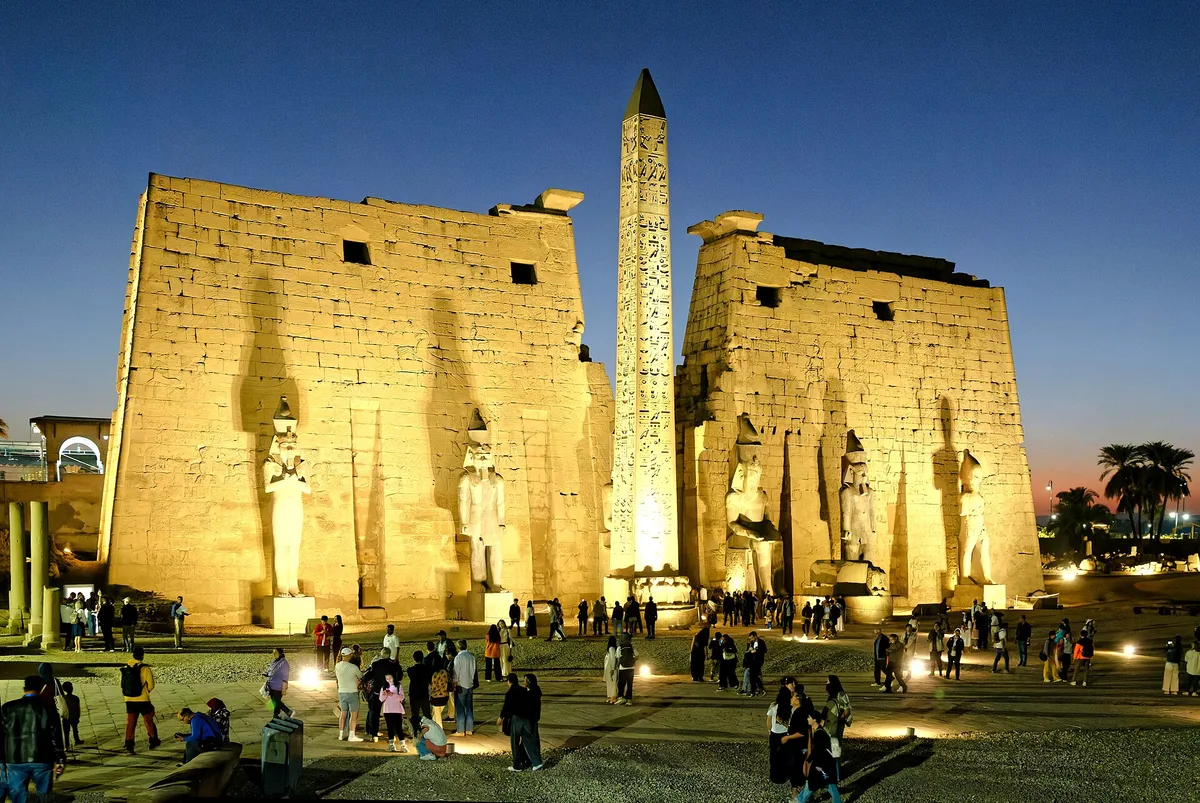
The front is the pylon of Ramesses II, a gateway wall carved with his battle scenes. Seated colossi of the king guard it. A single pink granite obelisk stands to the left. Its twin has stood in the Place de la Concorde in Paris since the 1830s, and the empty plinth beside the survivor shows where it used to be.
Pylon to Sanctuary, Court by Court
The temple was built mainly under Amenhotep III and Ramesses II. Tutankhamun and later rulers added to it. It reads as one long axis, so you walk in a straight line and roughly 1,400 years of building pile up around you.
Look for these, in the order you reach them:
- The Court of Ramesses II, ringed with papyrus columns and standing statues of the king between them.
- The Colonnade of Amenhotep III, two rows of towering open-papyrus columns. The walls carry reliefs of the Opet Festival, finished in Tutankhamun’s reign.
- The Sun Court of Amenhotep III, a wide double-colonnaded court that catches light from early morning.
- The Roman chamber, where an older hall was plastered over and painted with figures of Roman officials. It’s one of the few places in Egypt where Roman wall painting survives inside a pharaonic temple.
- The barque shrine of Alexander the Great, near the back, showing the Macedonian conqueror in full pharaonic dress offering to Amun.
The Opet reliefs explain why the temple exists at all. Once a year, the god Amun’s sacred boat was carried here from Karnak during the flood season. The colonnade walls show that procession: priests, musicians, acrobats and the boats on the river.
The Mosque Hanging Above the Columns
Look up from the Court of Ramesses II and you’ll see a door set high in an ancient wall, opening onto nothing. That’s the Mosque of Abu al-Haggag. It was built on top of the temple centuries ago, when sand and later houses had buried the courts to that height.
Excavators cleared the temple floor below it but left the mosque in place, and it is still in use. The stranded doorway shows you how deep the ground once was. Honouring Abu al-Haggag, Luxor’s patron saint, is a living tradition: his mawlid, a festival with processions through the streets, falls in the month before Ramadan.
If you want to visit the mosque itself, enter from the street side, not from inside the temple. Dress modestly and avoid prayer times.

Morning Stone or Evening Floodlights
At the moment the temple opens 6:00am–8:00pm, but Egyptian sites adjust their hours through the year. Check the current times on the official antiquities ticketing site before you set off.
Expect two very different visits. The quietest window is 7am–11am, on weekdays and weekends alike. The low sun puts the reliefs in sharp relief and the paving is still cool. From May to September that early start matters, because Luxor afternoons get properly hot.
At dusk the floodlights come on and the columns glow gold against a dark sky. That’s the temple most people picture. Be aware that weekends from 4pm to 8pm are the busiest period, with tour groups filling the colonnade just as the light turns. If you’re set on the night view, a weekday evening is the better bet.
You’ll want about 1.5 to 2 hours to walk the whole axis without hurrying.
Reaching the Corniche Gate
The temple is in the middle of Luxor City on the east bank, and the ticket office and entrance face the Corniche el-Nil. Many hotels along the river are close enough to walk.
From Luxor railway station, it’s a short walk west towards the Nile. Taxis and ride-hailing apps will drop you at the Corniche entrance. Horse-drawn carriages (calèches) work the same stretch; agree the fare and route before you climb in. Coming from the west bank, the public ferry lands near the temple.
Guards, Guides and the Folded Banknote
The ticket price is posted at the office by the entrance and on the official ticketing site. Card payment is increasingly common at Egyptian sites, but check before you rely on it. Keep small notes for tips anyway.
A few habits make the visit smoother:
- Uniformed guards may wave you towards a roped-off corner or offer to take “the special photo”. This is a request for baksheesh, not part of your ticket. A polite “la, shukran” (no, thank you) is enough if you’re not interested.
- Licensed guides can be booked through your hotel or a tour operator. Unofficial guides at the gate are less dependable.
- Phone photography is generally fine throughout. Tripods and professional kit may need separate permission.
- Stay off the statues and column bases, however tempting the pose. Guards do step in.
In the busy evening slot, walk straight to the far end of the axis first. Then come back towards the pylon as the groups move deeper in.
Following the Sphinxes North
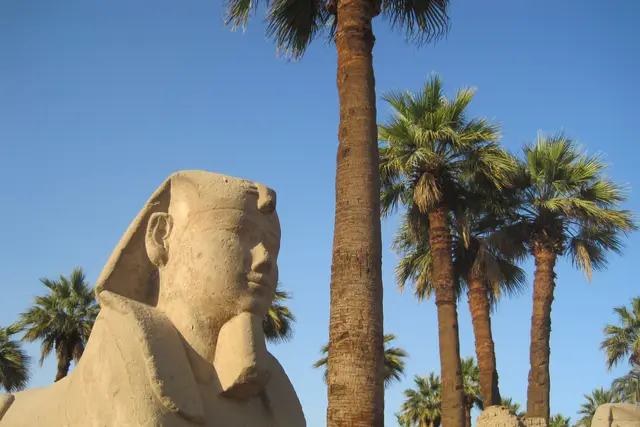
Luxor Temple was never meant to stand alone. From the forecourt, the excavated Avenue of Sphinxes runs north towards Karnak Temple, about 3km away. This is the processional route the Opet boats once followed.
A practical day pairs the two: Karnak early, during the cool hours, and Luxor Temple late for the lights. The Luxor Museum sits between them on the Corniche, a quieter, air-conditioned stop. It holds statues found in this very temple’s courts.
Frequently asked questions
When is the quietest time to visit Luxor Temple?
Typically 7am–11am, on both weekdays and weekends. Avoid weekends from 4pm to 8pm, which is usually the busiest stretch.
What are Luxor Temple's opening hours?
Currently 6:00am–8:00pm every day of the week. Egyptian sites adjust their hours through the year, so confirm on the official antiquities ticketing site before you go.
How long do I need at Luxor Temple?
Allow about 1.5 to 2 hours to walk from the Ramesses II pylon to the sanctuary at the back. Add more time if you're staying on to see the floodlights come on at dusk.
Is it better to visit Luxor Temple in the day or at night?
Mornings are cooler, quieter and best for reading the reliefs. Evenings bring the floodlit columns, but also the biggest crowds, especially on weekends. A weekday evening is the best compromise.
How do I get from Luxor Temple to Karnak?
Karnak is about 3km north. You can follow the Avenue of Sphinxes on foot, or take a taxi or calèche along the Corniche. The Luxor Museum is on the way.
Plan your trip to Luxor
Egypt eSIM & staying connected →
Some links above are affiliate links — if you book through them, Wander Atlas earns a small commission at no extra cost to you. It's how we keep every guide free.