A King Lying on His Face
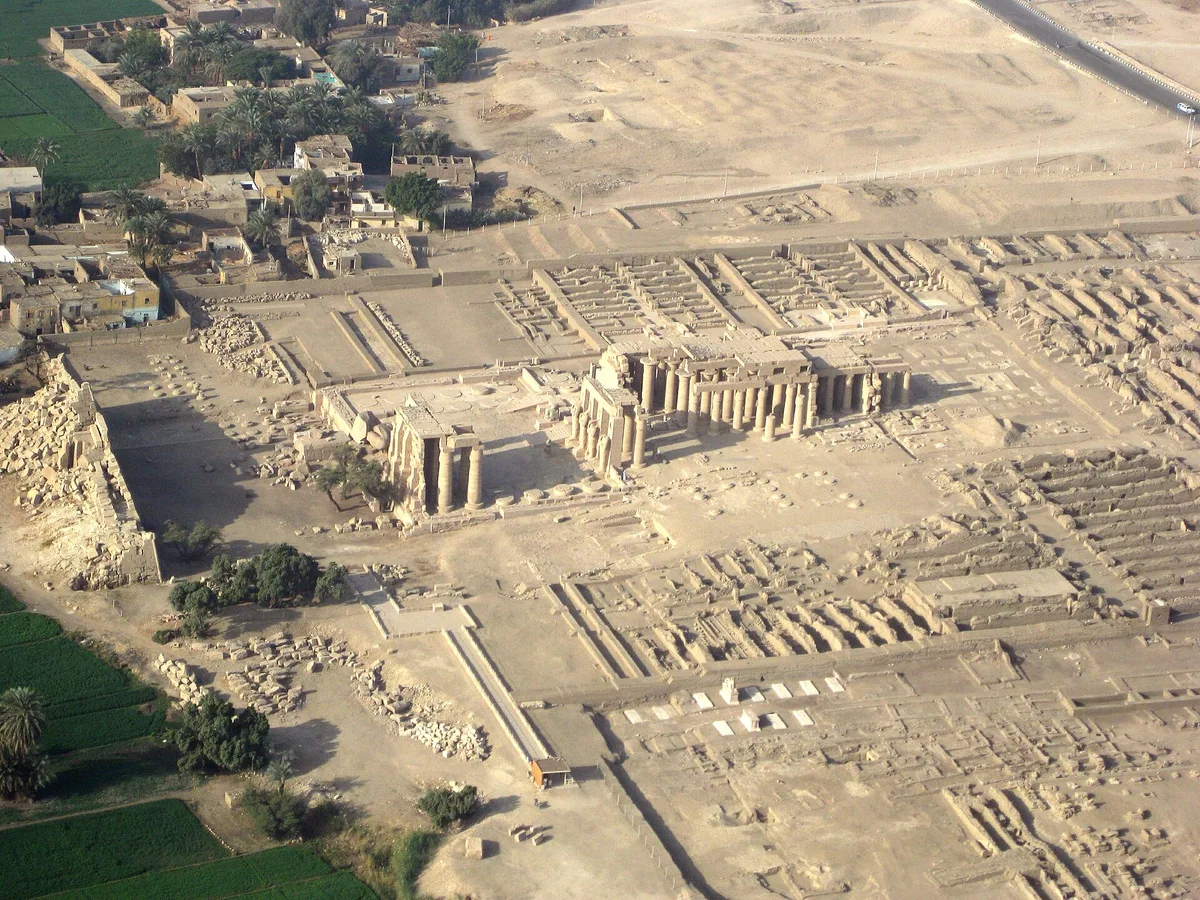
The statue is the place to start. In the second court of the Ramesseum, the shattered granite torso of Ramesses II lies across the ground in pieces. Sculptors once polished it smooth, and you can still read the cartouche cut into its upper arm. Standing, the figure would have been one of the largest freestanding statues Egypt ever produced.
Everything here is on that scale and in that condition. The pylons are cracked and slumped and the columns stand in broken rows. The mud-brick walls around the edge have worn down into soft brown ridges. The temple sits at the desert edge of Al Qarna, below the Theban hills, with green fields on one side and bare limestone on the other.
Ozymandias in the Second Court
Two English poems came out of this broken stone. In the first century BC the Greek historian Diodorus Siculus described a “Tomb of Ozymandias”, taking the name from a Greek rendering of Ramesses’ throne name, User-maat-re. Percy Bysshe Shelley read that account and wrote his sonnet in 1817. Its “vast and trunkless legs of stone” have been tied to this site ever since.
The poem’s timing matters. Around the same time, a huge carved bust from the Ramesseum was being shipped to London. It is known as the Younger Memnon and it is now in the British Museum. So the colossus you see on the ground is only part of what left this temple. Reading the sonnet before you go is worth the two minutes; reading it again beside the torso hits harder.
Look for these in the second court:
- The fallen granite colossus, with its huge carved fingers and feet scattered nearby
- Osiride pillars, standing figures of the king wrapped like Osiris with arms crossed
- A surviving granite head of a second statue, smaller and close to the steps
Reading the Battle of Qadesh off the Pylon
The walls are war reporting. Ramesses II fought the Hittites at Qadesh, in what is now Syria, around 1274 BC. He then covered his temples with his version of events, and the Ramesseum has some of the best-known copies. Look on the inner faces of the pylons for chariots in rows, a fortified city surrounded by a river, and the king firing arrows from his chariot, drawn far larger than anyone else.
The battle ended roughly even, and the Hittites later signed a peace treaty with Egypt. The reliefs show none of that. They show Ramesses alone saving the day. Low sun brings out the cut lines best, so the early morning light is the most useful flashlight you have.
Inside the hypostyle hall, the carvings shift to his campaign against Dapur, a Syrian town. You’ll see scaling ladders against the walls and soldiers climbing them. Those are the scenes the temple’s own summary singles out, and they sit at eye level rather than up on a pylon.

Halls, Ceilings and the Mud-Brick Ring
Past the courts, the temple becomes a forest of columns. The great hypostyle hall keeps many of its papyrus-bundle columns, some still roofed, so you walk from glare into a band of shade. Beyond it, a smaller hall has an astronomical ceiling with star and calendar figures, one of the earliest of its kind in Egypt.
Then walk out to the back. Long rows of vaulted mud-brick storerooms surround the stone core on three sides. Many of the barrel vaults are still standing, so you can see how the arches were built. These were the temple’s granaries and workshops, and most people leave without seeing them.
Crossing to Al Qarna
The Ramesseum is on the West Bank, across the Nile from Luxor city, Karnak and Luxor Temple. You have three easy ways over:
- The public ferry from the East Bank corniche, then a taxi on the far side
- A taxi or hired car over the Luxor Bridge, south of town
- A private motorboat across the river, which drivers on the West Bank will meet
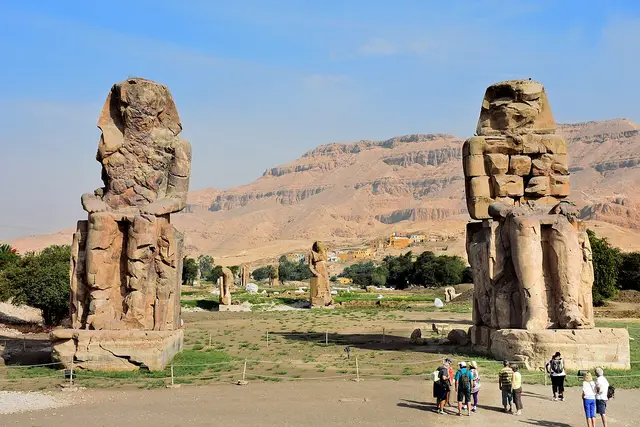
The temple is a short drive from the Colossi of Memnon, along the road that runs below the hills. Ticket arrangements on the West Bank have changed over the years, so before you cross, ask your hotel or driver where Ramesseum tickets are sold right now. The current price is posted at the ticket window.
Guardians, Tips and an Early Start
The guardians decide how much you see. Uniformed guards, called ghaffirs, watch the site, and some will offer to point out a carving or walk you to a corner that is normally out of bounds. That help comes with an expectation of baksheesh, a small cash tip. Carry low-value Egyptian pound notes in a separate pocket so you never have to show a full wallet.
A polite “la, shukran” (no, thank you) works if you’d rather wander alone. Say it once, smile, and keep walking. Don’t climb on the fallen statue or the pillars, however tempting the photo.
Timing is the other half. The site currently opens at 6am and closes at 5pm. Hours across Luxor’s temples move with the season, so check the official Egyptian antiquities site for this month’s times. Try not to arrive on a weekend between 10am and 3pm, which is when it usually gets busiest. On top of that, the midday sun on open stone is punishing.
The easy win is to go early, before 10am, when the low light shows up the reliefs. There’s very little shade outside the hypostyle hall, so bring water and a hat. Allow 60–90 minutes, longer if you want to read the Qadesh walls properly.
Building a West Bank Day Around It
Most visitors rush past this temple, and that is your advantage. A good loop starts at the Valley of the Kings at opening and moves on to Hatshepsut’s temple at Deir el-Bahari. The Ramesseum then fits in as the quiet middle stop.
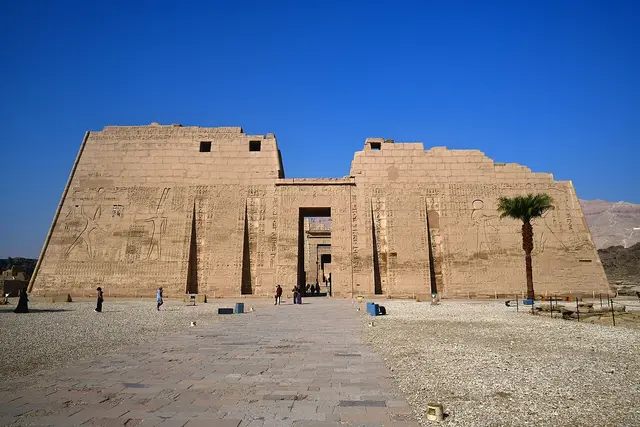
Medinet Habu, the mortuary temple of Ramesses III, is a short drive south. It copies the Ramesseum’s layout and its colour is far better preserved. Seeing both in one day shows you what the Ramesseum’s ruined walls once looked like. Deir el-Medina, the workers’ village with painted tombs, is close by too. End at the Colossi of Memnon on the way back to the ferry.
Frequently asked questions
When is the quietest time to visit the Ramesseum?
The crowd forecast doesn't name a quietest window. It does say weekends are usually busiest between 10am and 3pm, so avoid those hours. An early arrival soon after the current 6am opening gives you cooler air and better light on the reliefs.
How do I get to the Ramesseum from Luxor city?
Cross to the West Bank by public ferry, motorboat, or taxi over the Luxor Bridge. The temple is at Al Qarna, a short drive from the Colossi of Memnon. Ask your hotel or driver where Ramesseum tickets are currently sold before you cross.
How long should I spend at the Ramesseum?
Plan 60–90 minutes. That covers the fallen colossus, the Qadesh and Dapur reliefs, the hypostyle hall and the mud-brick storerooms at the back.
Is the Ramesseum the statue from Shelley's 'Ozymandias'?
Yes, it's the site linked to the poem. Shelley drew on Diodorus Siculus's description of the 'Tomb of Ozymandias'. The fallen granite colossus of Ramesses II still lies in the second court.
What else is nearby on the West Bank?
Medinet Habu, Deir el-Medina, the Colossi of Memnon, Deir el-Bahari and the Valley of the Kings are all a short drive away. That makes it easy to fit the Ramesseum into a full West Bank day.
Plan your trip to Luxor
Egypt eSIM & staying connected →
Some links above are affiliate links — if you book through them, Wander Atlas earns a small commission at no extra cost to you. It's how we keep every guide free.