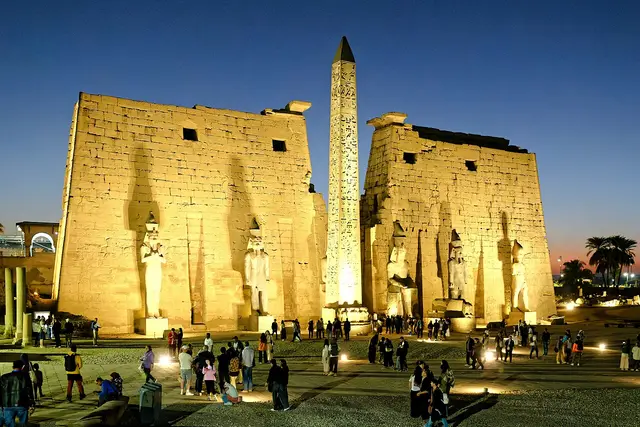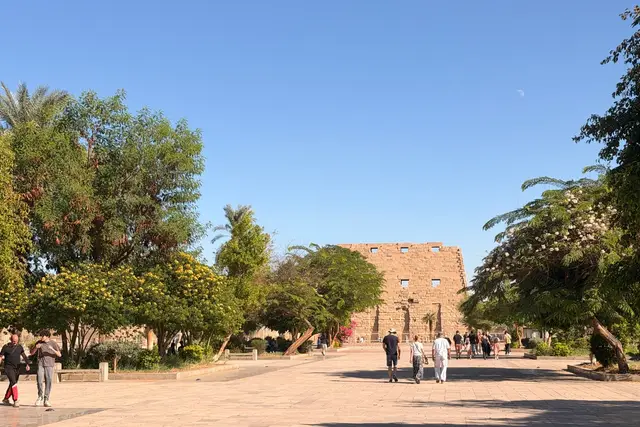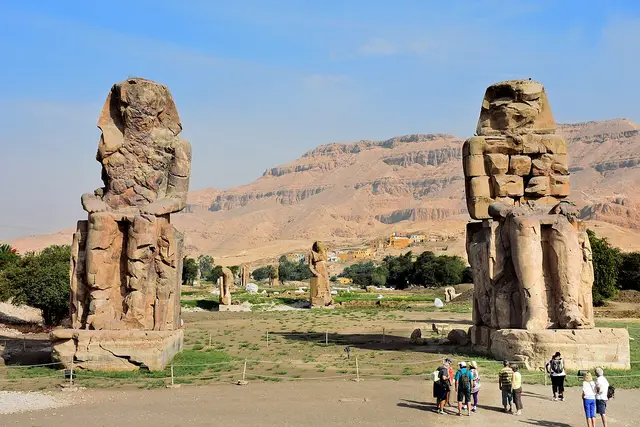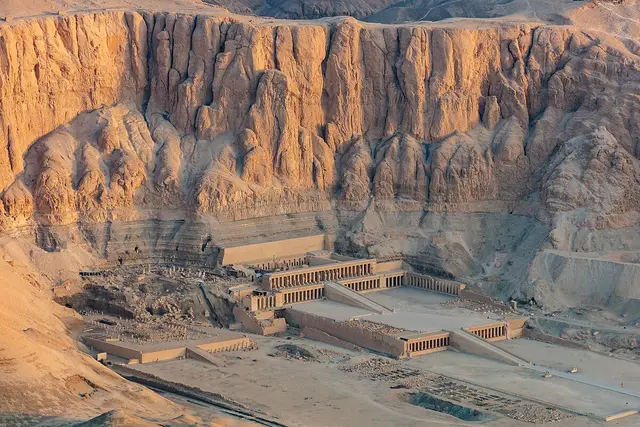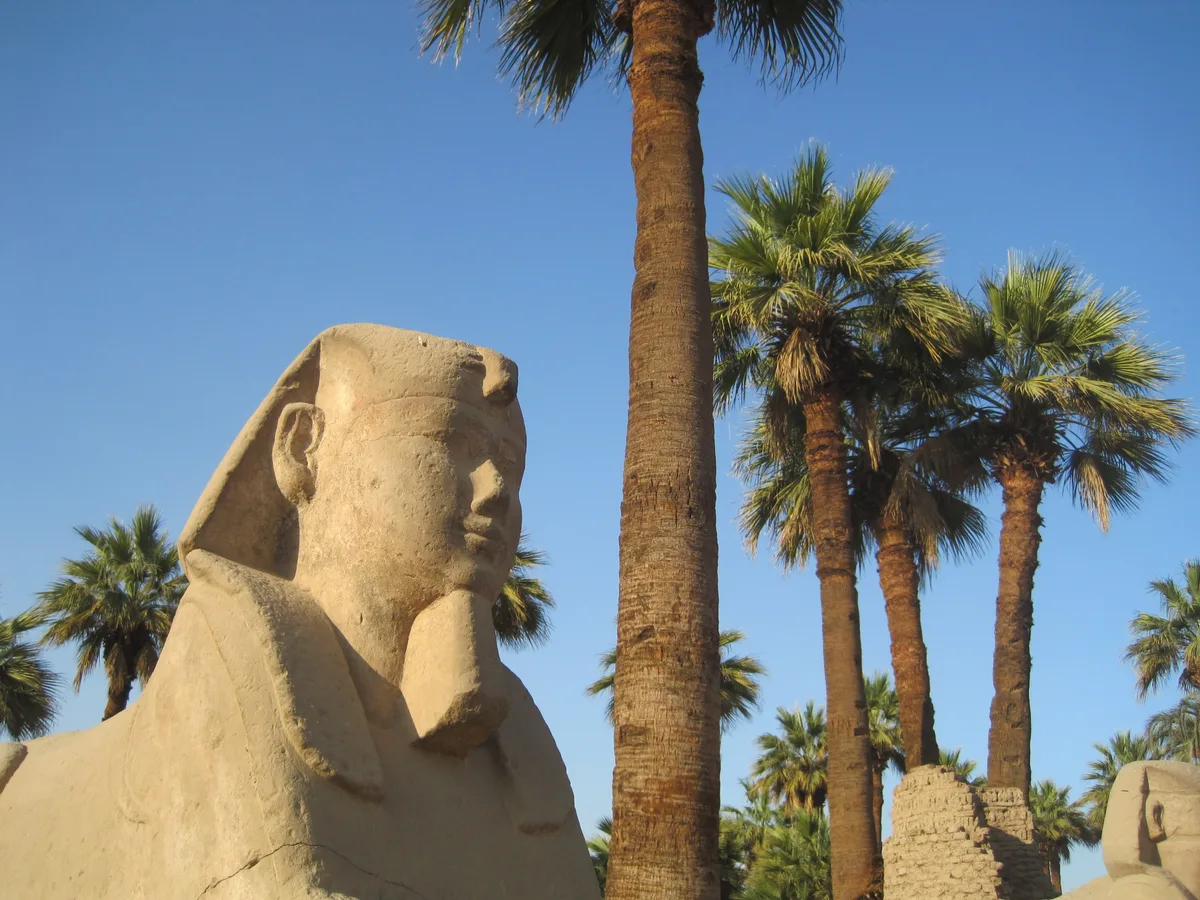
A processional road between two temples
Its first job was ceremonial. This stone-paved road was laid out so the god Amun’s statue could be carried from Karnak to Luxor Temple during the annual Opet Festival. Most of what survives dates to Nectanebo I of the 30th Dynasty, although parts go back to New Kingdom builders.
Sandstone sphinxes on low plinths line both sides. Near Luxor Temple they have human heads. At the Karnak end they become criosphinxes, with ram heads for Amun. Many are weathered down to their bases, and between the stumps you can see where whole rows once stood.
The modern town has been cut back on either side, so the avenue now sits below street level in a long sunken corridor. Once you are inside it, the traffic noise drops away.
Reaching each end
Both ends are on the East Bank and easy to find:
- Luxor Temple end: on the Corniche el-Nil in central Luxor, a short walk from most east-bank hotels and the ferry landing for the West Bank.
- Karnak end: about 3 km north, by the first pylon of Karnak Temple.
- In between: the route runs parallel to the Corniche, so a taxi or horse-drawn hantour can take you to either end in a few minutes.
To walk the whole length at a steady pace, allow 40–60 minutes. With stops for photos, plan on more.

Timing the walk
The shade runs out quickly. There are very few trees along the avenue, and Luxor heat is severe from late spring through early autumn. Google currently lists it as open 6:00 AM to 5:00 PM every day this week. Heritage sites in Egypt change their hours with the season, so confirm at the gate or on the official Egyptian antiquities channels.
An early start pays off twice: cooler air and low, raking light across the sphinx faces. Many visitors only see the avenue from inside Luxor Temple’s forecourt. That leaves the middle stretch comparatively quiet, which makes it a good place to slow down between the two big temple complexes.
Pair it in one of these ways:
- Morning: walk the avenue, then spend the rest of the morning in Karnak.
- Late afternoon: finish at Luxor Temple, which is often lit after dark.
Walking it without the hassle
Here are some practical habits for the avenue itself:
- Tickets: ticketing has changed in recent years, so ask at the Luxor Temple or Karnak ticket office how avenue access currently works. Check the posted price there rather than relying on old figures.
- Hantour drivers: they wait near both ends. Agree the full fare and the route before you climb in, and settle it in Egyptian pounds.
- Baksheesh: a small tip is customary for anyone who points out a carving or takes your photo. Carry small notes, because change is often hard to find.
- Don’t touch: stay on the paved path and don’t sit on or lean against the sphinxes. Guards will tell you off, and the sandstone is fragile.
- Water and cover: bring more water than you think you’ll need, plus a hat. You won’t find shade or kiosks inside the sunken stretches.
If you only have time for one end, start at Luxor Temple. That is where the human-headed sphinxes stand in their most complete rows.
Frequently asked questions
How long is the Avenue of Sphinxes and how long does it take to walk?
It runs about 2.7 km between Karnak Temple and Luxor Temple. Walking the full length takes roughly 40–60 minutes, longer with photo stops.
What are the opening hours?
Google currently lists 6:00 AM to 5:00 PM every day. Egyptian heritage sites adjust their hours by season, so check at the ticket office before you go.
Which end should I start from?
Start at Luxor Temple on the Corniche for the best-preserved human-headed sphinxes. Walk north to finish at the ram-headed sphinxes outside Karnak, then go into Karnak itself.
When is the best time of day to walk it?
Go right after the 6:00 AM opening. There is almost no shade along the route, and by midday the heat makes the walk hard going for much of the year.
What else is nearby?
Karnak Temple sits at the northern end and Luxor Temple at the southern end. The ferry landing for the West Bank, where you'll find the Valley of the Kings, is a short walk from Luxor Temple.
Plan your trip to Luxor
Egypt eSIM & staying connected →
Some links above are affiliate links — if you book through them, Wander Atlas earns a small commission at no extra cost to you. It's how we keep every guide free.